
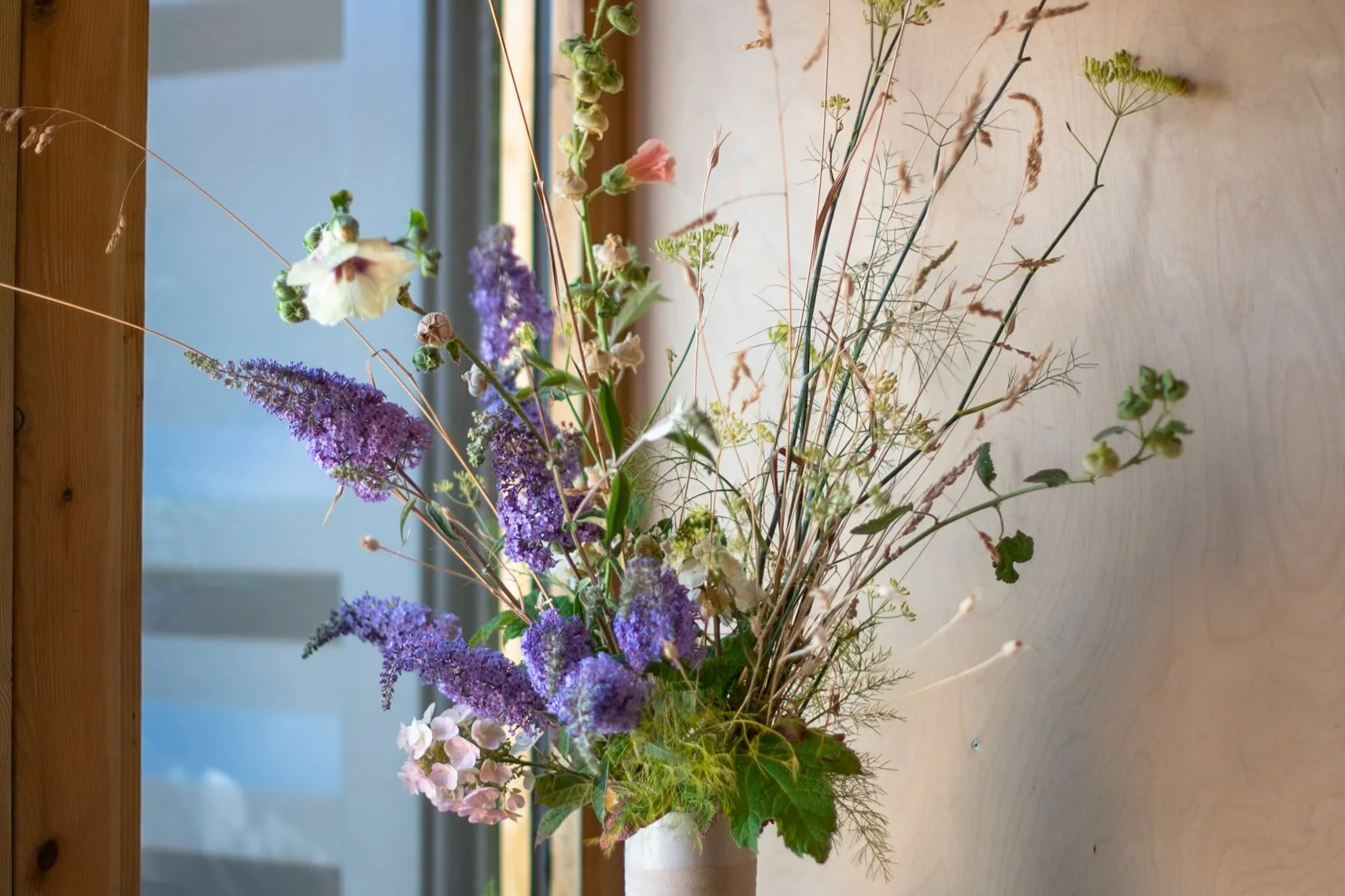
BUTTERFLY BUSH, ORCHARD GRASS
Sometimes I’m recipe-testing or flexing, or making something at home, and I want an arrangement to be a quick 5 minute affair as was this case with this hastily thrown-together jar.
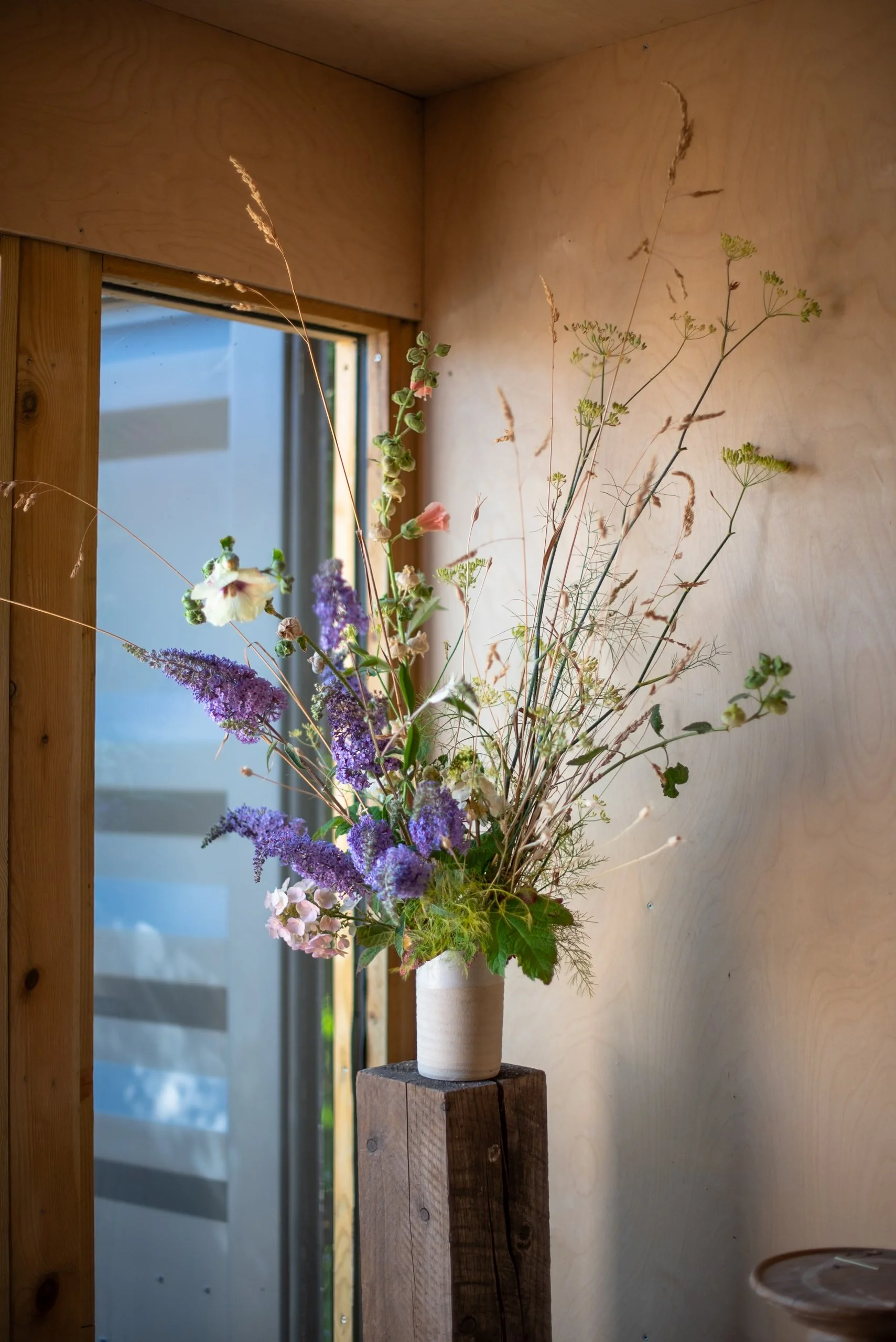
Butterfly bush (Buddleja)
Corncockle (Agrostemma githago)
Fennel (Foeniculum vulgare)
Hollyhock (Alcea rosea)
Oakleaf hydrangea (Hydrangea quercifolia)
Orchard grass (Dactylis glomerata)
Antique stoneware jar
AUGUST
Coming up to two months of drought and the garden is looking crispy with a capital C. There is not a lot we can do but water as responsibly and sparingly as possible, pray for rain and hope for the best. And we can also celebrate those tough cookies that are putting on a beautiful show despite the scorching heat and dust-dry soil.
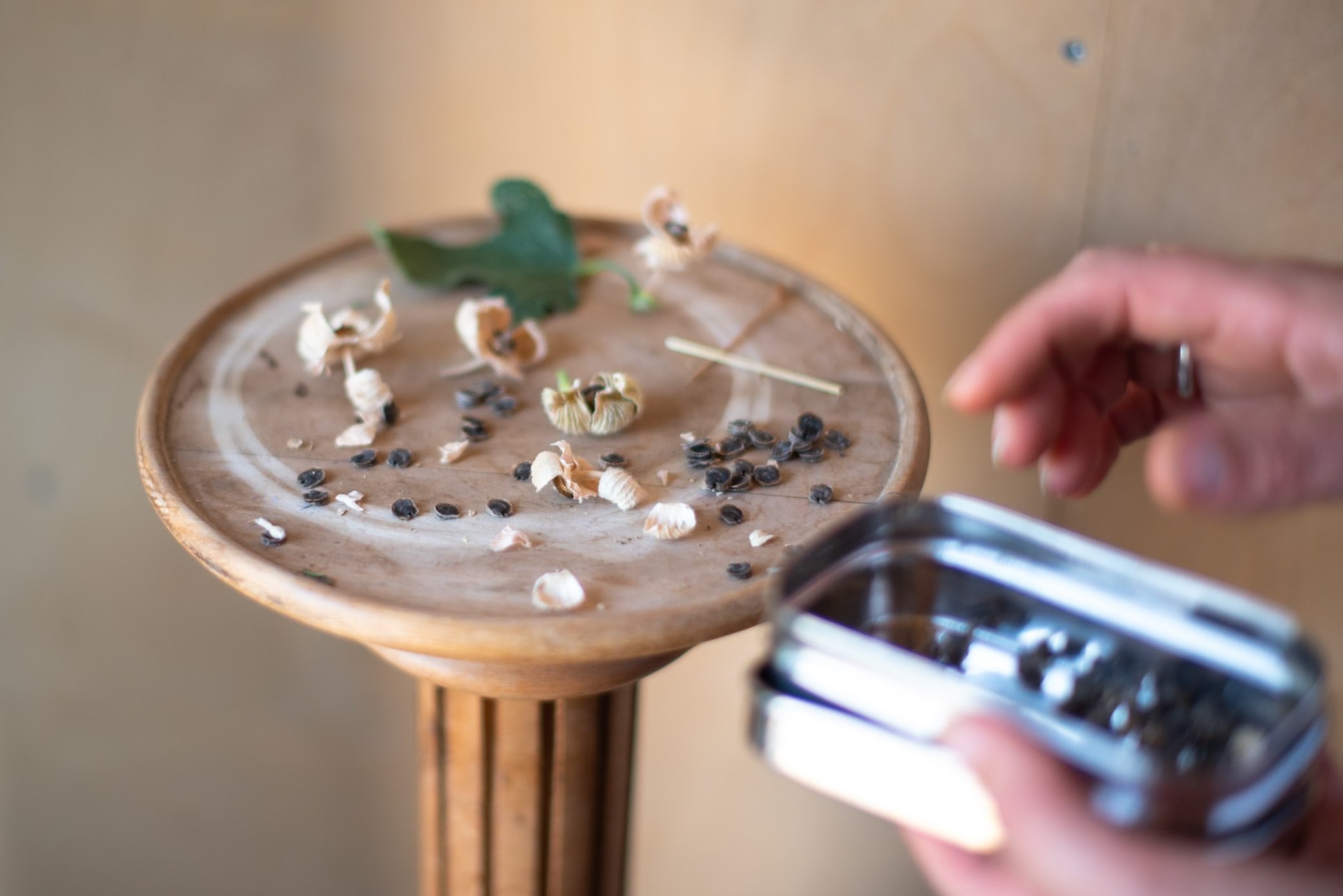
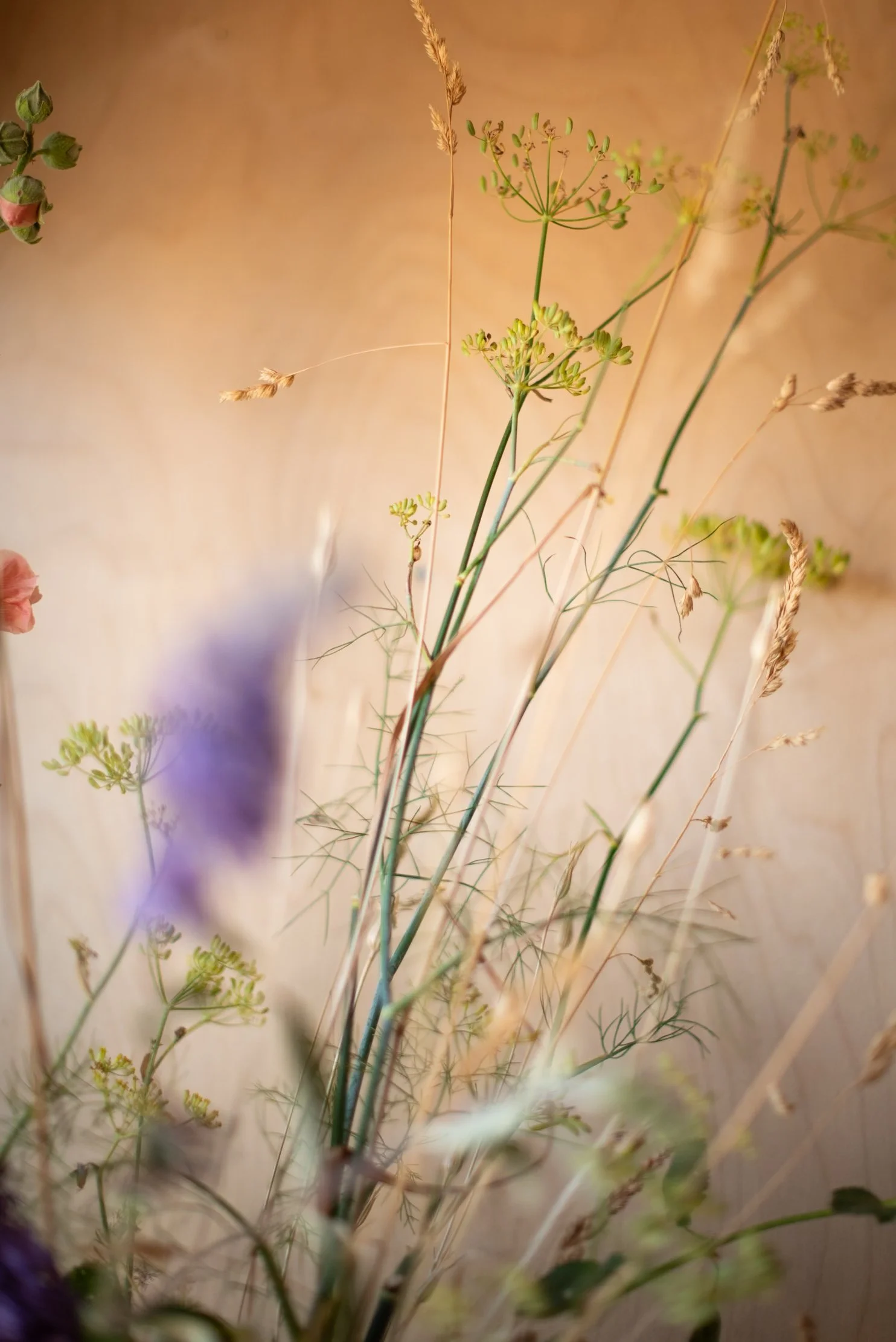
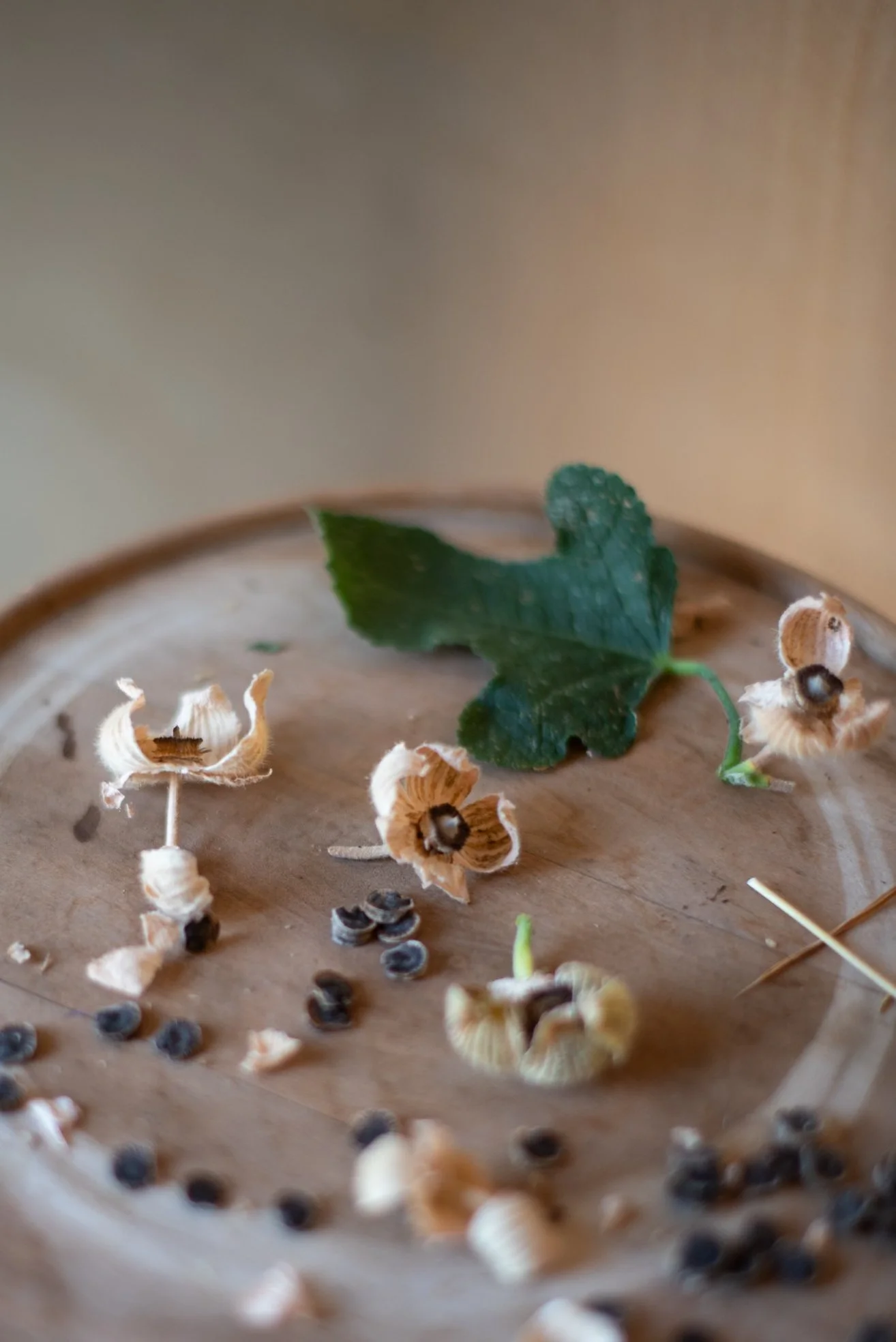
Sometimes I want to spend an hour on an arrangement, working through each stage in a mindful, thoughtful way and luxuriating in every step of the process, drawing it out, really making the most of that sacred time with the flowers. Sometimes I’m recipe-testing or flexing, or making something at home, and I want it to be a quick 5 minute affair as was this case with this hastily thrown-together jar. Massed buddleja (seared in boiling water to give them a boost as prone to wilting), waning hollyhocks scaled by crisp pods bursting with fossil-shaped seeds, the most gorgeous icecream scoops of hydrangea in a milky white rippled with rose-pink, aniseed-scented fennel stalks, the bleached husks of cornockle leftover from the spring and a sprinkling of orchard grass. Not perfect, a bit of a hot mess, but a good quick-release between emails.
GIANT HERB ROBERT, CUP & SAUCER VINE
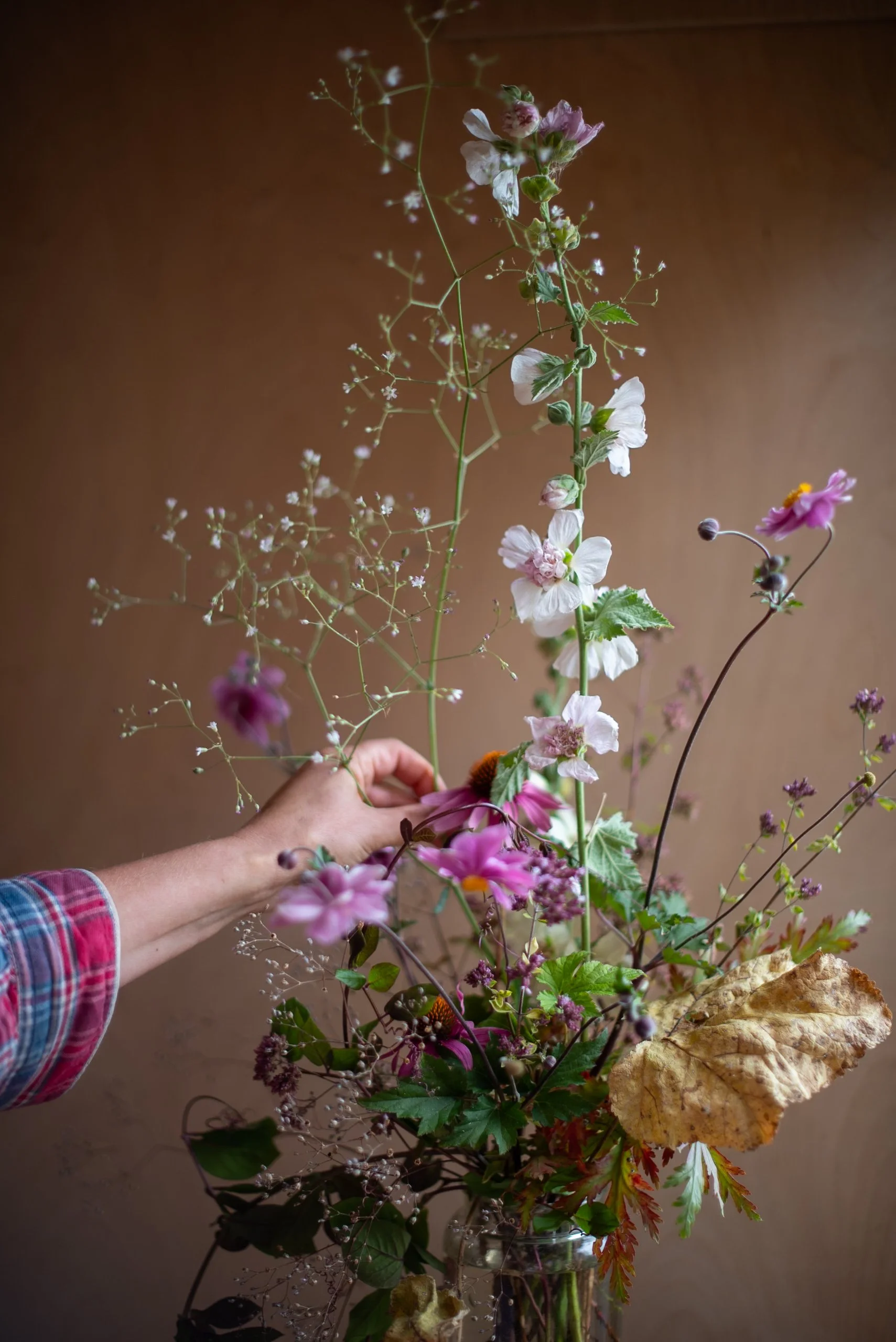
Sometimes you start with a leaf. I’ve generally been using a lot of geranium foliage this year, of different varieties, because they turn great colours when they are stressed. Harsh but true!
Babies breath (Gypsophila pacifica)
Cup & saucer vine (Cobea scandens)
Giant herb Robert (Geranium maderense)
Hollyhock - dried leaf (Alcea rosea)
Purple coneflower (Echinacea purpurea)
Shrubby hollyhock (Alcalthaea suffrutescens ‘Parkallee’)
Wild marjoram (Origanum vulgare)
Antique pickle jar
AUGUST
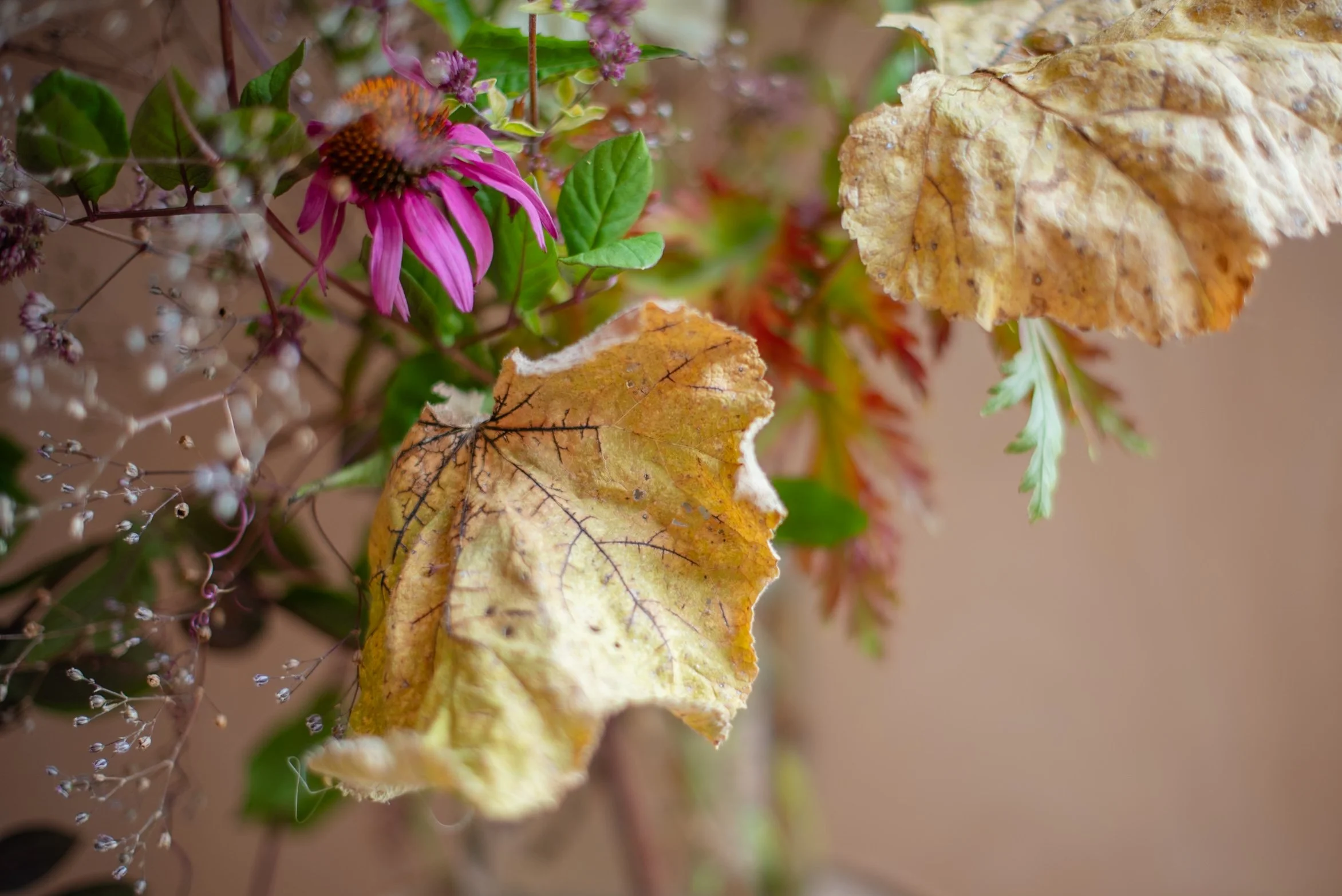
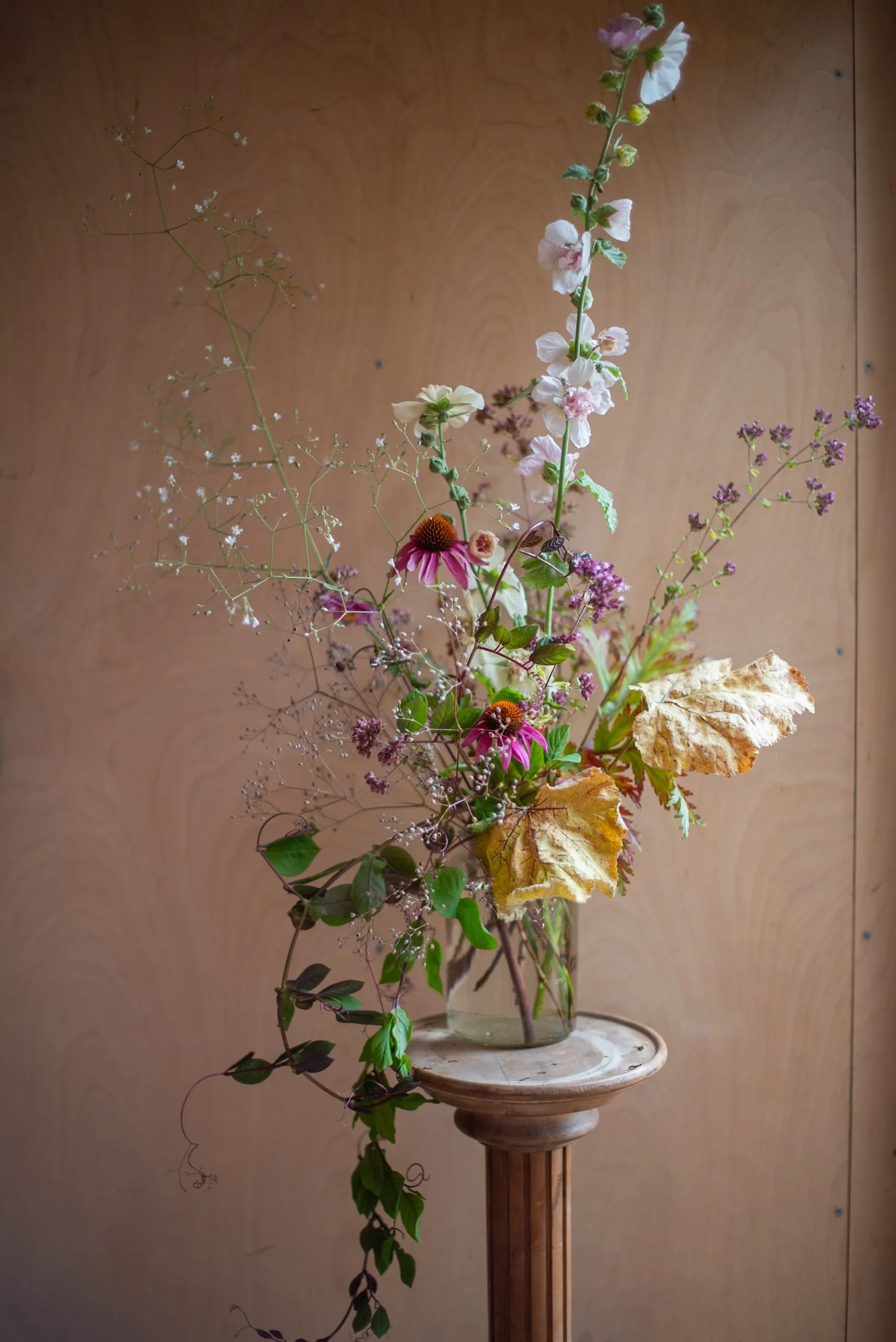
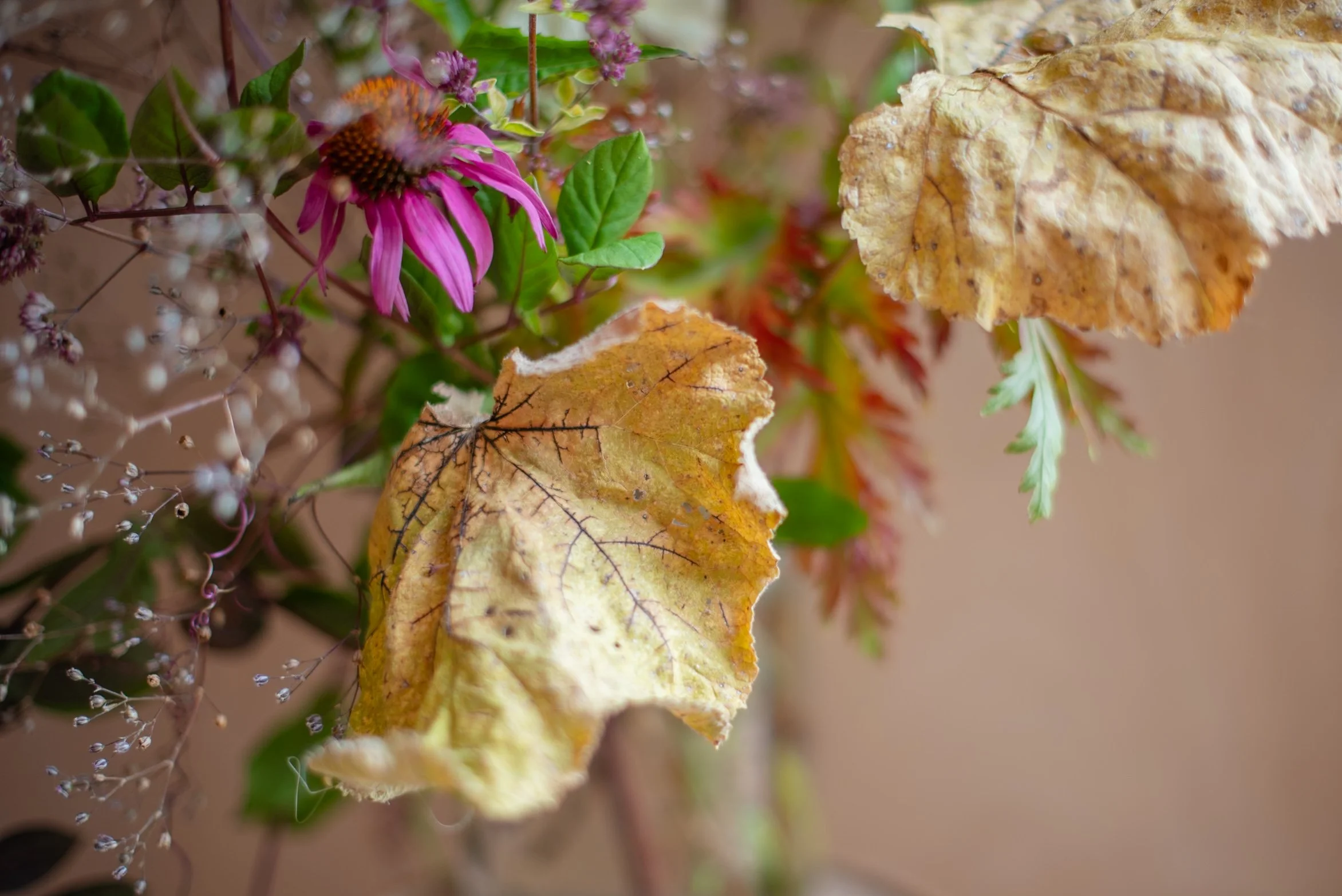
Sometimes you start with a leaf. This arrangement in a simple glass pickle jar has a few good ones. The giant herb Robert, native to Madeira, has ferny-shaped leaves turning from lime to raspberry red at the edges. I’ve generally been using a lot of geranium foliage this year of many different varieties because they turn great colours when they are stressed. Harsh but true! The hollyhock leaves I had ‘pruned’ off a two metre tall stem that kept getting in the way as I brushed past them. I must have left them out in the sun because they have dried to perfection - every detail preserved, the colour of tea-stained parchment. And of course the green and bronze two-tone vine (Cobea scandens) which is preparing to flower and we’ll be using profusely throughout our autumn classes - a lovely one for tumbles and tendrils. I wanted to highlight the exquisite spires of x Alcalthaea suffrutescens 'Parkallee', (a hybrid cross bred from a hollyhock and a marshmallow), one of our absolute favourites in August, layered with peppery post-flower dots of baby’s breath and smoky mauve oregano, one of my go-to aromatics that, massed, happens to be a superb filler, without being heavy. I should say that I also had a smattering of Japanese anemones in there (Anemone hupehensis ‘Sepember Charm’) which I later removed - beautiful as they are, they didn’t add anything and I’m trying to take at least one thing out to really ensure that every material is fulfilling a purpose within the design.
FIREWEED, FAT DOMINO
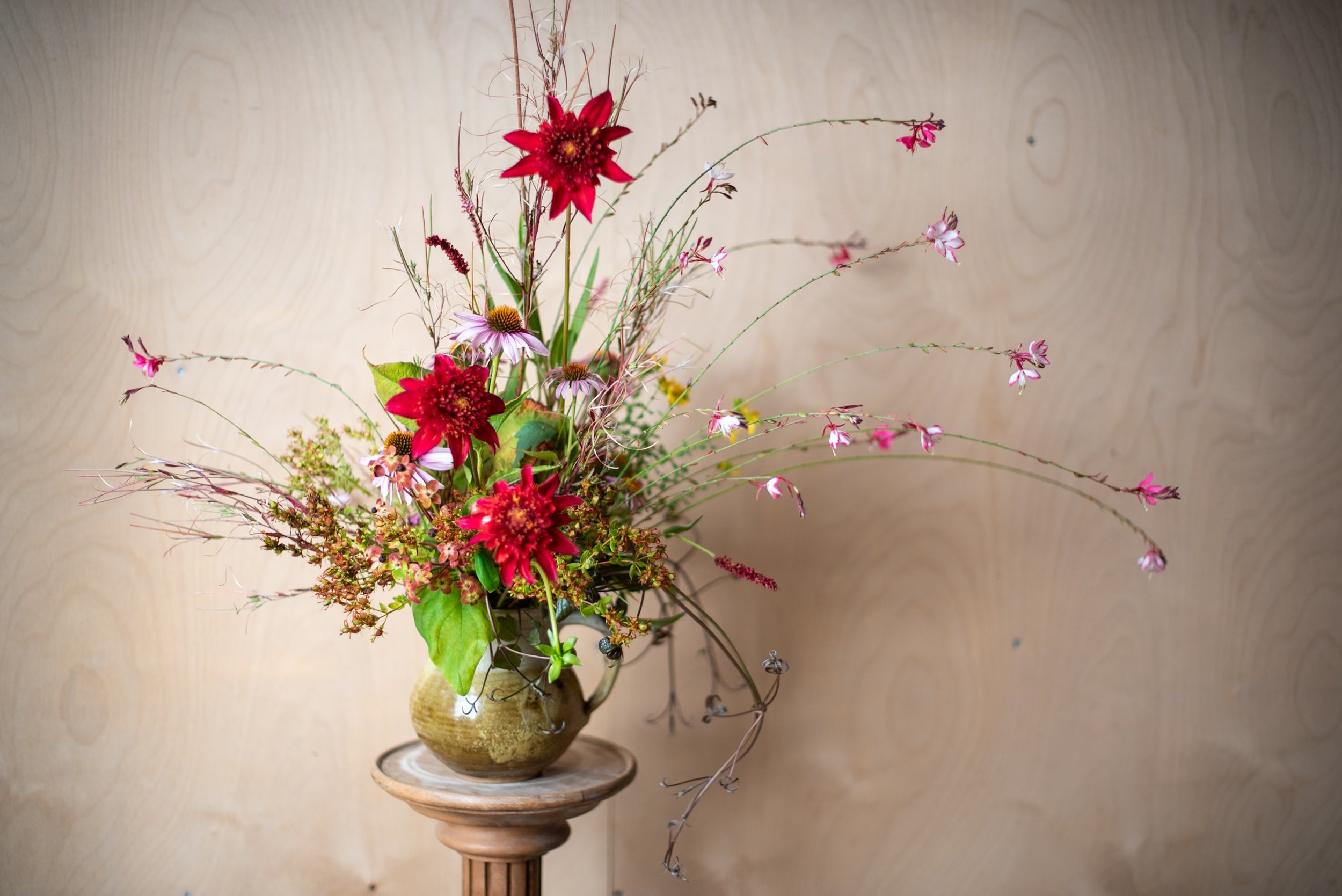
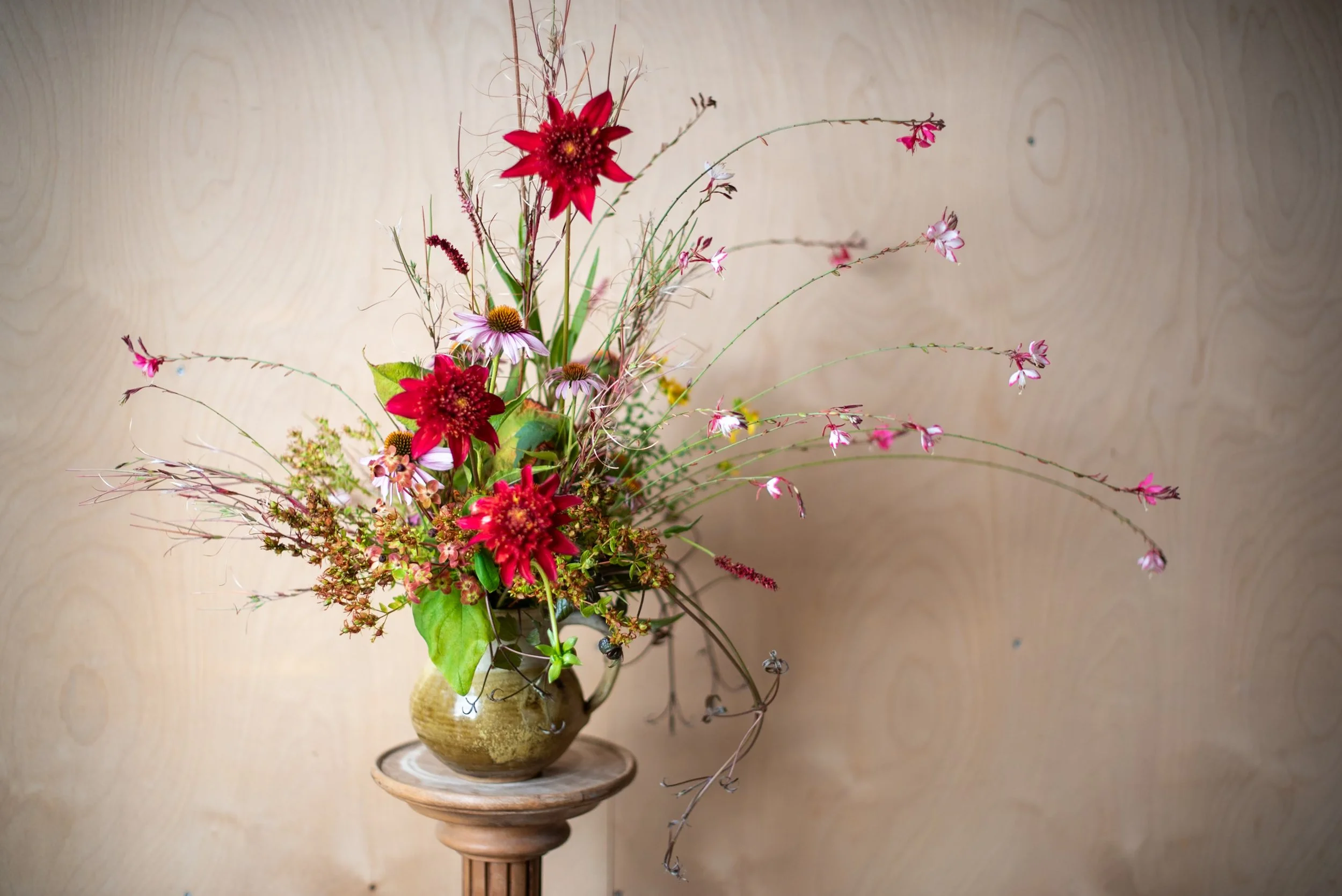
Many of you longer-term readers will know that my feelings for dahlias are either confused or extremely specific, which is to say that there are only a few varieties I’m into and year by year our collection has been whittled down to just a few.
Clematis (Clematis montana ‘Elizabeth’)
Dahlia (Dahlia ‘Jive’)
Fireweed (Chamaenerion angustifolium)
Purple coneflower (Echinacea purpurea)
Red bistort (Persicaria amplexicaulis ‘Fat Domino’ & ‘Rosea’)
St John’s Wort (Hypericum perforatum & ‘Hidcote’)
Wandflower (Oenothera lindheimeri ‘Siskiyou Pink’ & ‘Rosyjane’)
Stoneware ceramic jug
JULY
Many of you longer-term readers will know that my feelings for dahlias are either confused or extremely specific, which is to say that there are only a few varieties I’m into and year by year our collection has been whittled down to just a few. ‘Cafe au Lait’ makes the cut, as ubiquitous as she is, the dinner-plate size and the colour (a pale coffee-shell pink) being so suitable for the larger, later summer arrangements. She’s like good jeans - she stays. The poms poms are extremely streamlined and at the smaller end of the scale, mainly because I don’t tend to like obvious colours and heavy, spherical shapes in one package. This year we’ve reintroducing a few single-petalled varieties into the rotation and so far I’m enjoying them in small doses and then there’s this (my novelty choice)… Dahlia ‘Jive’. How do we feel about it? The colour comes across as more obvious when photographed, it’s smokier in real life and I like the variability between the flowers, the size, the star shaped anemone-form, the streaks, and there’s a sprinkling of gold through it, too, which makes for interesting options when it comes to building out a palette. Make me think maybe next season we’ll bring back the ‘Platinum Blonde’ (white with a creamy, sunny centre) that I used to love but didn’t survive the cull. A good one if you’re looking for an anemone form in a subtle shade / you’re not brave enough for the tomato red!
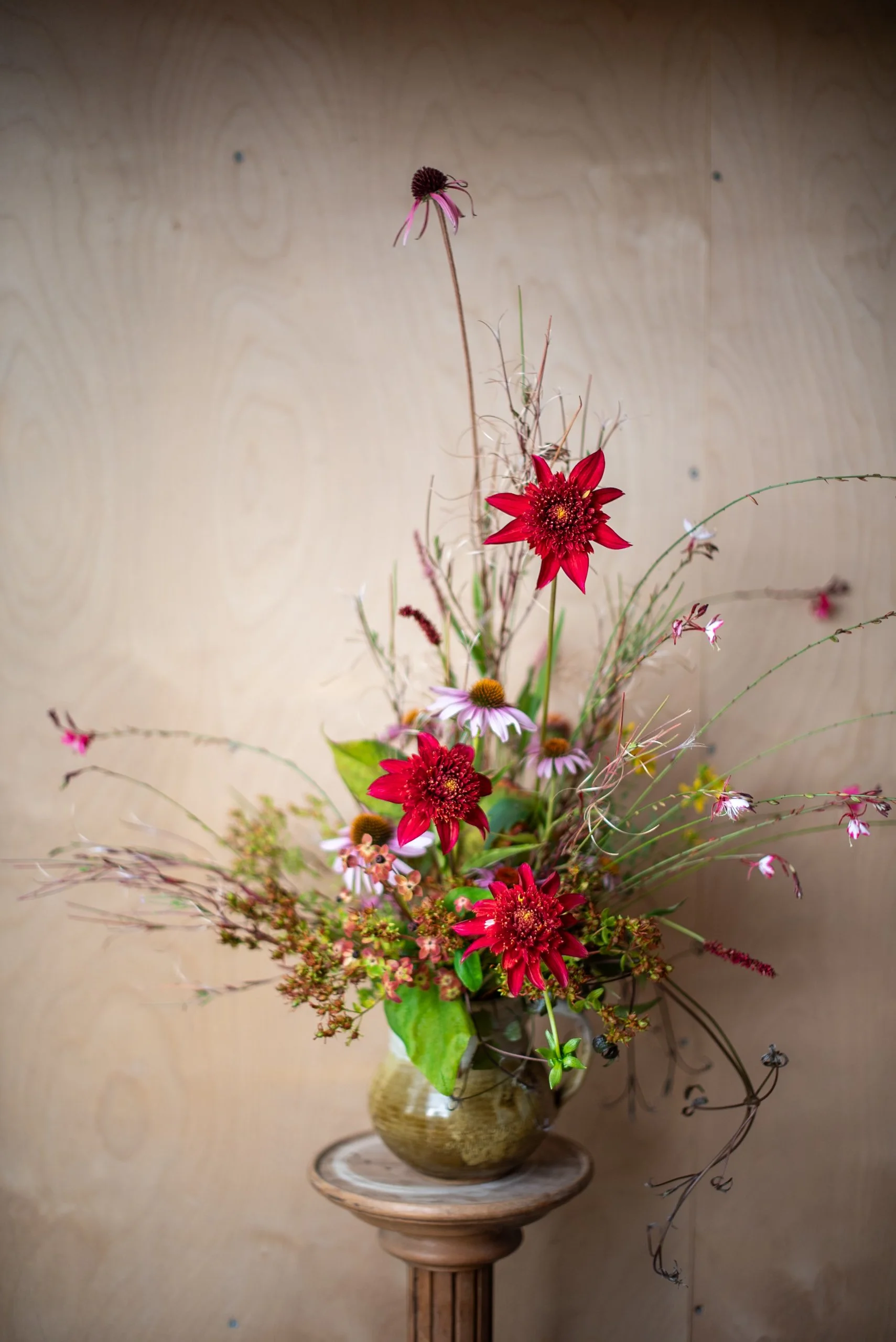
Let me explain where I was going with this as I walked through the garden with my bucket and snips… I already had my dahlias and was leaning towards a raspberry colour story which lead me through to the prairie beds where we have a few self-seeded fireweed here and there (tolerated in small doses). The wisps are great for texture and I like using them almost in place of a branch when I want something lighter but still structural. Following this trajectory I took a few stems of gaura and in my rummaging for this came across the red bistort. Echinacea for a secondary flower form. St John’s wort for filler and texture - both the wild self-seeders which are fading to a burnt toffee colour and the cultivated ‘Hidcote’ with lime leaves (great with the raspberry) and faded flowers, dusky clusters of small stars that play off well with the dahlias. The clematis was a last minute addition - the vine strands dangle enticingly from the roof of our conditioning shelter but persist in threatening to garrotte us on our way in and out and regular pruning is essential - the brown adds a fun cascade but would work equally well with the wild Clematis vitalba for another touch of lime.
Worth noting that I had no chicken wire or pinholder for this arrangement so I made sure to cross the stems over one another (if you imagine the mouth of the vase as a circle and the addition of each stem dividing that circle into multiple wedges, this provides a structure to lean the subsequent stems against until you have a close network and can add in the taller / weightier elements with the structural support to keep them upright).
RETURN TO RECIPES
FOXTAIL LILY, RAMBLING ROSE
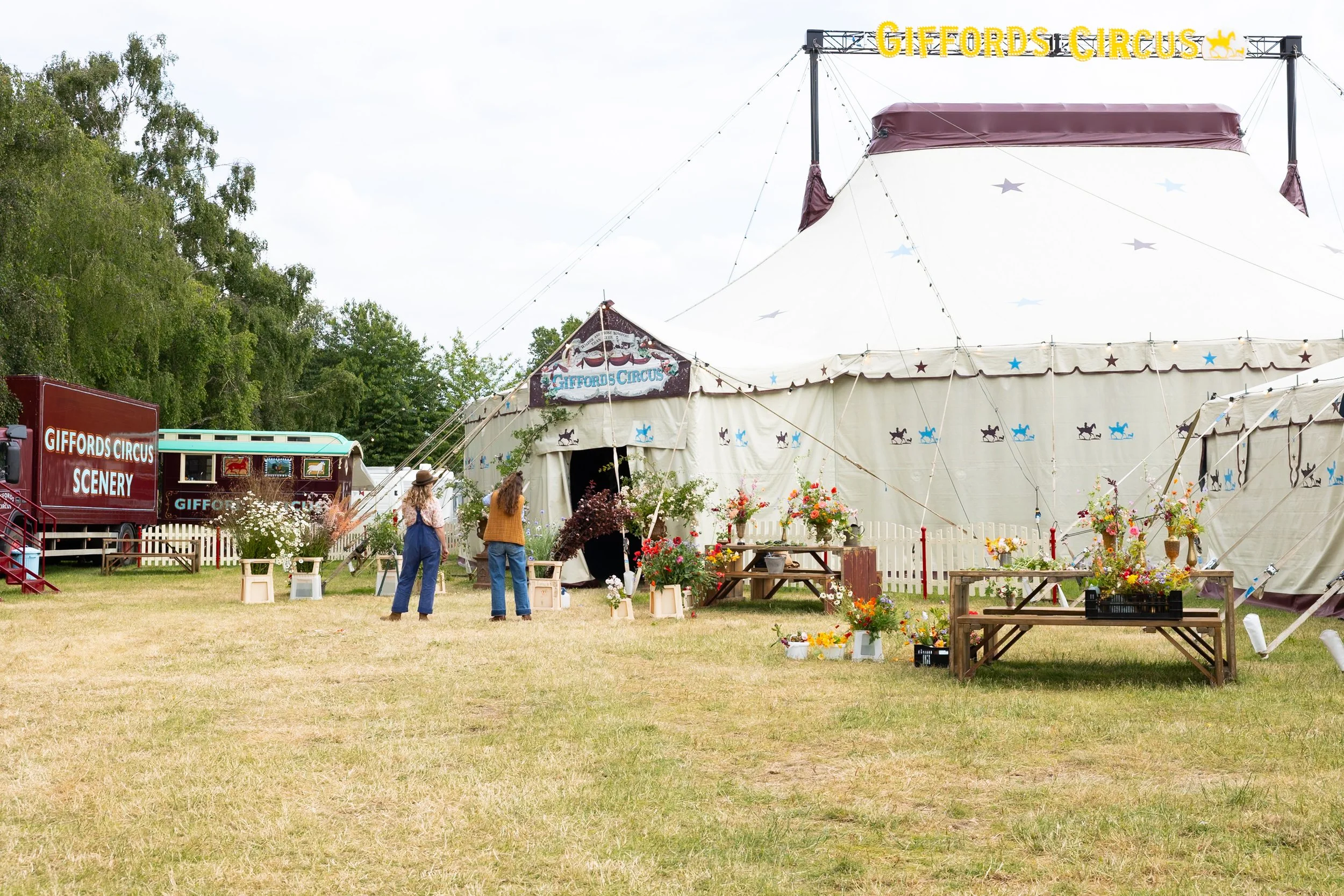
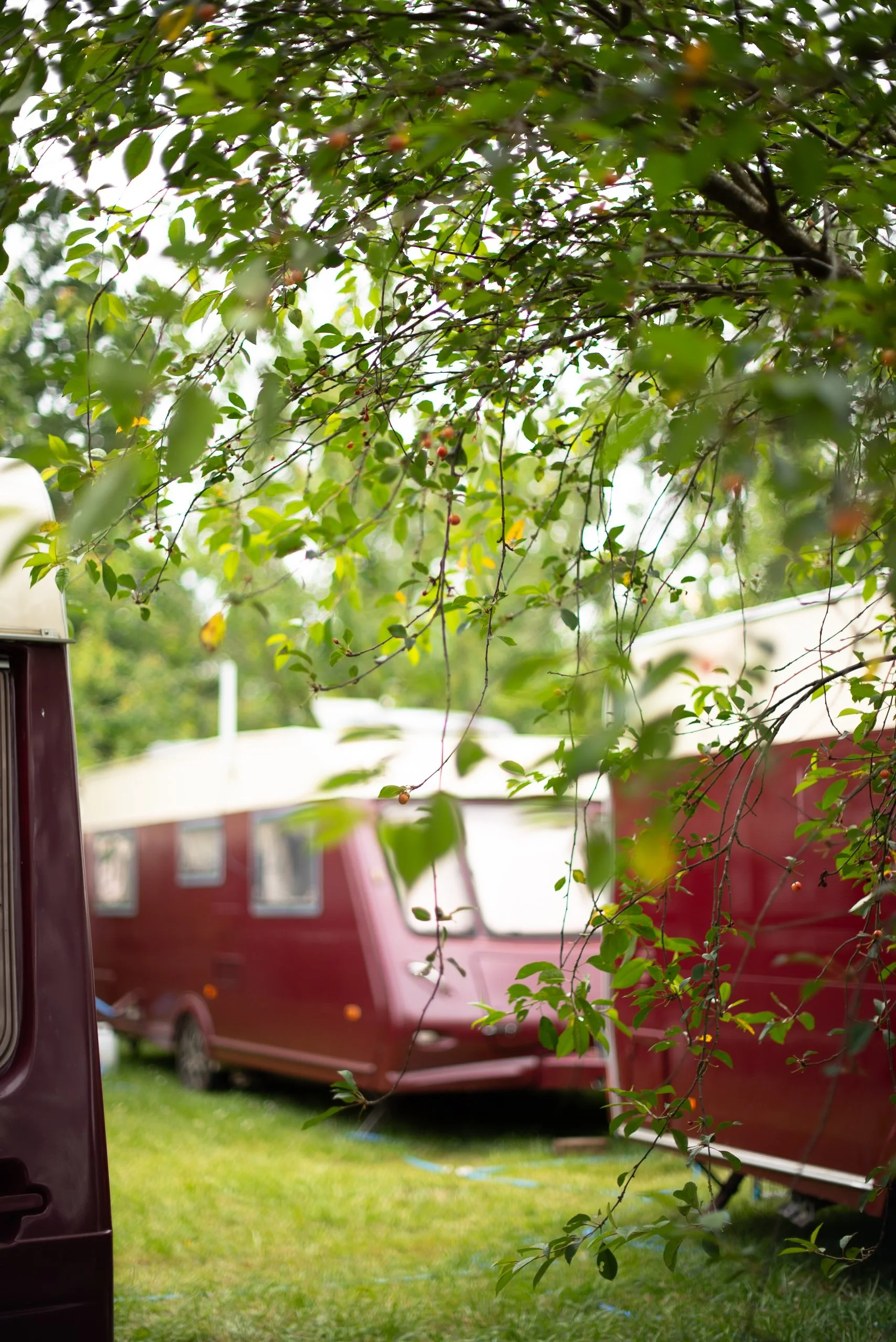
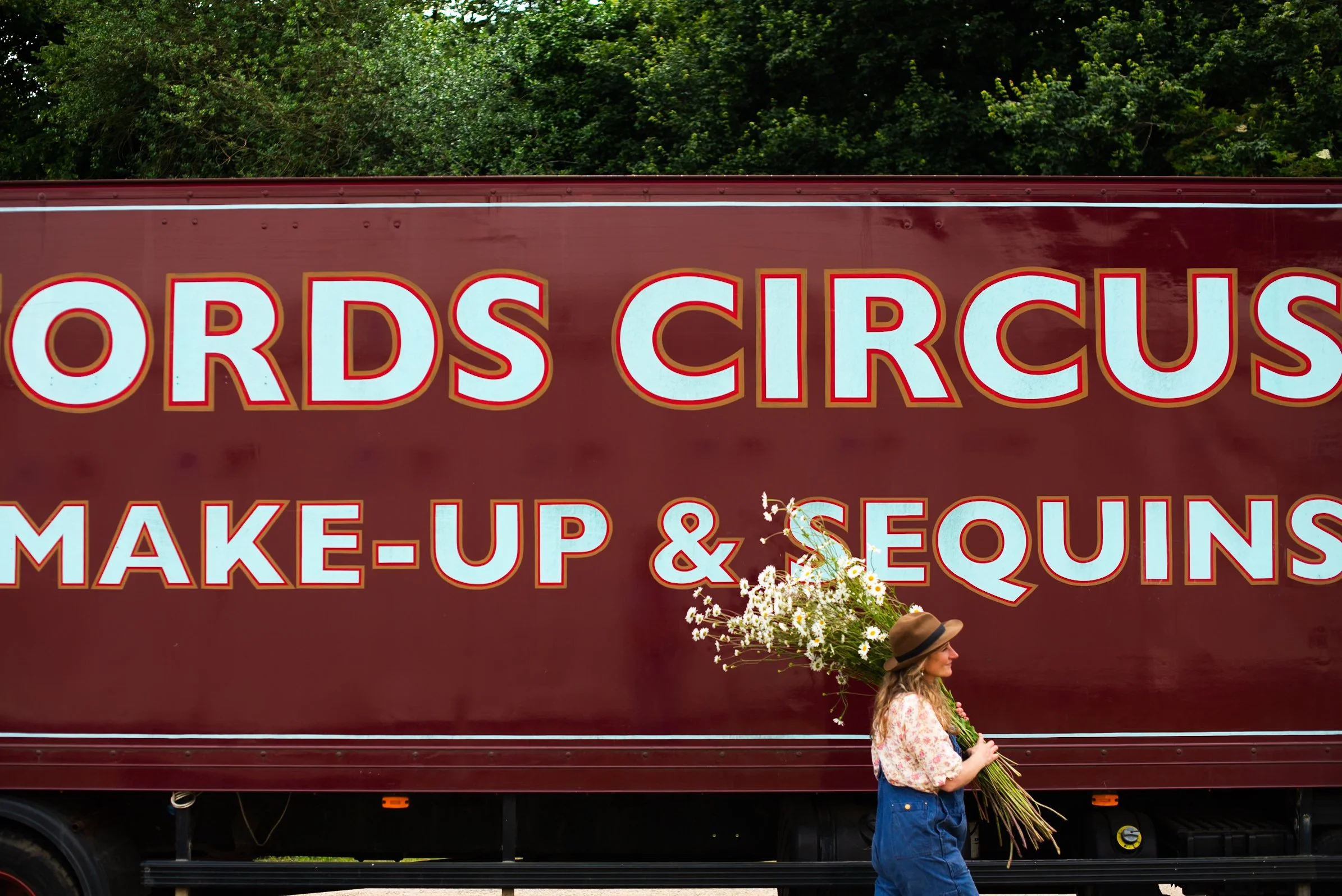
Roll up roll up, it’s party time at the circus and that calls for lots of flowers. Giffords unsurprisingly are very into their adornment. There are potted plants at the steps of the wagons, flickering lights and garlands and flags.
All-heal (Valeriana officinalis)
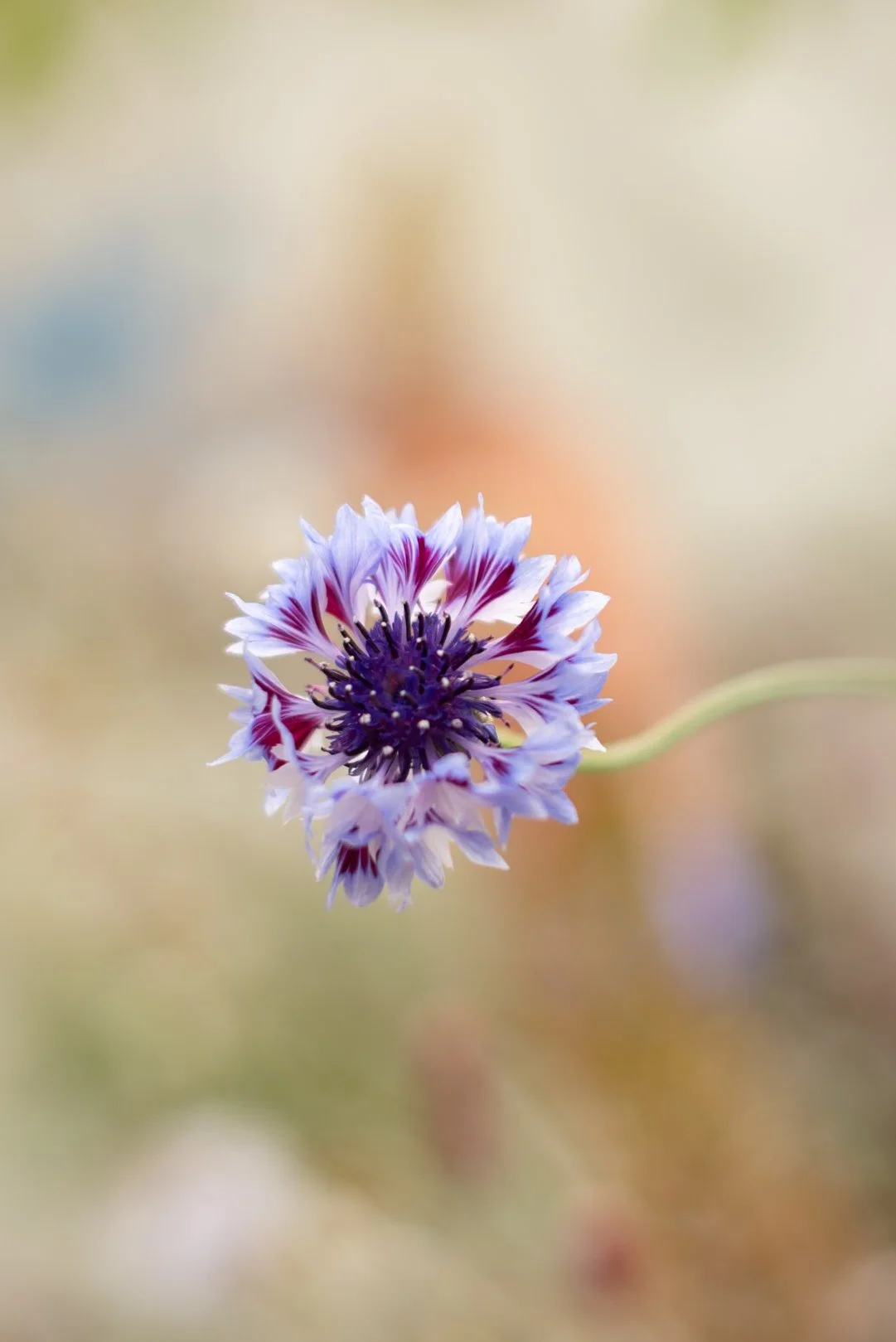
Cornflower (Centaurea cyanus ‘Classic Fantastic’)
Diabolo (Physocarpus ‘Summer Wine’ / Diable D’or)
Foxtail lily (Eremerus ‘Romance’)
Golden oats (Stipa gigantea)
Ox-eye daisy (Leucanthemum vulgare)
Rose (Rosa ‘Lykkefund’)
Rose (Rosa ‘Rambling Rector’)
Wild dog rose (Rosa canina)
A pair of antique cast iron urns
Liner bucket
Large pinholder
Chicken wire
JUNE
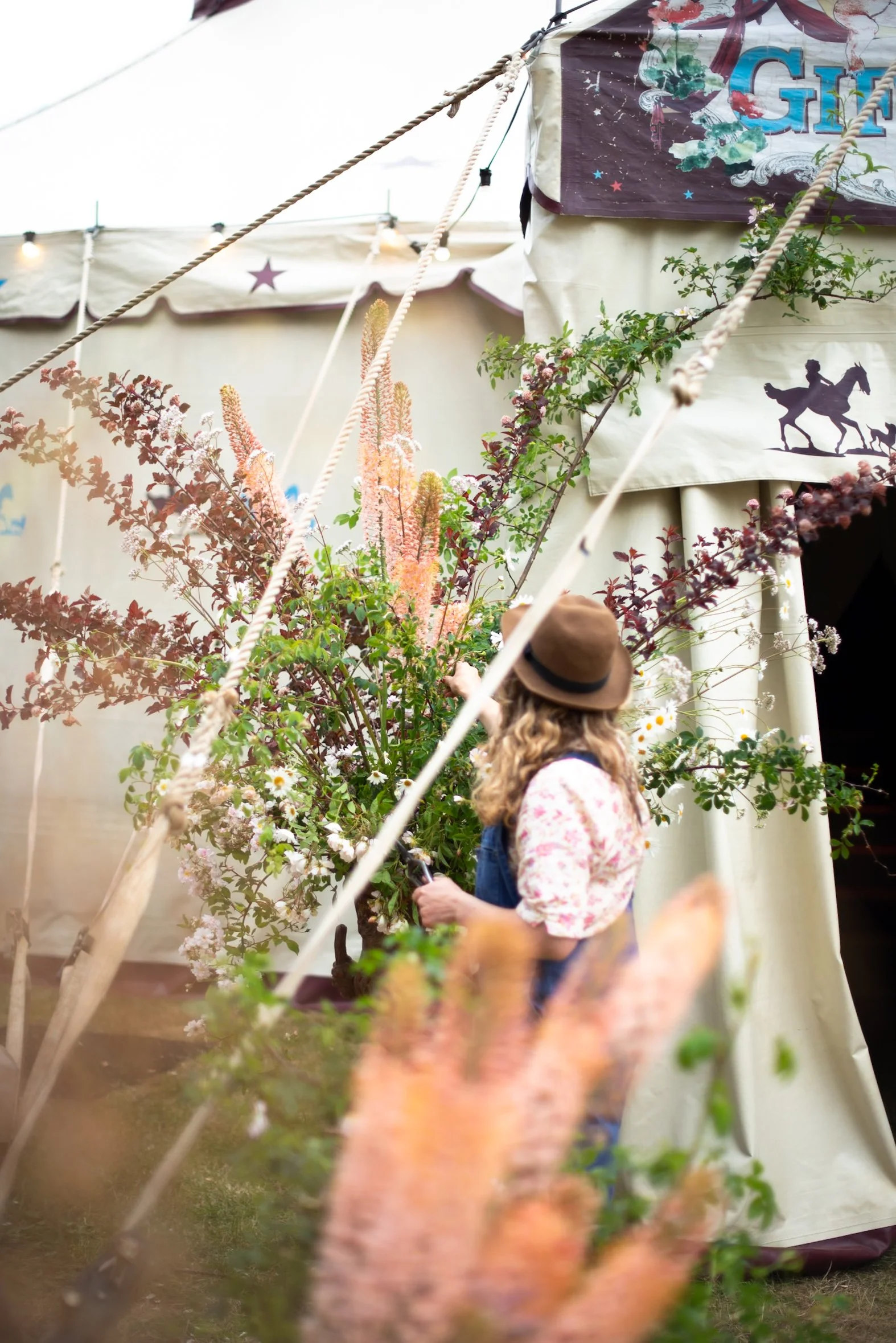
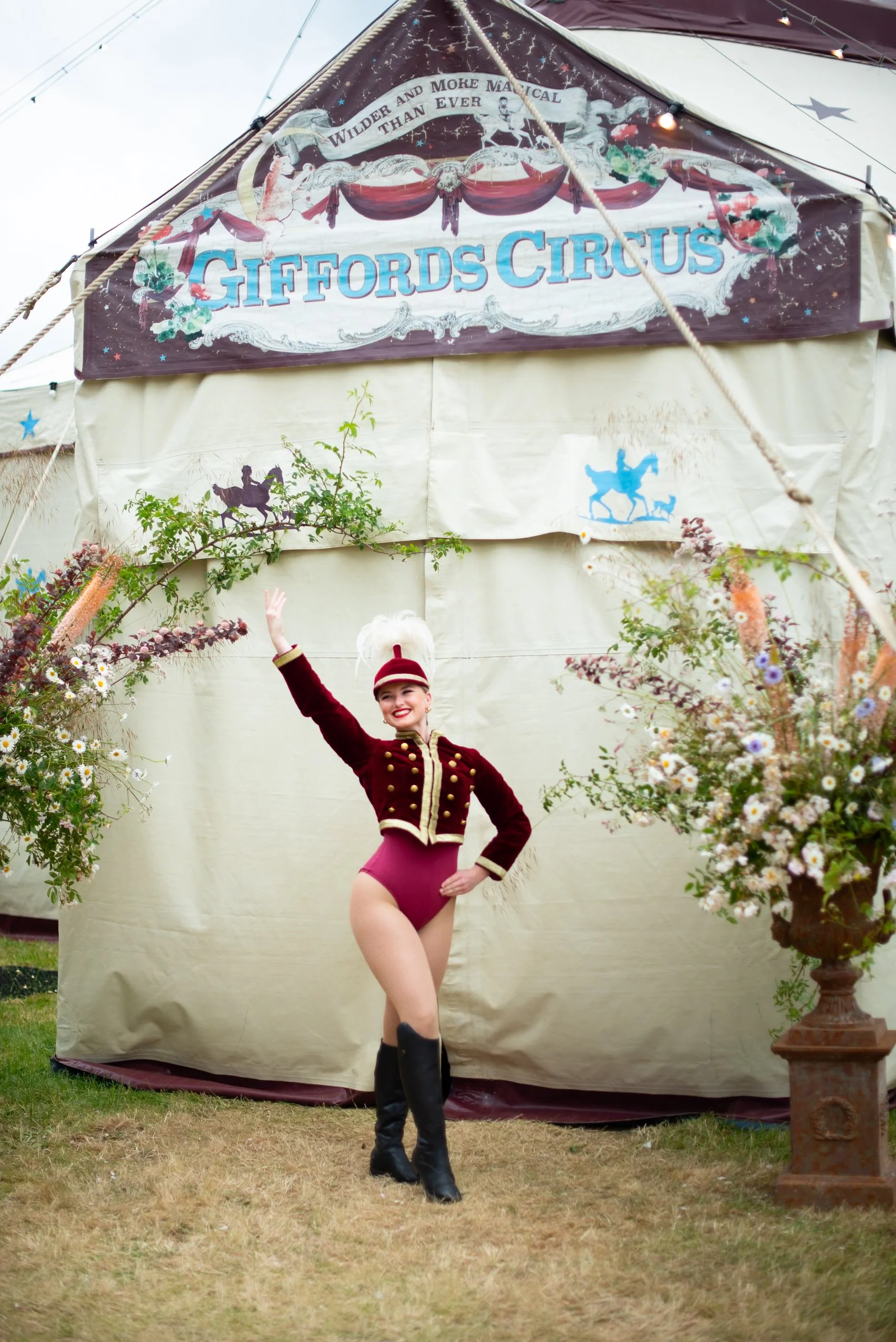
Roll up roll up, it’s party time at the circus and that calls for lots of flowers. Giffords unsurprisingly are very into their adornment. There are potted plants at the steps of the wagons, flickering lights and garlands and flags. In typical English style the summer’s evening is set to be stormy and grey so much of the focus is on getting into the cosiness of the tent. We wanted the designs to feel very English, like they had just been cut from the borders of Chiswick House with a heady, windswept quality of rose briars, valerian and the shimmer of golden oats rustling in the breeze.
For the Big Top we symmetrically position a pair of urns to flank the entrance against the faded parchment-white of the tent. They are colossally heavy - cast iron - and not watertight. Originally designed to be planted garden urns for they each need a liner bucket to hold water for the branches and flowers. In this goes a large flower frog and generous bundle of chicken wire. The wild and rambling rose briars are the first and most time consuming stage - getting them into the right positions to hold the sprawling canes securely in place. Next a fan of diabolo branches (Physocarpus) for that burgundy red. Spires of foxtail lily in a gorgeous salmon hue that perfectly sets off the ice-blue cornflowers. A speckling of marguerite daisies, all-heal and golden oats grasses.
PLUME POPPY, CANARY BIRD
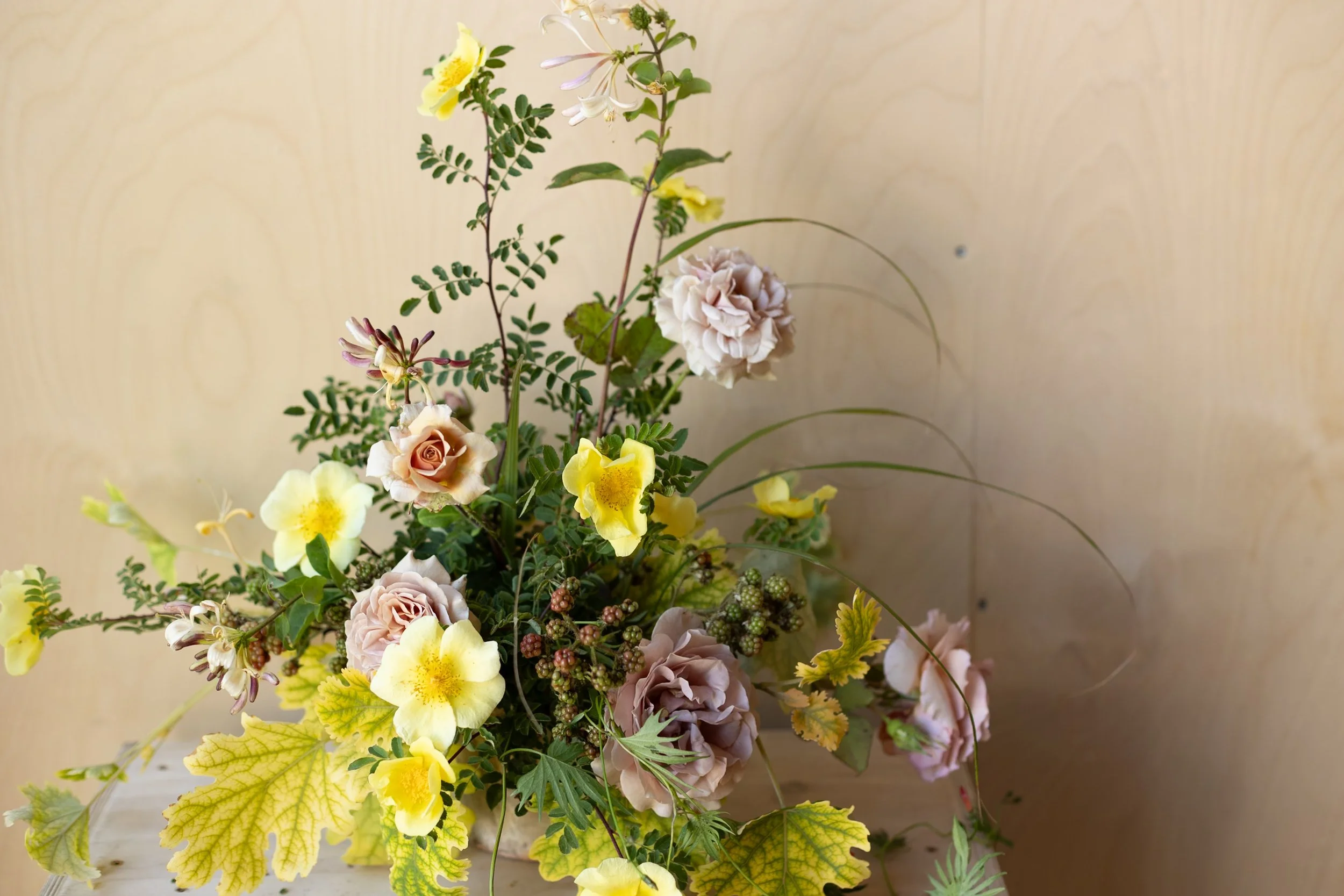
The garden is a vaguely alcoholic blur of pastels now, fuzzy and unrefined. This is her spell as an impressionist painting, broken brushstrokes of colour in quick daubs, the backdrop a shifting sea of windblown green.
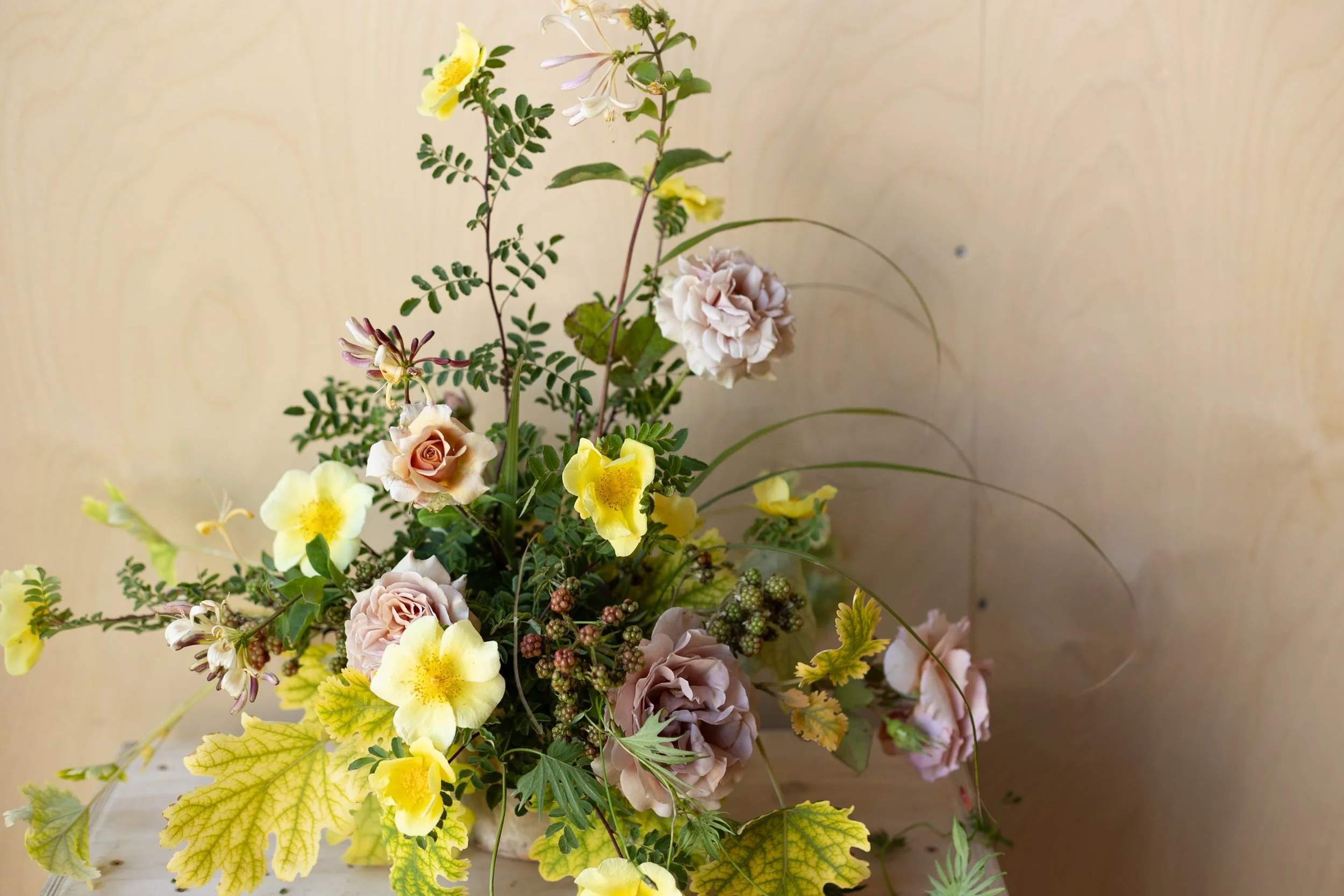
Blackberry (Rubus fruticosus)
Honeysuckle (Lonicera periclymenum)
Plume poppy (Macleaya cordata)
Rose (Rosa ‘Canary Bird’ & ‘Mokarosa’ & ‘Julia’)
Terracotta bowl
Kenzan
Small scrunch of chicken wire
JUNE
The garden is a vaguely alcoholic blur of pastels now, fuzzy and unrefined. This is her spell as an impressionist painting, broken brushstrokes of colour in quick daubs, the backdrop a shifting sea of windblown green. With daily surges of growth the lines become indistinct - paths erased by the swell of foliage, beds smeared together in the converging haze of flowers.
Berries, too. And in particular the humble blackberry, Rubus fruticosus. Of all botanical ingredients this indefatigable plant, to me at least, is teetering on the edge of perfection. You might ask why, and I’ll be glad to tell you. There is a whole host of reasons, not least of which is blackberry crumble with custard in early autumn on one of the first evenings when there is enough of a nip in the air to light the fire.
Sure, there is the aesthetic pleasure of the flowers - white and the palest pink, which unfold from silvery buds in early summer and look a little like a tiny, creased version of the wild dog rose (Rosa canina). The resemblance makes sense, since the Rubus genus is a member of the rose family (Rosaceae). The glossy berries gradually darken, from a vibrant lime green to khaki, through gold and dusky red (at this time of the year) to the deepest purple-black. The leaves are exquisite, arranged alternately along curving, thorned canes, paler to the underside, divided into multiple leaflets and often tinted maroon, pink or lime. There is its usefulness to consider, too. A natural barbed wire, it has been utilised for centuries as a way to delineate boundary lines. If you can abide the thorns it serves the flower arranger all year round, from bud to blossom to fruit and on into the winter months - I love a desiccated blackberry bramble early in the year, with the gilded autumn fruits still in evidence.
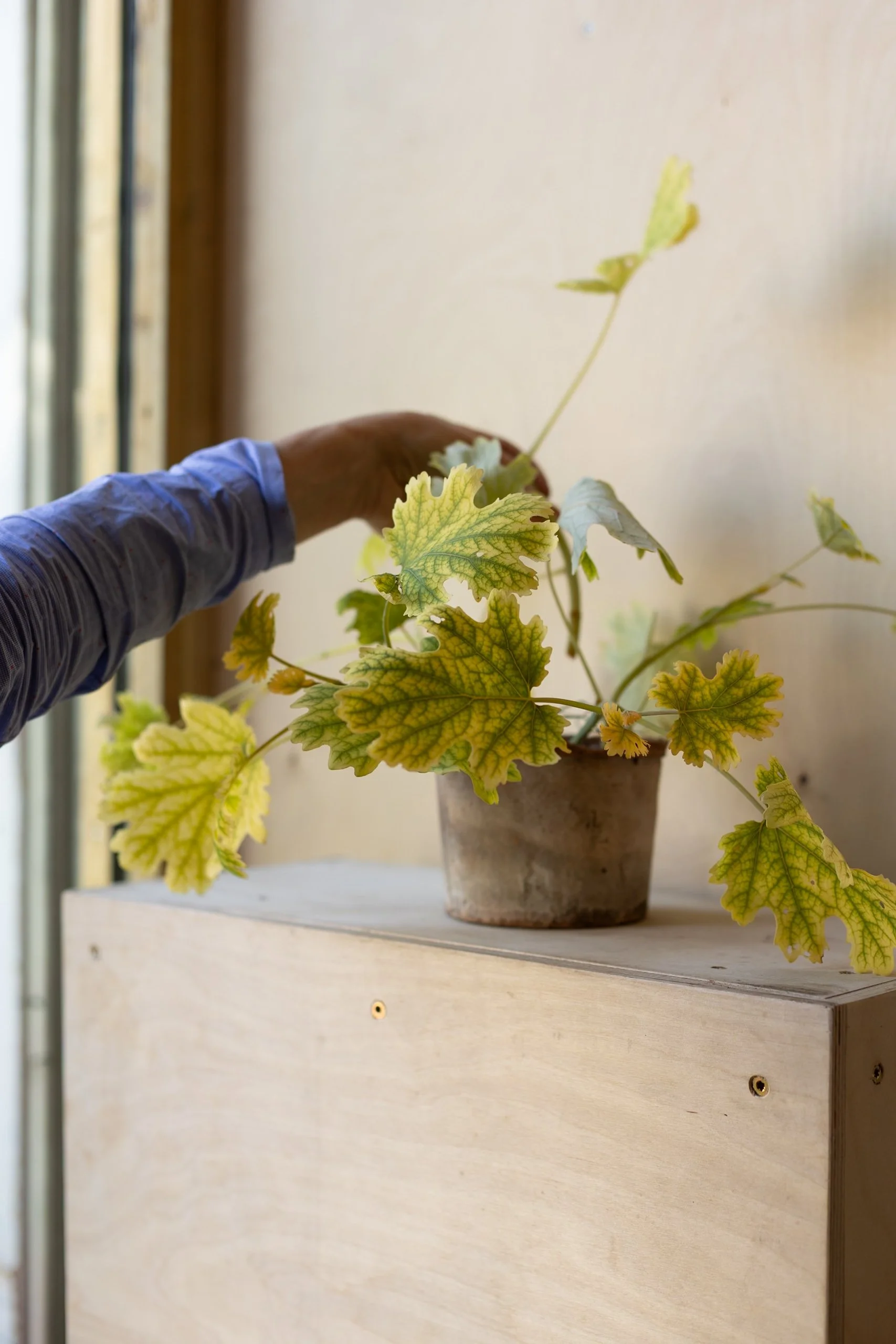
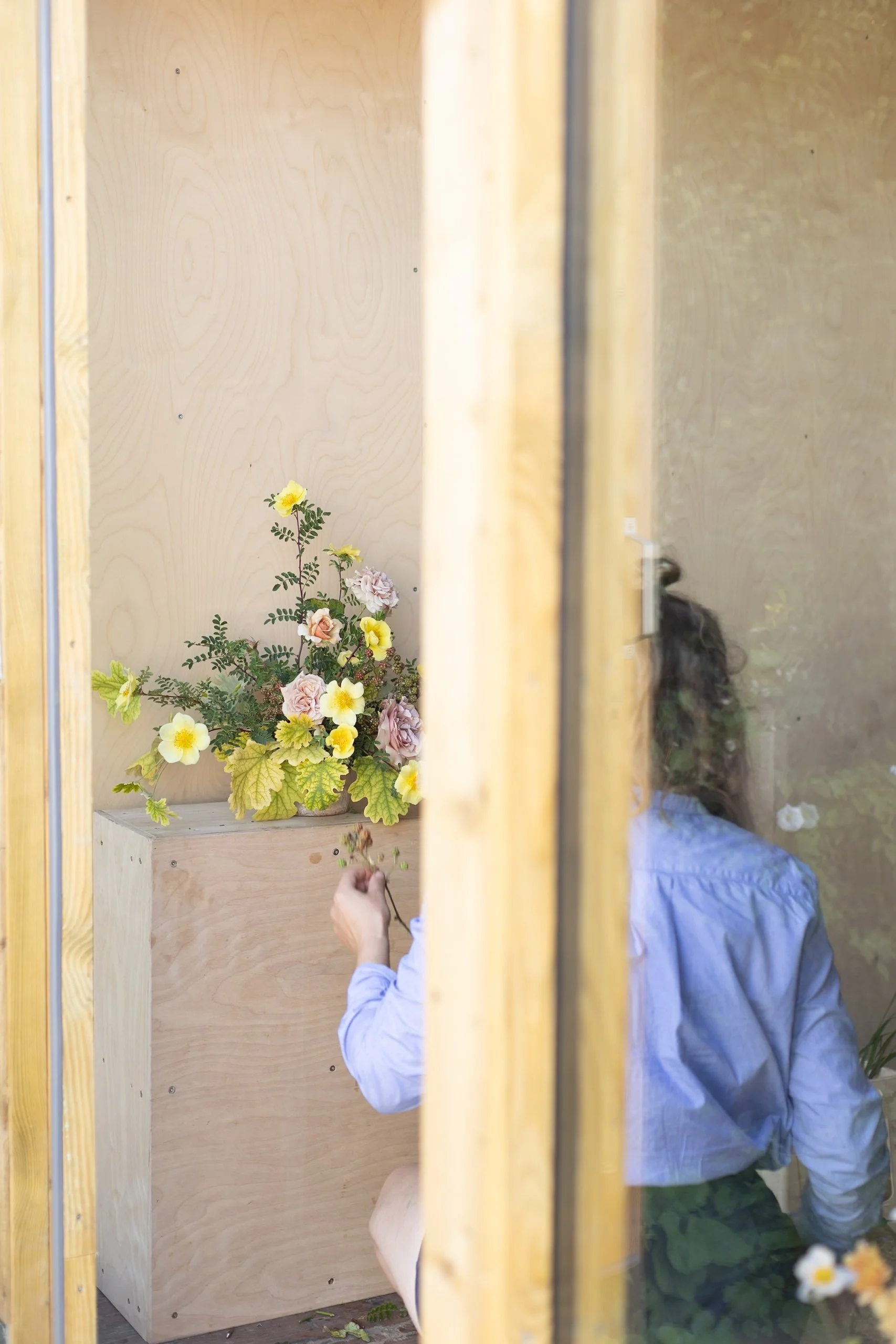
Then there is its ubiquity - festooning our native hedgerows up and down the country. And the admirable spirit of persistence and tenacity that makes it almost unconquerable. I rate a plant that has pluck and with the bramble you just know that however hard you try, it will always outwit you, will always creep back around when your back is turned. Rubus is steeped in ancient folklore, magic and superstition - valued for its protective, preventative, binding and healing properties. The blackberry briar was considered sacred by the druids to protect the faery realm. In European folk medicine, children would be passed through arching gaps in the bushes to cure them of disease, the dried leaves burned and scattered around a property to shield from bad luck, and blackberry bushes planted on graves to keep the dead in and the devil out. Bramble hoops strung from the door were said to ward away evil, particularly in the darkest months of the year when strange spirits walk the land more so than in summertime. Hung above the bed they supposedly protect against nightmarish dreams and ensnare negative energies. In witchcraft the supple canes were used for binding spells. I’m generally sceptical of metaphysical woo-woo, but it does undoubtedly add to the romance. I do, however, firmly believe in a bowl of blackberries, freshly picked and just washed, as a token of friendship, and of love.
For there is, of course, the nostalgia factor… The delight of foraging for berries as a child, picking the ripest fruit with chubby fingers and filling baskets to carry home through leafy tunnels and knee-high grass. As little girls Jess and I loved the stories of Brambly Hedge by Jill Barklem and we’ve been rediscovering them recently with the children. Perhaps some of you have read them too? In the ‘Autumn Story’ you might recall the mice harvesting blackberries before the autumn rain sets in and Primrose finding herself lost in the Chestnut Woods as dark begins to fall… When my son was eight months old I strapped him to my chest and took him blackberry picking for the first time. Approaching the bushes he’d urgently kick his little legs then lean forward and gently take the fruit in his mouth from my fingers, greedily gorging on berries, hands and chin stained with the wine-coloured juice. It’s one of my happiest memories, the weight and press of his body on my chest, small but already strong, the scent of the back of his neck where his flaxen hair curled upward.
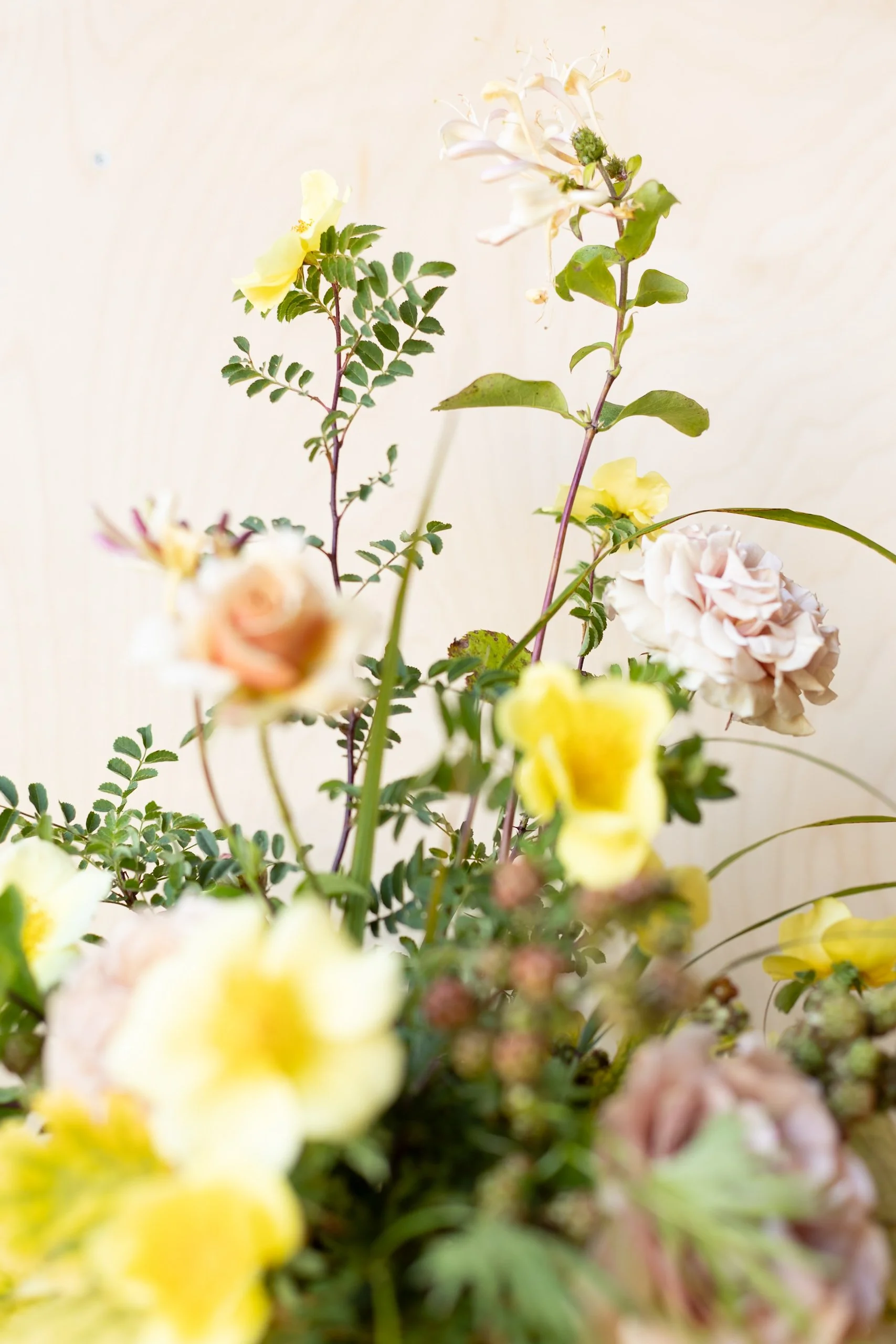
The soft fruit flowers of the blackberry are highly fragrant, frequented by many a pollinator including the honey bee, butterflies, hoverflies and bumblebees that linger lazily over the rich nectar and pollen. The berries - that perfect balance of sweet and tart - have been eaten by humans for thousands of years. Mavis loves them. As do the birds. As do moles, mice, foxes (and, apparently, racoons, though we don’t see many of those in these parts). The stewed fruit can be used as fillings for pies, cordials, syrups and jams; fellow whisky drinkers tell me that bramble whisky is delicious; I’d like to try it! And not just the fruit - the foliage is consumable too. There’s blackberry leaf tea, blackberry leaf sorbet, even blackberry leaf tobacco, of all things… And here, the inexhaustive list of Rubus attributes dwindles on into the medicinal and nutritional… High in vitamin C. Loaded with nutrients and antioxidants. Reduces inflammation. Improves blood sugar levels. Aids digestion. A good source of fibre.
Well, you did ask! I’m sure there’s a great many more but I’ll leave it there for now, accompanied by coffee roses and fragrant curls of common honeysuckle.
RETURN TO RECIPES

WISPY LILAC, SMOKY MAUVE
June is one of the best months for creating soft and ethereal flower arrangements using all the ruffly shapes in bloom now in the garden.

Clematis (Clematis ‘Samaritan Jo’)
Jacob’s ladder (Polemonium ‘Heaven Scent’)
Japanese Itoh peony (Paeonia ‘Canary Brilliants’)
Mullein (Verbascum ‘Southern Charm’)
Rock rose(Helianthemum ‘Wisley Pink’)
Rose (Rosa ‘Goldfinch’, ‘Buff Beauty’, ‘Julia’)
Sweet rocket (Hesperis matronalis)
Ceramic pedestal bowl (Aesme Studio design)
Kenzan
Small scrunch of chicken wire
JUNE
June is one of the best months for creating soft and ethereal flower arrangements using all the ruffly shapes in bloom now in the garden. I want to make a romantic and shapely centrepiece design in a footed bowl. I choose several blowsy focal flowers which all have interesting nuances in colour and keep these low and close to the opening of the bowl, allowing the smaller, wispier flowers to reach out and up. Julia’s rose is a creamy coffee colour with a glowing honey centre. The intersectional peony - highly fragrant - has a large six-inch face, a froth of stamens and undulating petals that range from cream through pale lemon to coral with streaks of pink. The star-shaped clematis looks almost as though it has been traced with a fine pen along the outline of the silvery petals.
A tip: sear the rock rose and verbascum - they tend to droop once cut.
RETURN TO RECIPES

FIGWORT, BEDSTRAW, BELLFLOWER
The tall spire flower with the dark stem is a native weed that we enjoy in the cutting garden - it is water figwort (Scrophularia auriculata) and produces masses of tiny maroon flowers from July to September that provide nectar for butterflies, bees and wasps.

Cone flower (Echinacea ‘Paradoxa’ & ‘Pallida’)
Hedge bedstraw (Galium mollugo)
Lindheimer's beeblossom (Gaura ‘Siskiyou Pink’ & ‘Rosyjane’)
Milky bellflower (Campanula lactiflora ‘Loddon Anna’, ‘Pritchard’s Variety’ & ‘Alba’)
Ox-eye daisy (Leucanthemum vulgare)
Water figwort (Scrophularia auriculata)
White-flowered burnet (Sanguisorba tenuifolia ‘Alba’)
Aesme Studio ceramic bowl, approx 30cm diameter
Kenzan
Chicken wire
JUNE
The tall spire flower with the dark stem is a native weed that we enjoy in the cutting garden - it is water figwort (Scrophularia auriculata) and produces masses of tiny maroon flowers from July to September that provide nectar for butterflies, bees and wasps. Happy in the pond or bog garden it is also able to tolerate periods of drought. The name ‘Auriculata’ refers to the shape of the tiny flowers and translate as ‘shaped like an ear’.
RETURN TO RECIPES

CINQUEFOIL & FEATHERTOP
The glaze is called ‘tenmoku’ and was likely first introduced to the West from Japan by Shoji Hamada when he set up the Leach Pottery with Bernard Leach in 1920s St Ives.

Blackberry (Rubus)
Cranesbill (Geranium ‘Walter’s Gift’)
Feathertops (Pennisetum villosum)
Sacred bamboo (Nandina domestica)
Shrubby cinquefoil (Potentilla fruiticosa ‘Primrose Beauty’)
Shrubby hollyhock (Alcalthaea suffrutescens 'Parkallee' & ‘Parkrondell’)
Strawberry (Fragaria × ananassa)
Small vase in a tenmoku glaze
AUGUST
This is one of our favourite vases, from the Norfolk based pottery ‘Made in Cley’ (shop till you drop!) The glaze is called ‘tenmoku’ and was likely first introduced to the West from Japan by Shoji Hamada when he set up the Leach Pottery with Bernard Leach in 1920s St Ives. The name translates as ‘heaven’s eye’ referring to the Tianmu mountain in China. It was here that Japanese monks first discovered the glaze, taking the recipe back home with them; it is believed to have originated in China during the Song Dynasty where it was used to decorate bowls for use during tea ceremonies. Tenmoku is a reduction fired stoneware glaze containing iron oxide that fires to a high-gloss somewhere between a rich maroon, dark chocolate and almost-black. This vase can look glittery in some lights - a result of the minute iron silicate crystals that form in the glaze during the firing process. I love the ‘breaking points’ where the glaze has thinned to a rust colour over the ridges.
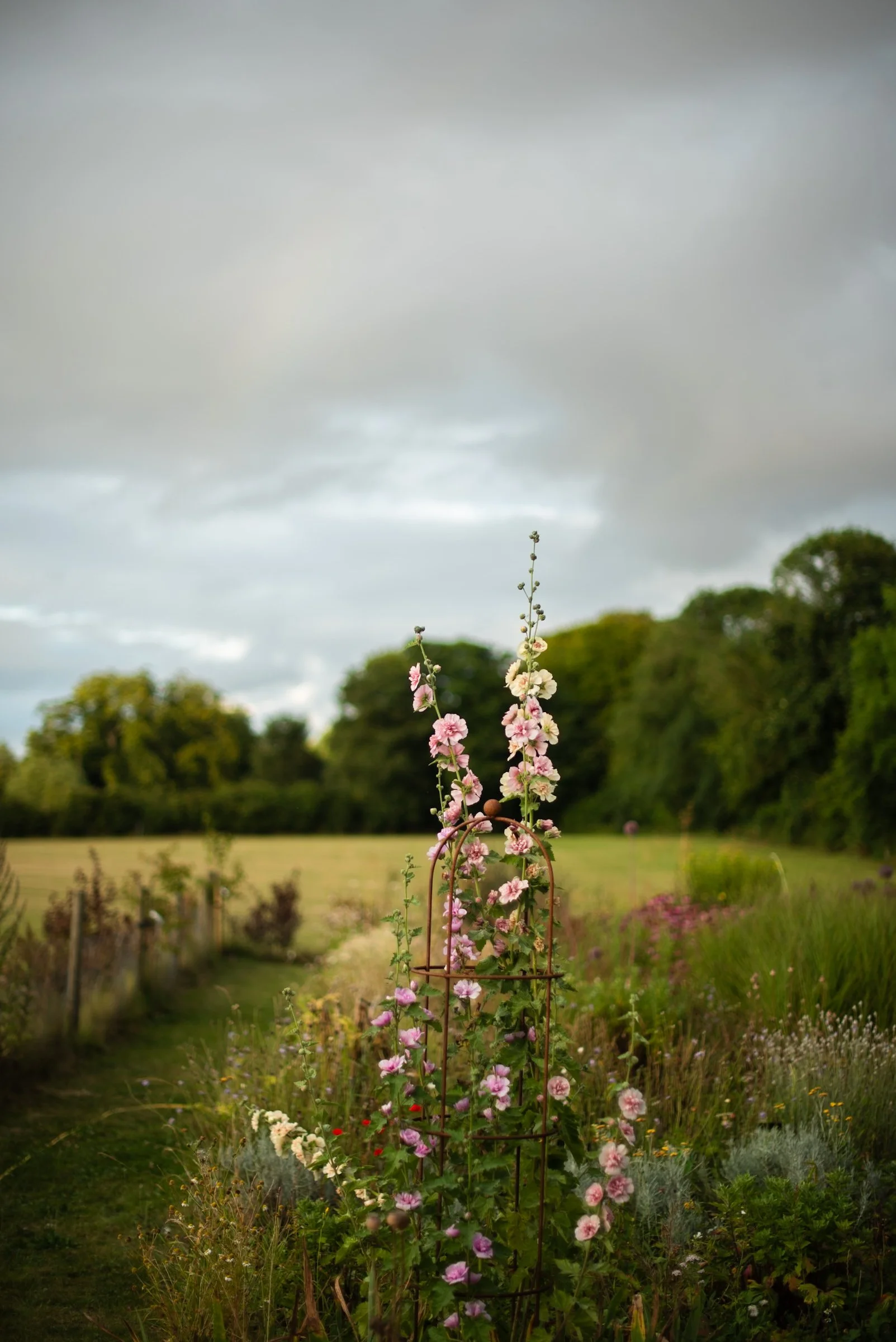
The Alcalthaea are a cross between a hollyhock and a mallow; they have greater rust resistance (allegedly) than a hollyhock and flower right through from mid-summer to the first frost. Very tall stems bear bowl-shaped flowers sprinkled with bronze stamens. We sear them immediately once cut for around 40 seconds in just-boiled water and find that they last extremely well in a vase.
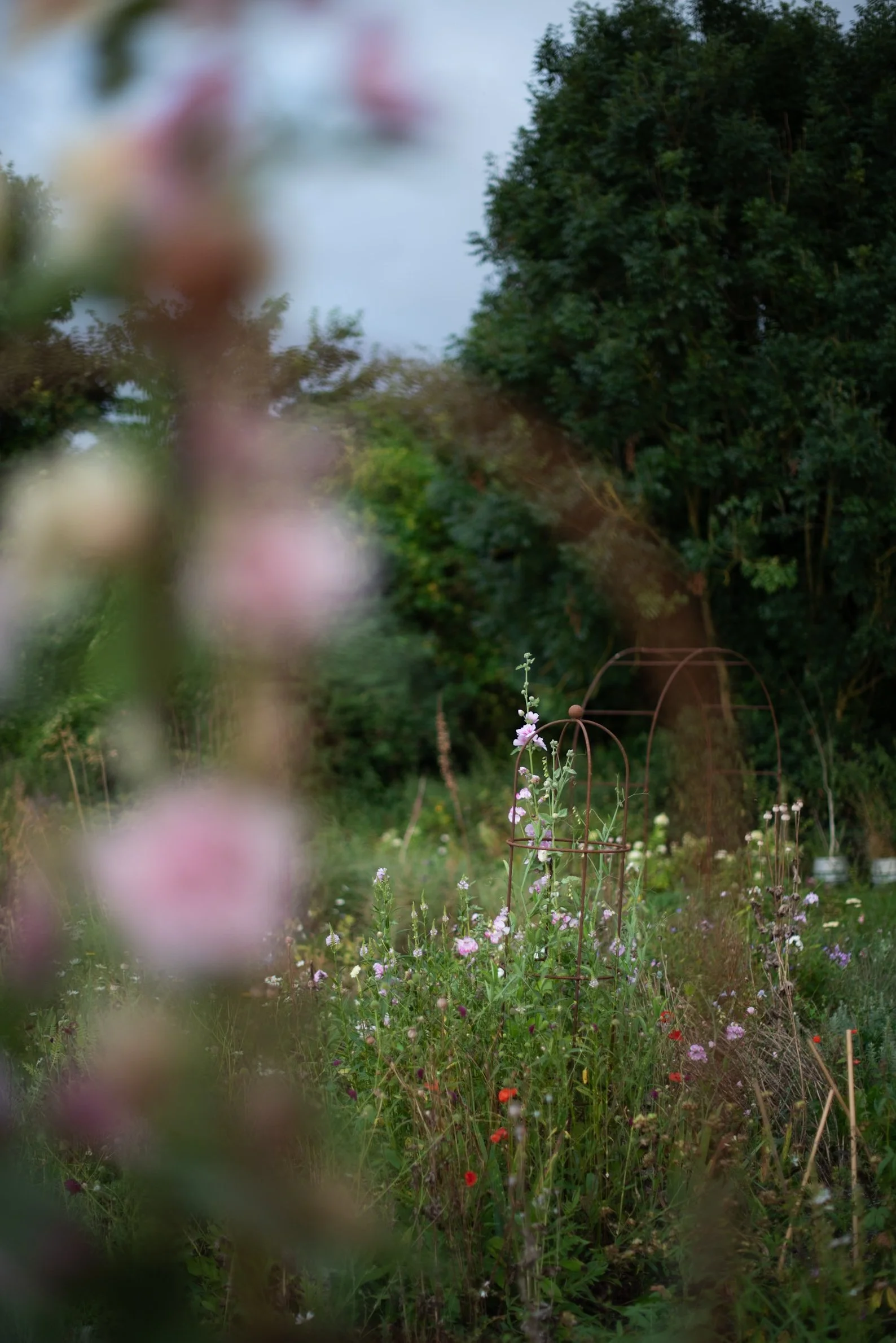
There comes a time in late summer when it is necessary to slow down and reassess. The heady first flushes are past - I’m thinking of May and June when the abundant supply of flowers is still a novelty after a long winter. There have been many harvests: convivial harvests of chatter and gossip, hot harvests scented by dust, sweat and suncream, not enough wet harvests. We are now week seventeen in a thirty week season. Thousands of stems have been cut and conditioned and ferried from here to there. Dozens of cutting lists both hasty and studied, some vague sketches, some precise plans. Hundreds of buckets scrubbed and stacked, suds dripping. Rinse and repeat.
Do you ever stop and wonder at where you are and how you got here? There’s rarely time for introspection, life is so very busy, but occasionally I find it necessary to zoom way back. A moment of self-indulgence, but worth it for the perspective that bigger picture can give us. How very small we are, how brief life is. What do we want from the rest of it?
I never imagined I’d be working with flowers. It’s a peculiar thing - harvesting a natural product for purely ornamental purposes. We work with the plants too, of course - and there in the garden, still connected, still living, flowers make sense. They are there to ensure the survival of their species. But the arrangement of cut flowers? Well, I suppose it isn’t so different to basket weaving, making silk, or hand-dipped candles, or sculpting clay. Except that those things have a practical use and a lasting value and arrangements of flowers, once consumed by the eyes, have none. Ephemerally decorative, we can’t own them, long-term. They pass through our hands and our homes so fleetingly. They barely touch us. And yet.
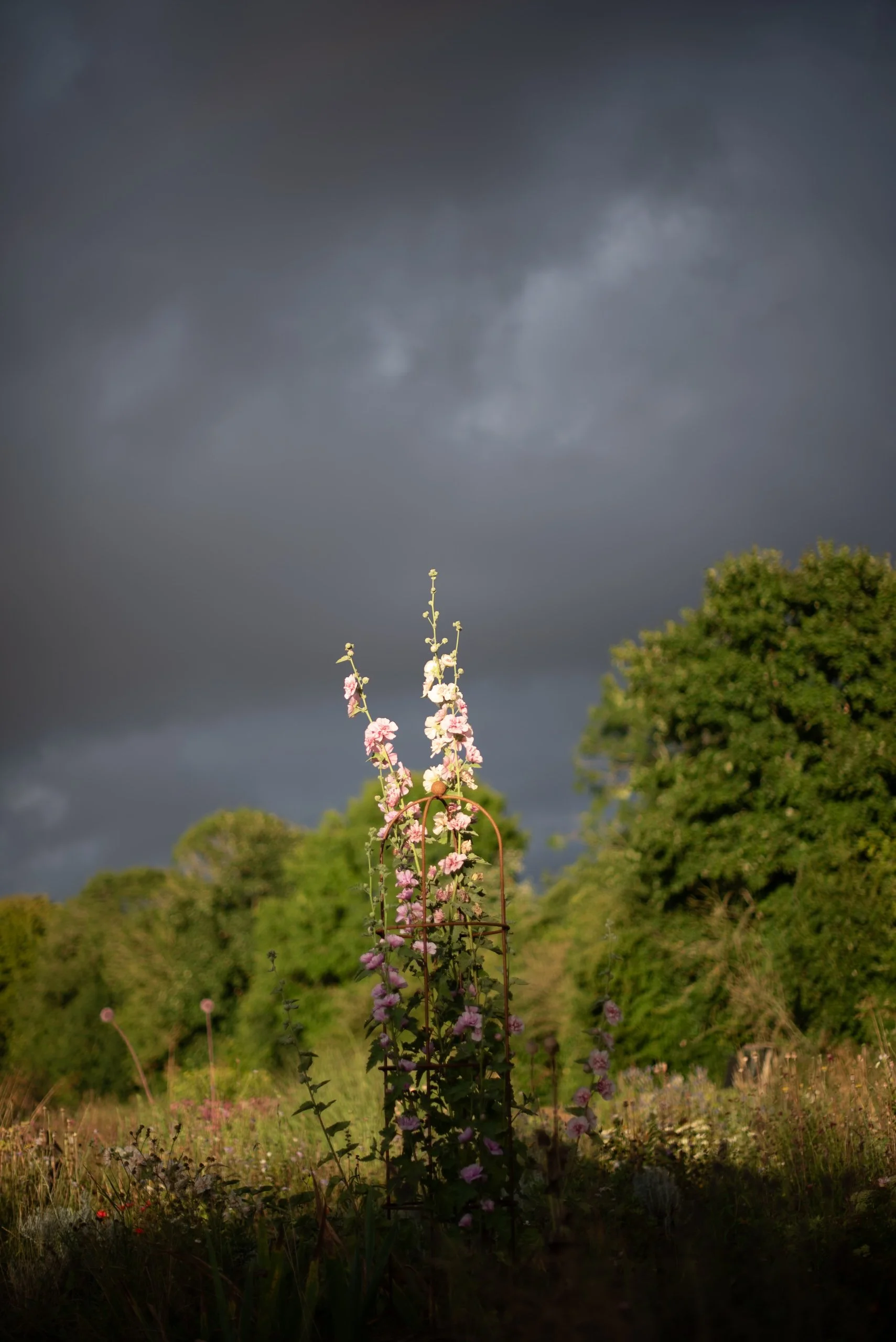
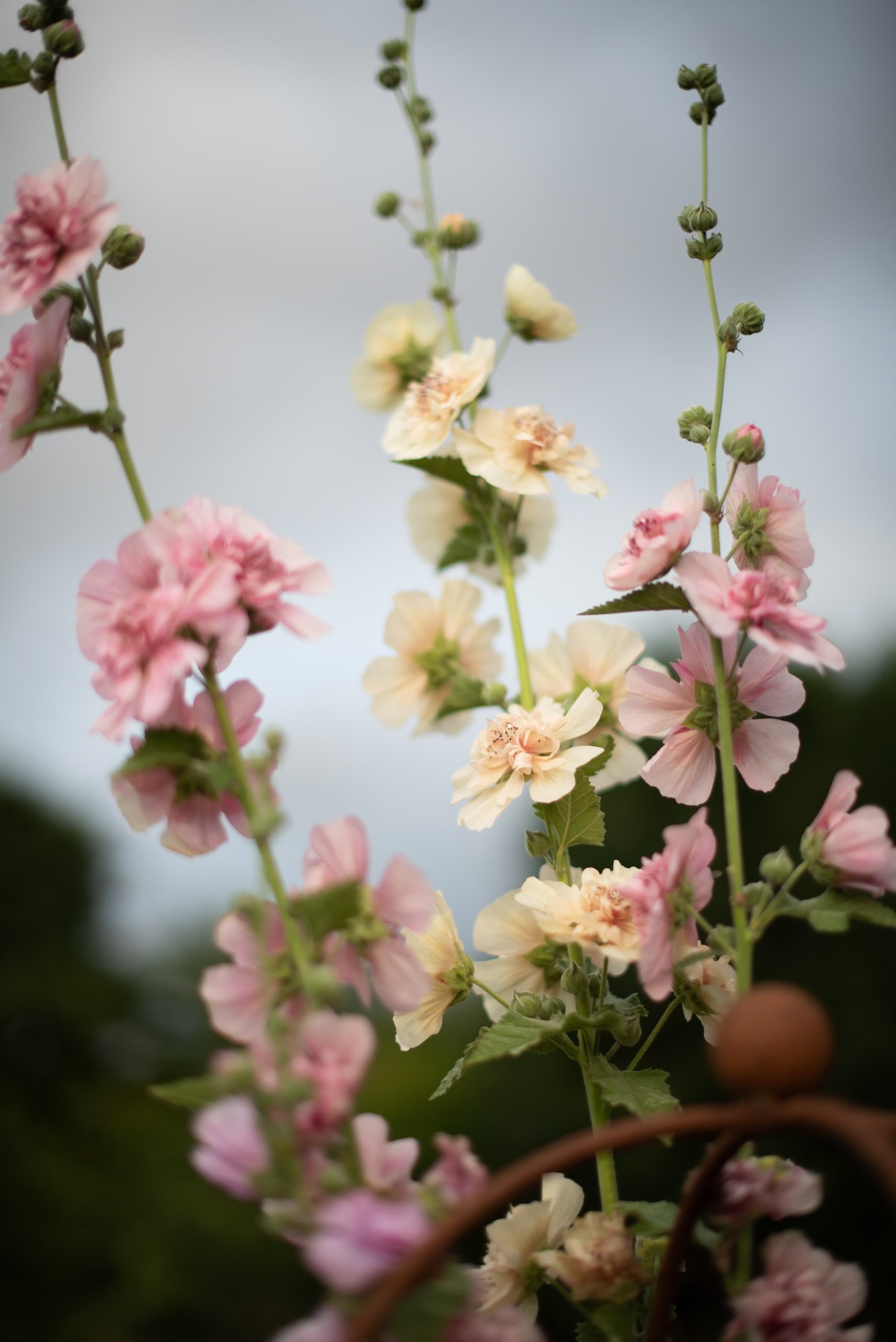
A few years ago Jess planted some Alcalthaea suffrutescens. Shrubby hollyhock is the common name, in fact a cross of Alcea rosea (hollyhock) and Althaea officinalis (wild marshmallow) that was bred in 1953 in Hungary by Professor Zoltan Kovats who wanted to breed a hollyhock that would be resistant to the rust (Puccinia malvacearum) that so often corrupts them.
They grew (and grew and grew) and we gave them stakes and support against the wind that whips across the open field. From their towering, slender spires unfurled grey-green leaves and rosettes of bowl-shaped flowers with a double centre. As a flower arranger, from a design perspective, their architectural merits were immediately obvious - the stature useful for large-scale work, the colours gorgeously subtle with petals that have a slight sheen, like a pearl. But there isn’t a way to describe these flowers to match the way you feel when you look at them. Every year about this time they arrive just when I need them to remind me.
Flowers are language, poetry, a conduit for human connection. They have a rare gift of enabling us to see the world through the eyes of a child, to ‘re-see’ that it is magical and miraculous and that our hearts’ desires are still possible if only we work towards them. Perhaps in their brevity there is a reminder of our own mortality, an invitation to grasp this very moment and to make those we love know it.
So, when people ask me, or even occasionally when - burnt-out, questioning, late summer - I ask myself: what is the purpose that flowers serve? The answer remains the same.
Flowers help us to live.
RETURN TO RECIPES
DAHLIA, PHLOX, OATS, APPLES
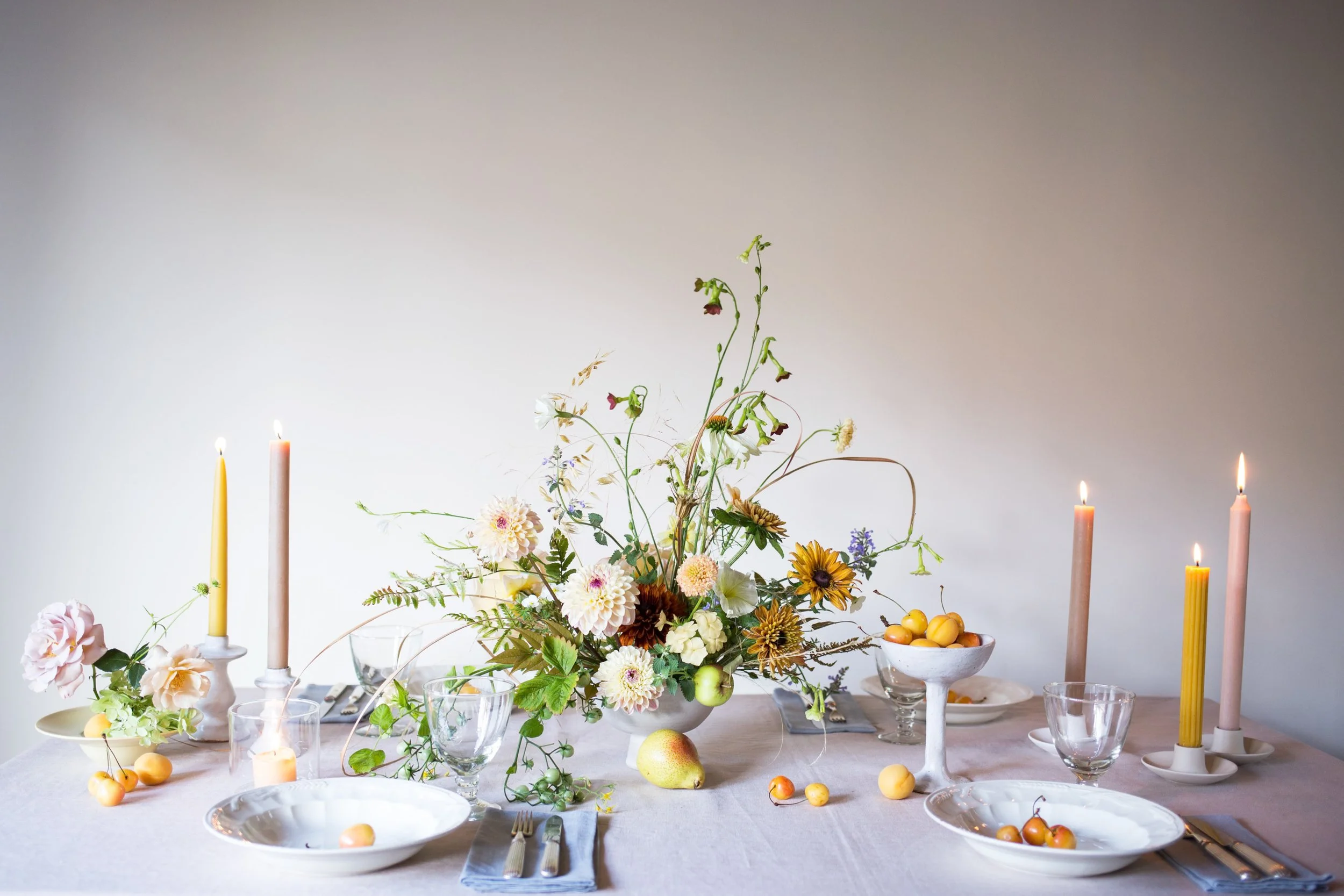
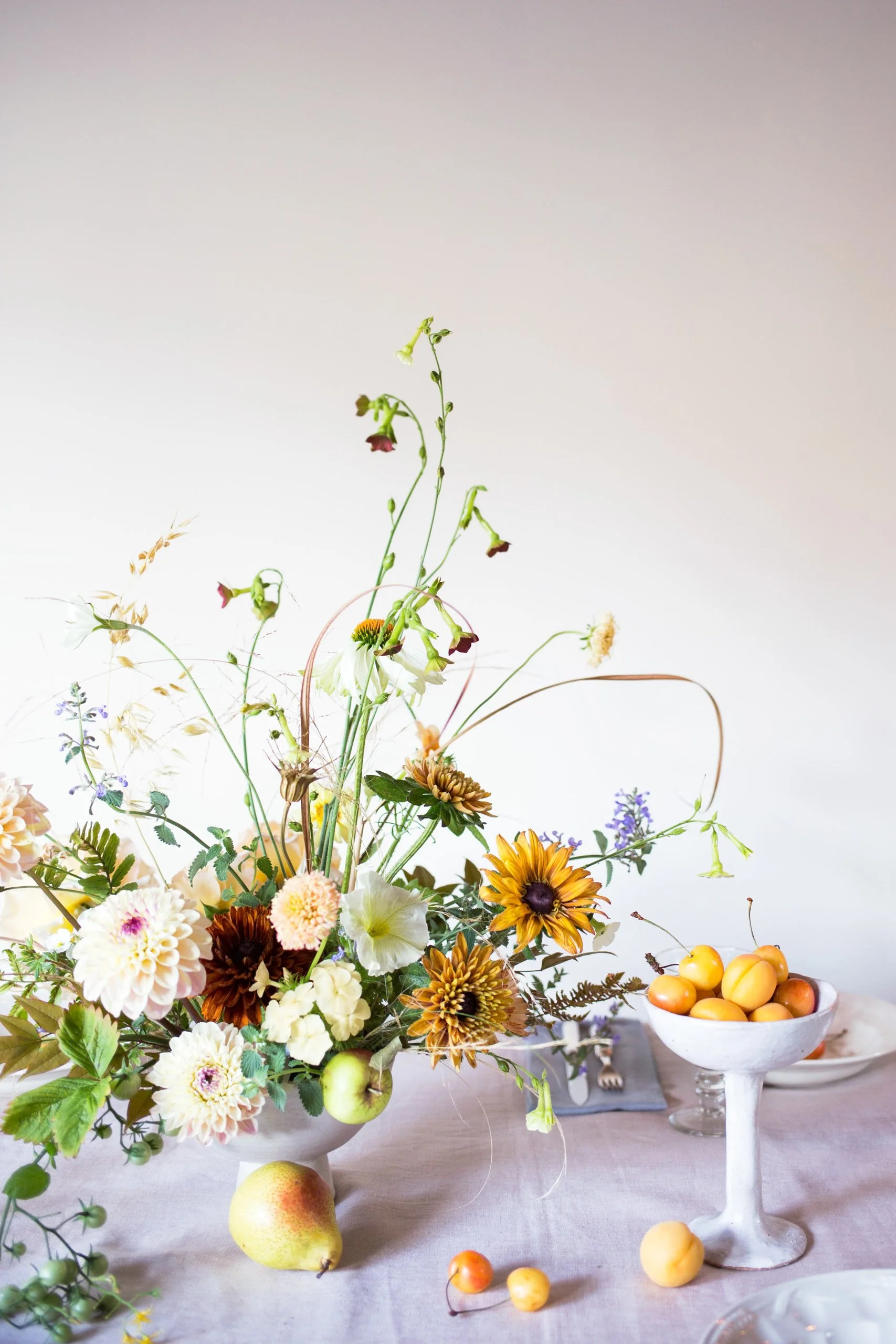
I could use ‘nose-to-tail’ eating as a metaphor to describe how we think about our own produce, and how we use our garden too, and perhaps that’s because it’s a concept people are familiar with from the food world. When it comes to the plants, we look at the whole, not just the flower.
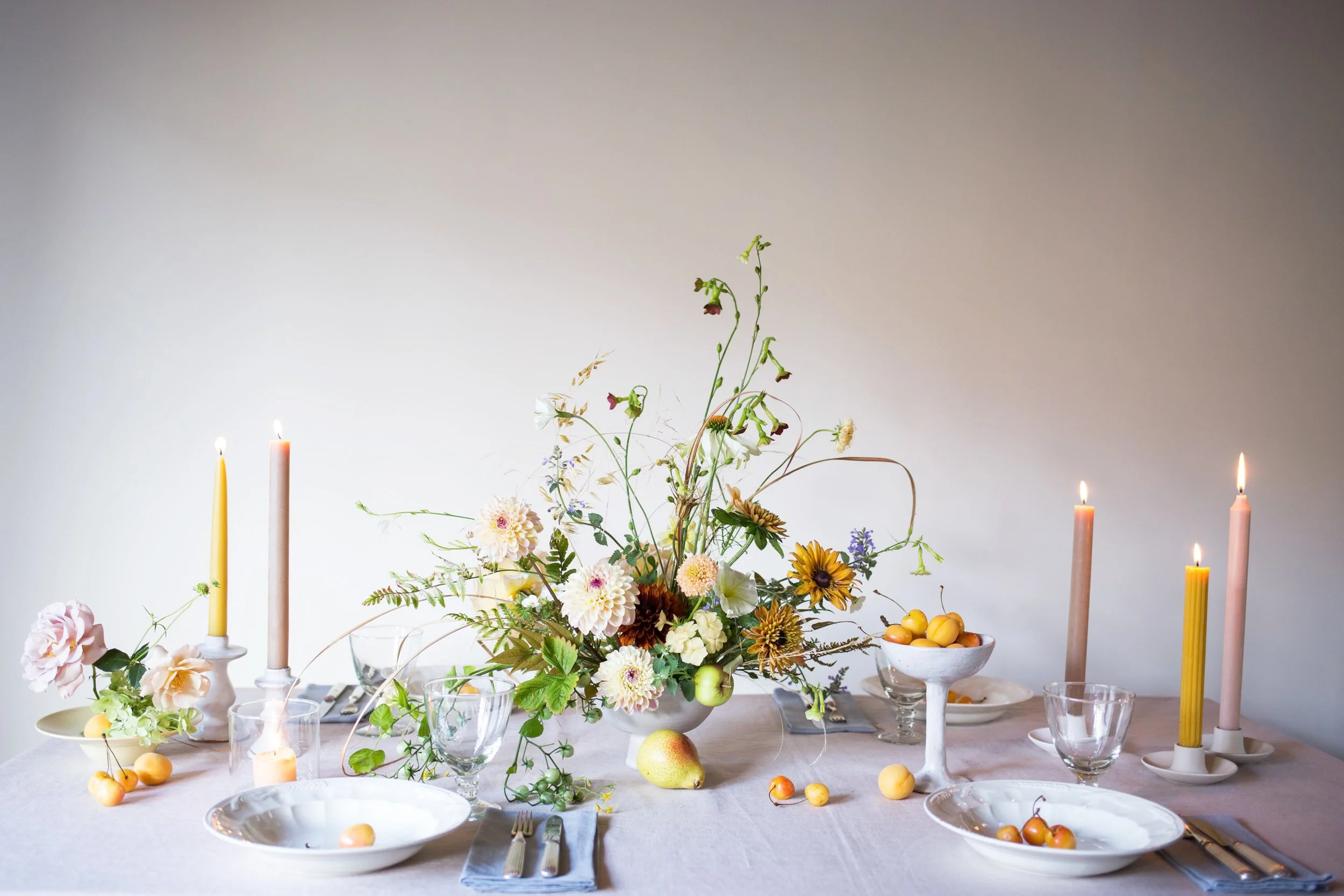
Apple (Malus)
Black-eyed Susan (Rudbeckia hirta ‘Indian Summer’)
Catmint (Nepeta faassenii 'Walker's Low')
Coneflower (Echinacea purpurea ‘White Swan’)
Dahlia (Dahlia ‘Wine-eyed Jill’)
Garden phlox (Phlox drummondii ‘Isabellina’)
Love-in-a-mist (Nigella damascena ‘Miss Jekyll’)
Oats (Avena sativa)
Petunia (Petunia ‘Easy Wave Yellow’)
Sacred bamboo (Nandina domestica)
Strawberry (Fragaria vesca)
Sweet scabious (Scabiosa atropurpurea ‘Fata Morgana’)
Tobacco plant (Nicotiana langsdorffii 'Bronze Queen’)
Tomato (Solanum ‘Sungold’)
Wood fern (Dryopteris)
Footed bowl designed by Aesme Studio
Small scrunch of chicken wire
AUGUST
Jess and I get a lot of our inspiration from restaurants, particularly those that put local, seasonal produce at the heart of their menus. St. JOHN, Sally Clarke’s, Chez Panisse of course. We have been ‘strictly seasonal’ now at Aesme for several years, but we weren’t in the beginning. I think having that connection with the seasons, with what is naturally growing, flowering, fruiting, is - and always was - our raison d’etre as a creative business. But at first seasonality felt like such a loaded issue (I’m talking real seasonality, not the way the word is bandied about as a marketing term with only the loosest attachment to the truth); for many years we shied away from using language that we felt would be off-putting to potential customers. We needed bread and butter jobs, and desperately needed experience. We didn’t have the confidence to say ‘no’ and perhaps that was because we hadn’t yet fully realised our ‘why’ (more on this another time!).
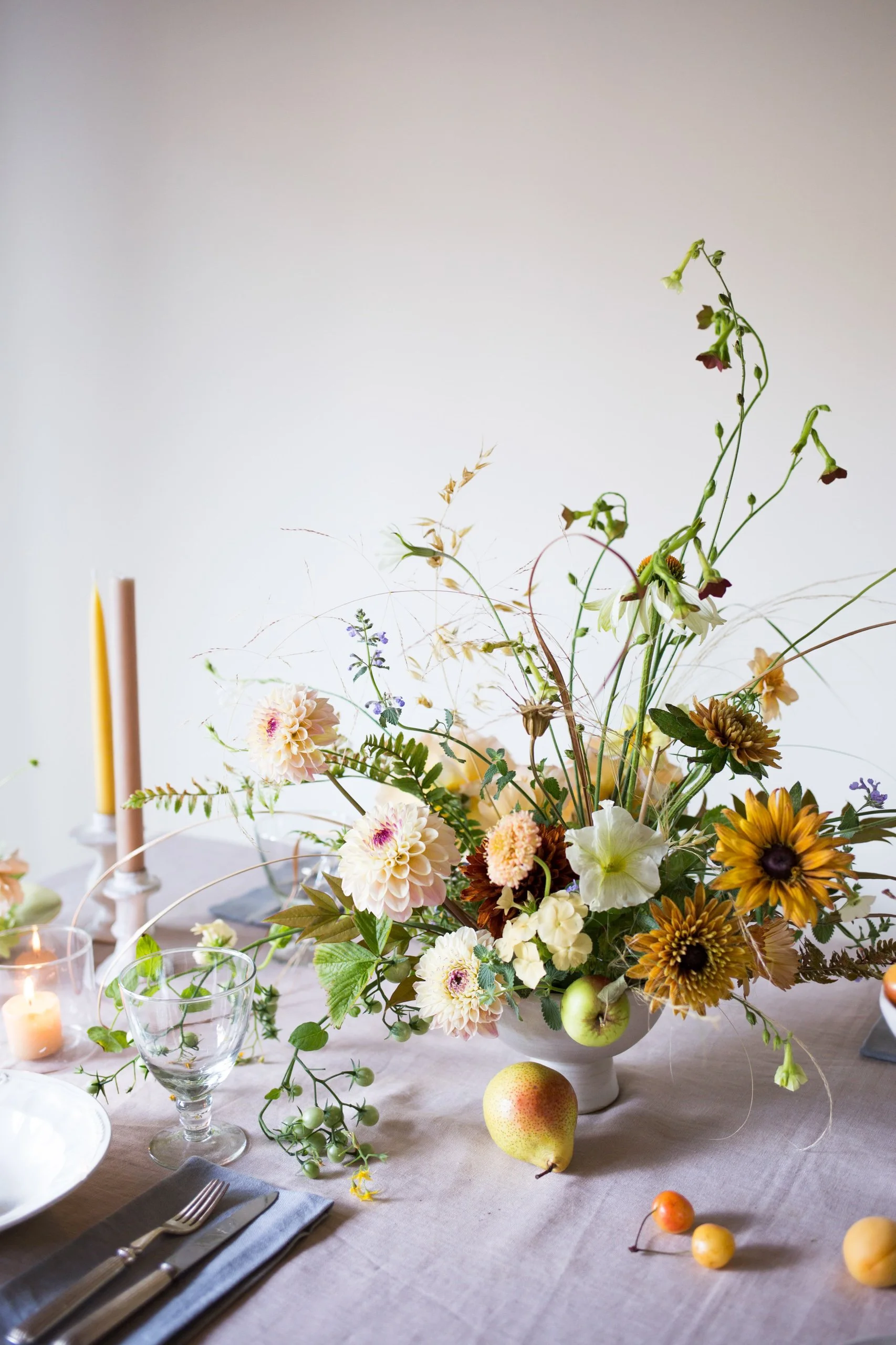
I could use ‘nose-to-tail’ eating as a metaphor to describe how we think about our own produce, and how we use our garden too, and perhaps that’s because it’s a concept people are familiar with from the food world. When it comes to the plants, we look at the whole, not just the flower. And we look at the whole season - from buds and shoots through blooms, fruits, pods, skeletons. We try to avoid wastage as much as possible. When I’m cutting stems I’ll always amass a pile of off-cuts - leafy snippets, side stems. Instead of sweeping them into the green waste, they get used as filler or for last-minute tweaks. We compost - a circular economy. And we use weeds, from the garden and locally foraged - brambles, wild roses, dead nettle, celandine, campion. Materials that are drying and going to seed - blades of grasses, drying ferns, nigella seedpods. Anything useful can be beautiful and anything beautiful can be useful.
RETURN TO RECIPES
TOBACCO PLANT, MUGWORT, APPLE
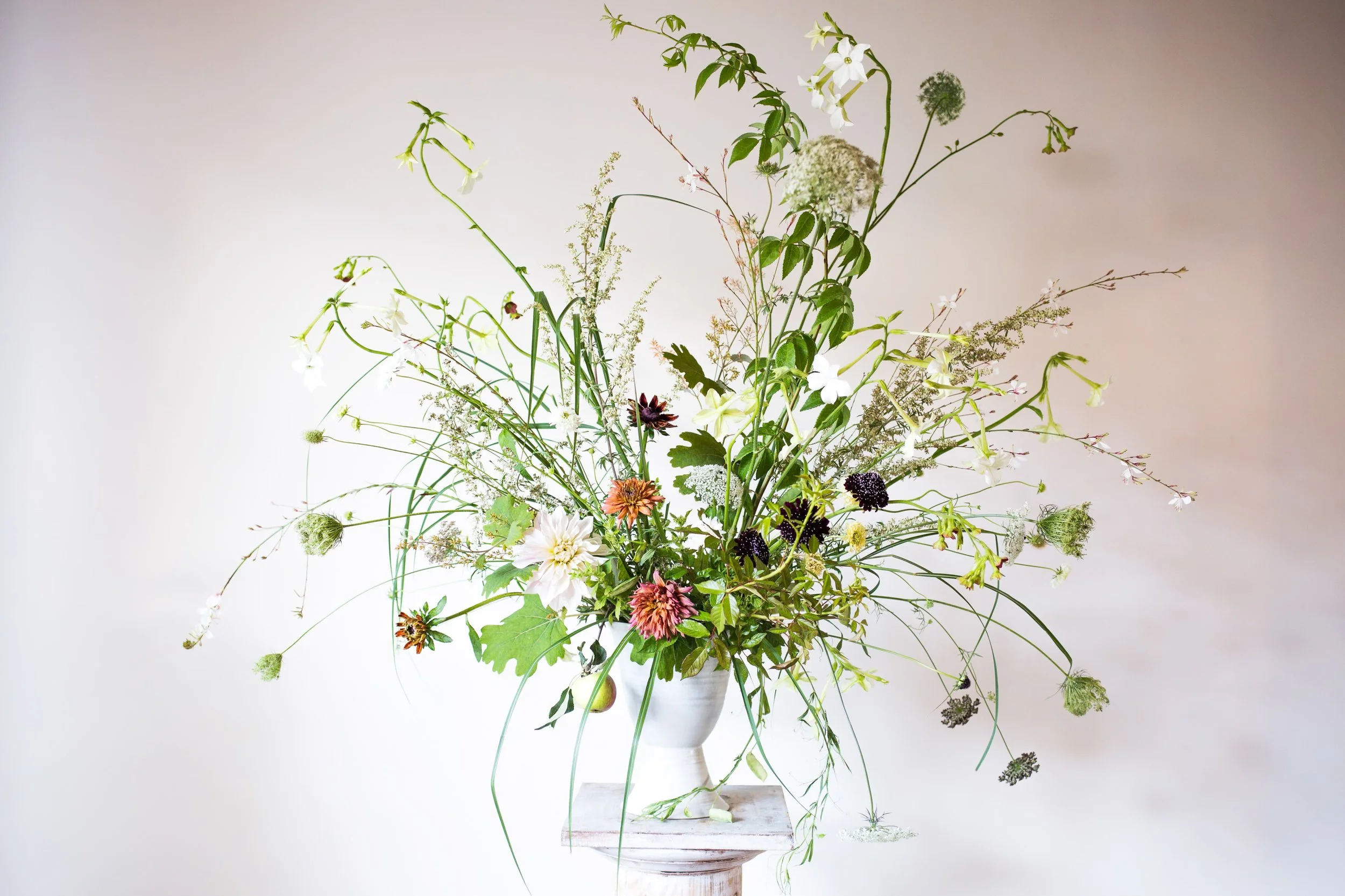
The unexpectedly entangled moments and haphazard appearances of plants is where the magic creeps in. In this arrangement I wanted to capture this feeling of high summer when the garden is at its most ravishing - and most untamed! Cont…
Apple (Malus)
Bee blossom (Oenothera lindheimeri ‘Whirling butterflies’)
Black-eyed Susan (Rudbeckia hirta ‘Sherry Brandy’)
Dahlia (Dahlia ‘Cafe au Lait’)
Mugwort (Artemisia vulgaris)
Pampas (Cortaderia sellonana 'Pampas Plume Pink')
Plume poppy (Macleaya cordata)
Rose (Rosa ‘Lykkefund’)
Sweet scabious (Scabiosa atropurpurea ‘Black Knight’ & ‘Snowmaiden’)
Tobacco plant (Nicotiana alata ‘Grandiflora’ & Nicotiana langsdorffii 'Bronze Queen’)
Wild carrot (Daucus carota)
Large, waisted vase designed by Aesme Studio
Kenzan
Small scrunch of chicken wire
AUGUST
We often refer to our style of arranging as ‘garden-inspired’ and the gardens that we like the most tend to have naturalistic planting schemes, achieving a romantic, dishevelled quality as a result. Carefully, intelligently planted and maintained, they are also allowed to go a little wild around the edges, for ‘Mother Nature’ to show her face and encroach in some places, rather than being completely tamed. The unexpectedly entangled moments and haphazard appearances of plants is where the magic creeps in. In this arrangement I wanted to capture this feeling of high summer when the garden is at its most ravishing - and most untamed! The mugwort is a weed that crops up here and there but we find her both beautiful and useful. The blades of pampas grass are added in a fan formation which adds to the textural, whiskery effect. Apples, always!