
PLUME POPPY, CANARY BIRD
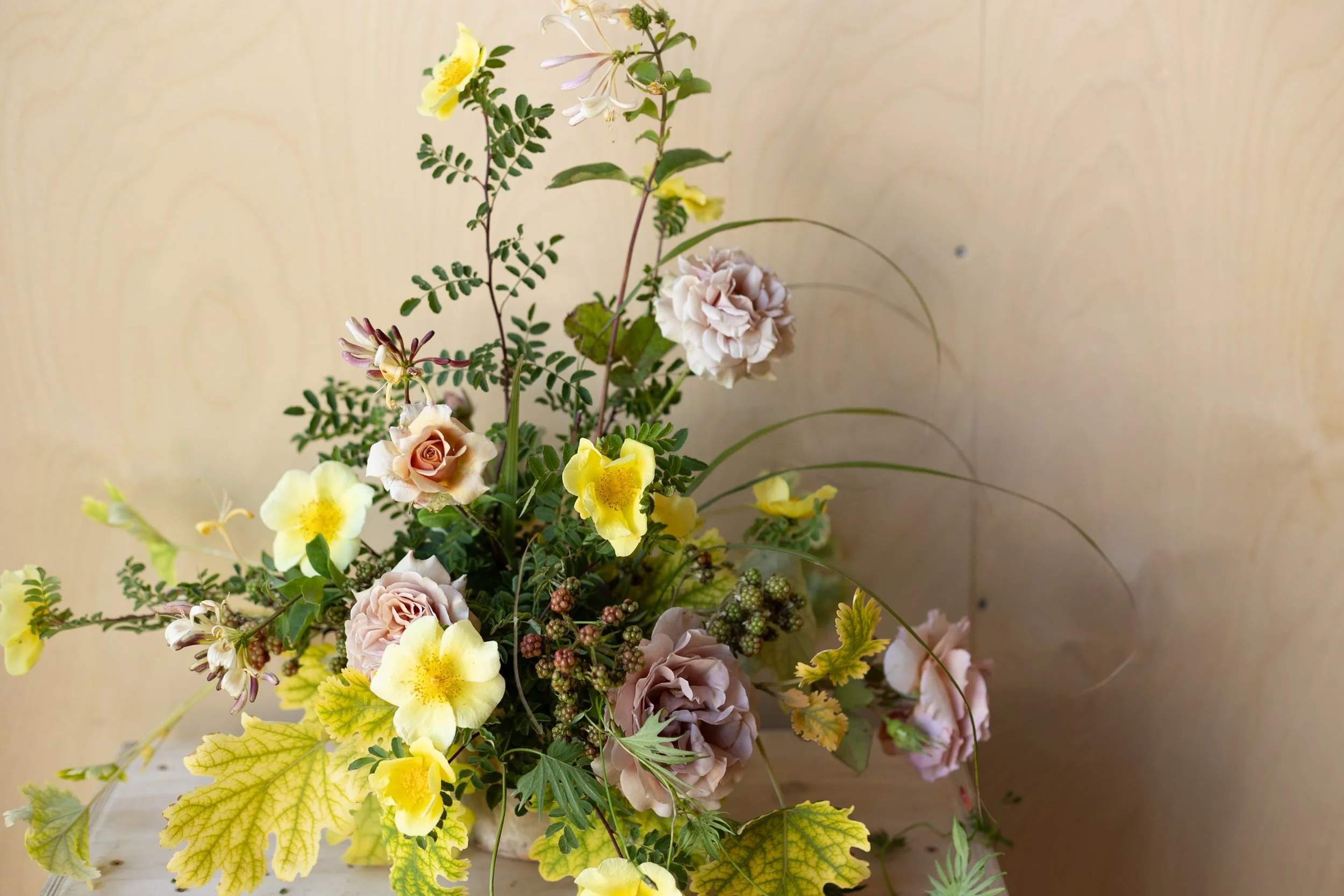
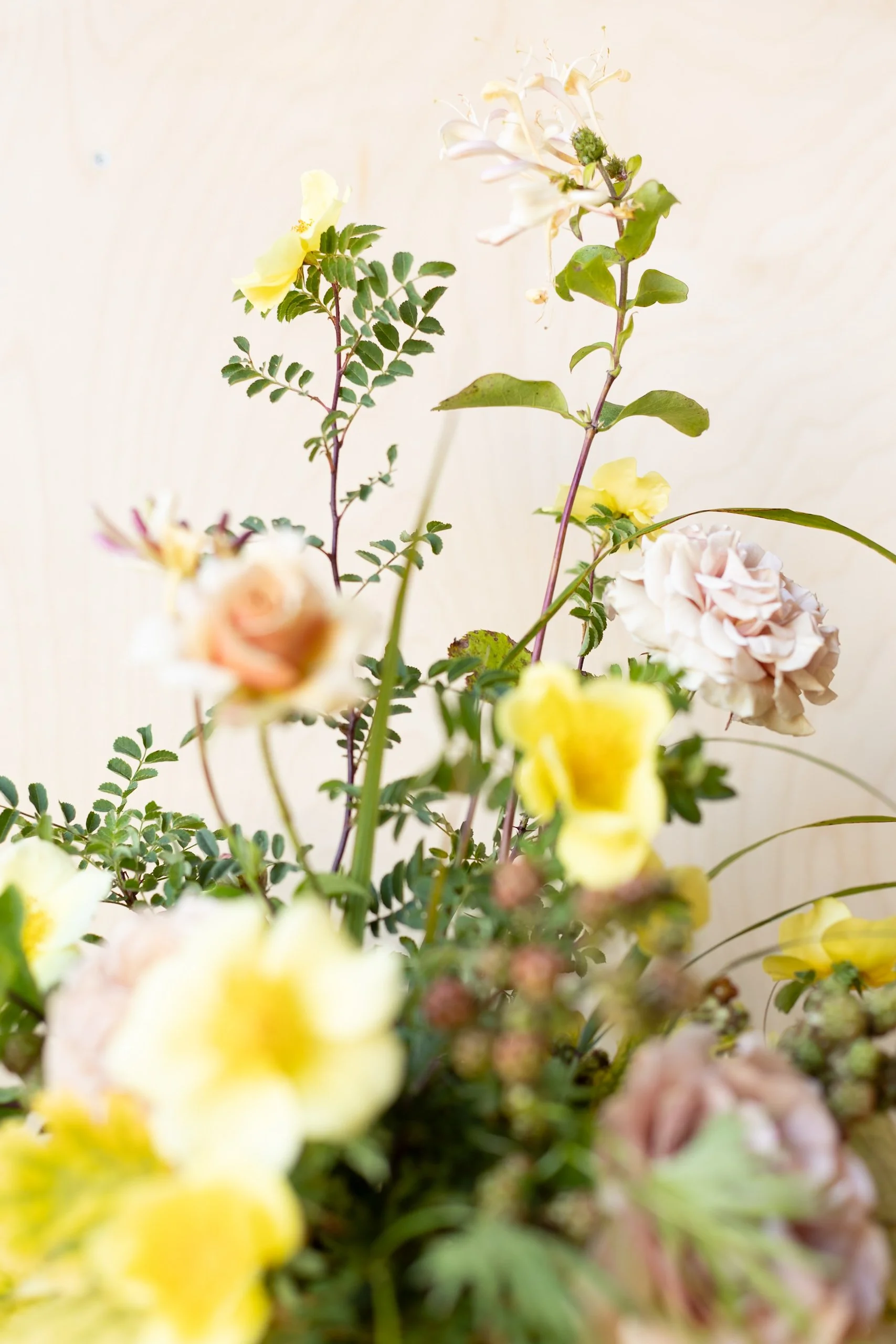
Blackberry (Rubus fruticosus)
Honeysuckle (Lonicera periclymenum)
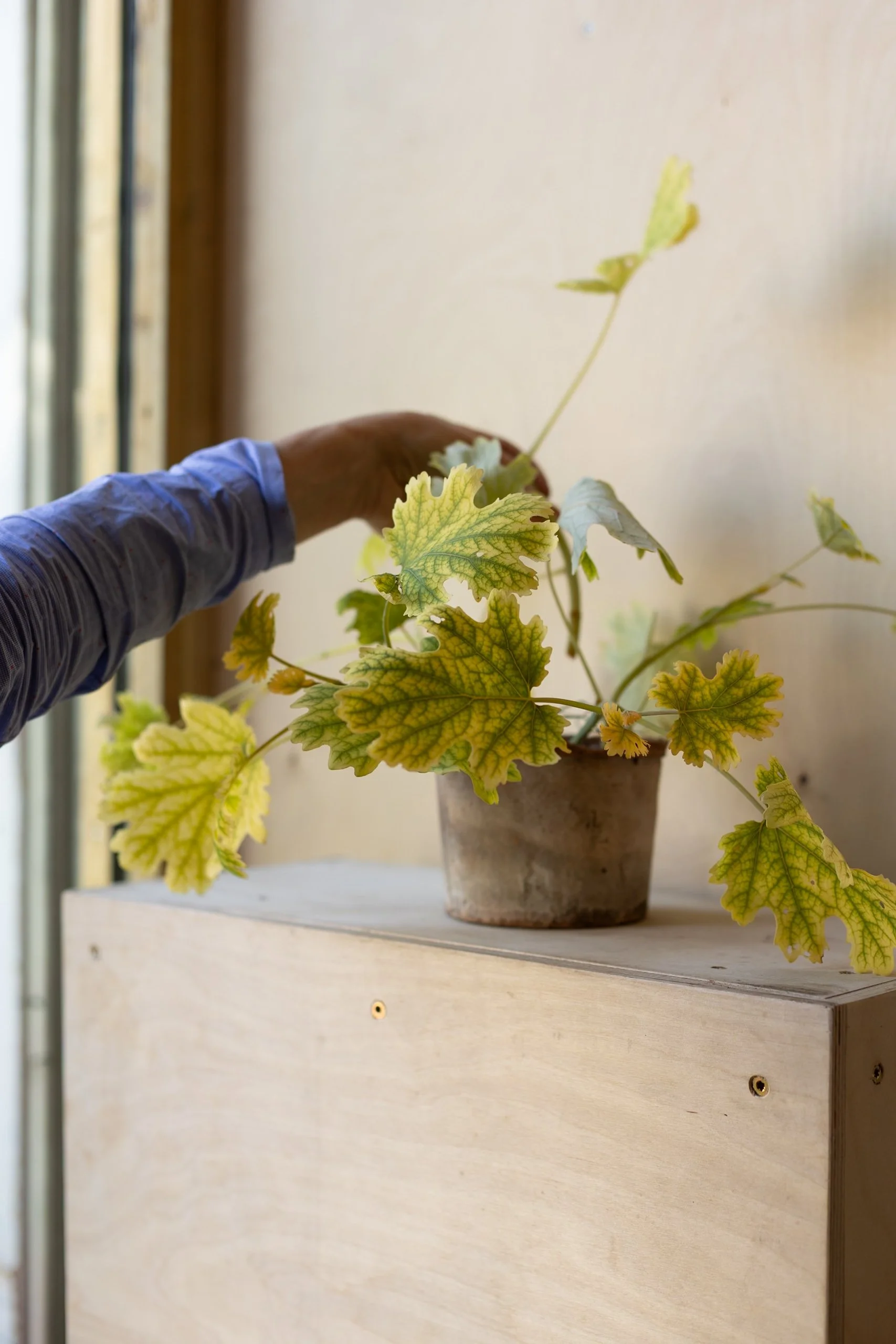
Plume poppy (Macleaya cordata)
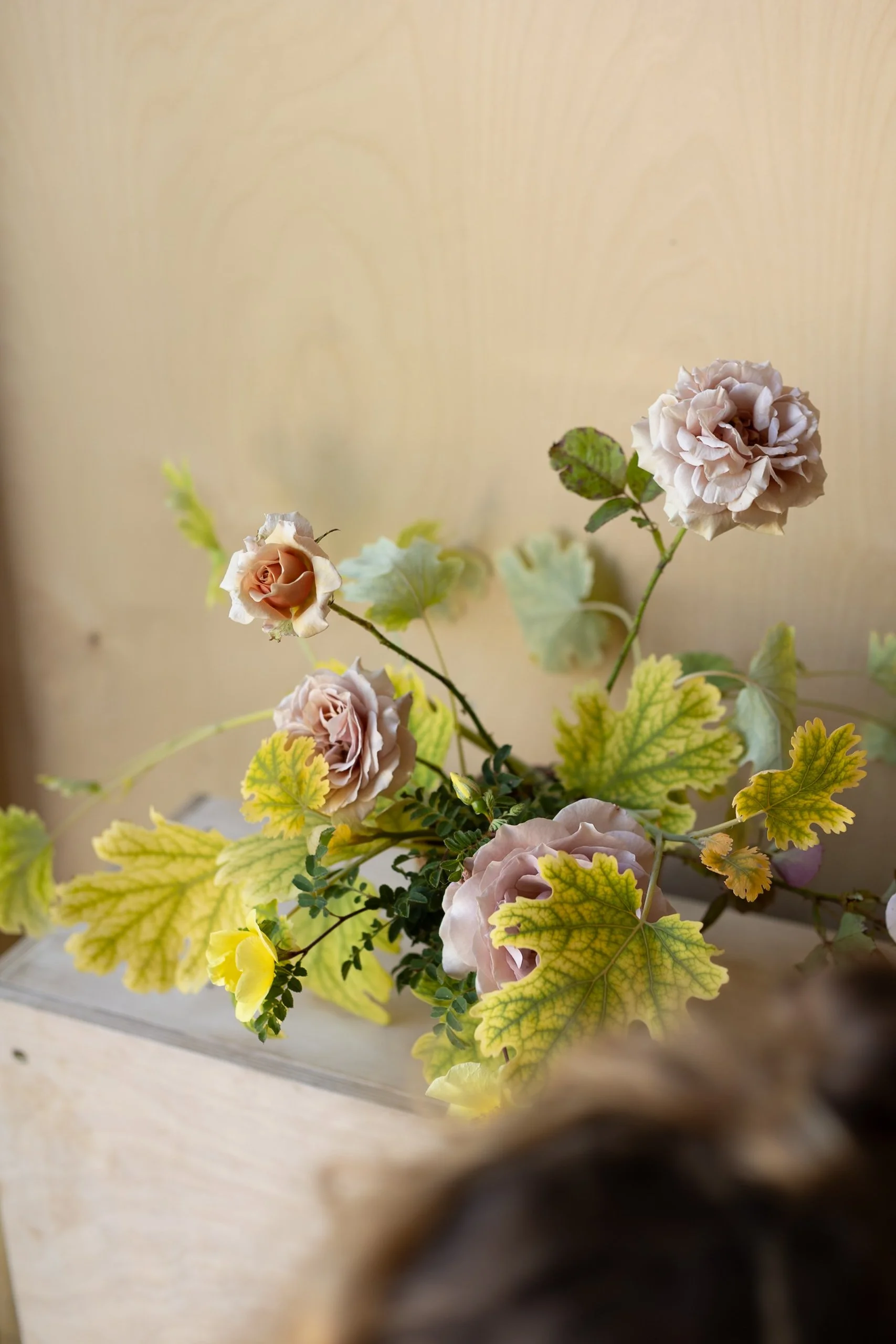
Rose (Rosa ‘Canary Bird’ & ‘Mokarosa’ & ‘Julia’)
Terracotta bowl
Kenzan
Small scrunch of chicken wire
JUNE
The garden is a vaguely alcoholic blur of pastels now, fuzzy and unrefined. This is her spell as an impressionist painting, broken brushstrokes of colour in quick daubs, the backdrop a shifting sea of windblown green. With daily surges of growth the lines become indistinct - paths erased by the swell of foliage, beds smeared together in the converging haze of flowers.
Berries, too. And in particular the humble blackberry, Rubus fruticosus. Of all botanical ingredients this indefatigable plant, to me at least, is teetering on the edge of perfection. You might ask why, and I’ll be glad to tell you. There is a whole host of reasons, not least of which is blackberry crumble with custard in early autumn on one of the first evenings when there is enough of a nip in the air to light the fire.
Sure, there is the aesthetic pleasure of the flowers - white and the palest pink, which unfold from silvery buds in early summer and look a little like a tiny, creased version of the wild dog rose (Rosa canina). The resemblance makes sense, since the Rubus genus is a member of the rose family (Rosaceae). The glossy berries gradually darken, from a vibrant lime green to khaki, through gold and dusky red (at this time of the year) to the deepest purple-black. The leaves are exquisite, arranged alternately along curving, thorned canes, paler to the underside, divided into multiple leaflets and often tinted maroon, pink or lime. There is its usefulness to consider, too. A natural barbed wire, it has been utilised for centuries as a way to delineate boundary lines. If you can abide the thorns it serves the flower arranger all year round, from bud to blossom to fruit and on into the winter months - I love a desiccated blackberry bramble early in the year, with the gilded autumn fruits still in evidence.
Then there is its ubiquity - festooning our native hedgerows up and down the country. And the admirable spirit of persistence and tenacity that makes it almost unconquerable. I rate a plant that has pluck and with the bramble you just know that however hard you try, it will always outwit you, will always creep back around when your back is turned. Rubus is steeped in ancient folklore, magic and superstition - valued for its protective, preventative, binding and healing properties. The blackberry briar was considered sacred by the druids to protect the faery realm. In European folk medicine, children would be passed through arching gaps in the bushes to cure them of disease, the dried leaves burned and scattered around a property to shield from bad luck, and blackberry bushes planted on graves to keep the dead in and the devil out. Bramble hoops strung from the door were said to ward away evil, particularly in the darkest months of the year when strange spirits walk the land more so than in summertime. Hung above the bed they supposedly protect against nightmarish dreams and ensnare negative energies. In witchcraft the supple canes were used for binding spells. I’m generally sceptical of metaphysical woo-woo, but it does undoubtedly add to the romance. I do, however, firmly believe in a bowl of blackberries, freshly picked and just washed, as a token of friendship, and of love.
For there is, of course, the nostalgia factor… The delight of foraging for berries as a child, picking the ripest fruit with chubby fingers and filling baskets to carry home through leafy tunnels and knee-high grass. As little girls Jess and I loved the stories of Brambly Hedge by Jill Barklem and we’ve been rediscovering them recently with the children. Perhaps some of you have read them too? In the ‘Autumn Story’ you might recall the mice harvesting blackberries before the autumn rain sets in and Primrose finding herself lost in the Chestnut Woods as dark begins to fall… When my son was eight months old I strapped him to my chest and took him blackberry picking for the first time. Approaching the bushes he’d urgently kick his little legs then lean forward and gently take the fruit in his mouth from my fingers, greedily gorging on berries, hands and chin stained with the wine-coloured juice. It’s one of my happiest memories, the weight and press of his body on my chest, small but already strong, the scent of the back of his neck where his flaxen hair curled upward.
The soft fruit flowers of the blackberry are highly fragrant, frequented by many a pollinator including the honey bee, butterflies, hoverflies and bumblebees that linger lazily over the rich nectar and pollen. The berries - that perfect balance of sweet and tart - have been eaten by humans for thousands of years. Mavis loves them. As do the birds. As do moles, mice, foxes (and, apparently, racoons, though we don’t see many of those in these parts). The stewed fruit can be used as fillings for pies, cordials, syrups and jams; fellow whisky drinkers tell me that bramble whisky is delicious; I’d like to try it! And not just the fruit - the foliage is consumable too. There’s blackberry leaf tea, blackberry leaf sorbet, even blackberry leaf tobacco, of all things… And here, the inexhaustive list of Rubus attributes dwindles on into the medicinal and nutritional… High in vitamin C. Loaded with nutrients and antioxidants. Reduces inflammation. Improves blood sugar levels. Aids digestion. A good source of fibre.
Well, you did ask! I’m sure there’s a great many more but I’ll leave it there for now, accompanied by coffee roses and fragrant curls of common honeysuckle.