
CINQUEFOIL & FEATHERTOP

Blackberry (Rubus)
Cranesbill (Geranium ‘Walter’s Gift’)
Feathertops (Pennisetum villosum)
Sacred bamboo (Nandina domestica)
Shrubby cinquefoil (Potentilla fruiticosa ‘Primrose Beauty’)
Shrubby hollyhock (Alcalthaea suffrutescens 'Parkallee' & ‘Parkrondell’)
Strawberry (Fragaria × ananassa)
Small vase in a tenmoku glaze
AUGUST
This is one of our favourite vases, from the Norfolk based pottery ‘Made in Cley’ (shop till you drop!) The glaze is called ‘tenmoku’ and was likely first introduced to the West from Japan by Shoji Hamada when he set up the Leach Pottery with Bernard Leach in 1920s St Ives. The name translates as ‘heaven’s eye’ referring to the Tianmu mountain in China. It was here that Japanese monks first discovered the glaze, taking the recipe back home with them; it is believed to have originated in China during the Song Dynasty where it was used to decorate bowls for use during tea ceremonies. Tenmoku is a reduction fired stoneware glaze containing iron oxide that fires to a high-gloss somewhere between a rich maroon, dark chocolate and almost-black. This vase can look glittery in some lights - a result of the minute iron silicate crystals that form in the glaze during the firing process. I love the ‘breaking points’ where the glaze has thinned to a rust colour over the ridges.
The Alcalthaea are a cross between a hollyhock and a mallow; they have greater rust resistance (allegedly) than a hollyhock and flower right through from mid-summer to the first frost. Very tall stems bear bowl-shaped flowers sprinkled with bronze stamens. We sear them immediately once cut for around 40 seconds in just-boiled water and find that they last extremely well in a vase.
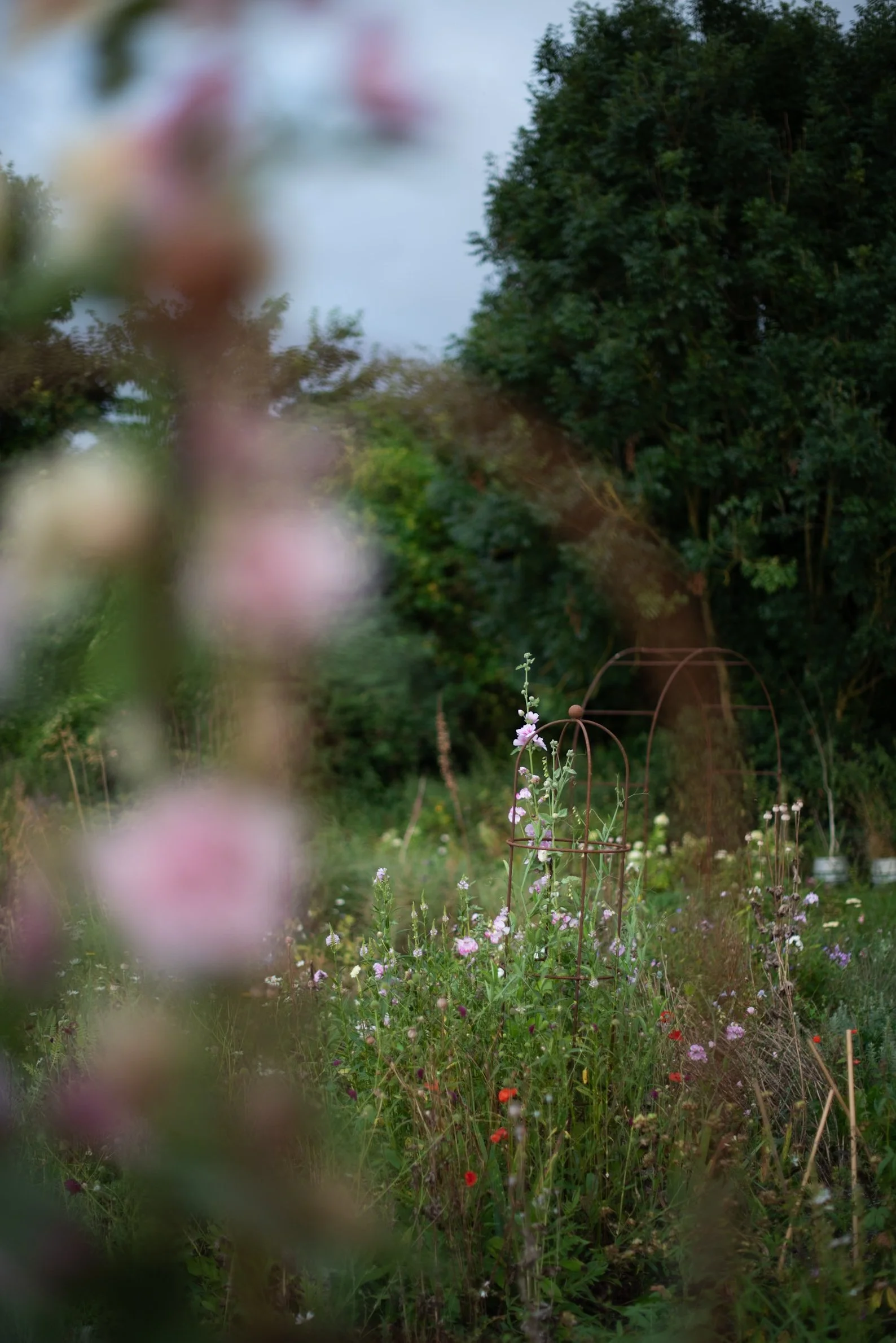
There comes a time in late summer when it is necessary to slow down and reassess. The heady first flushes are past - I’m thinking of May and June when the abundant supply of flowers is still a novelty after a long winter. There have been many harvests: convivial harvests of chatter and gossip, hot harvests scented by dust, sweat and suncream, not enough wet harvests. We are now week seventeen in a thirty week season. Thousands of stems have been cut and conditioned and ferried from here to there. Dozens of cutting lists both hasty and studied, some vague sketches, some precise plans. Hundreds of buckets scrubbed and stacked, suds dripping. Rinse and repeat.
Do you ever stop and wonder at where you are and how you got here? There’s rarely time for introspection, life is so very busy, but occasionally I find it necessary to zoom way back. A moment of self-indulgence, but worth it for the perspective that bigger picture can give us. How very small we are, how brief life is. What do we want from the rest of it?
I never imagined I’d be working with flowers. It’s a peculiar thing - harvesting a natural product for purely ornamental purposes. We work with the plants too, of course - and there in the garden, still connected, still living, flowers make sense. They are there to ensure the survival of their species. But the arrangement of cut flowers? Well, I suppose it isn’t so different to basket weaving, making silk, or hand-dipped candles, or sculpting clay. Except that those things have a practical use and a lasting value and arrangements of flowers, once consumed by the eyes, have none. Ephemerally decorative, we can’t own them, long-term. They pass through our hands and our homes so fleetingly. They barely touch us. And yet.
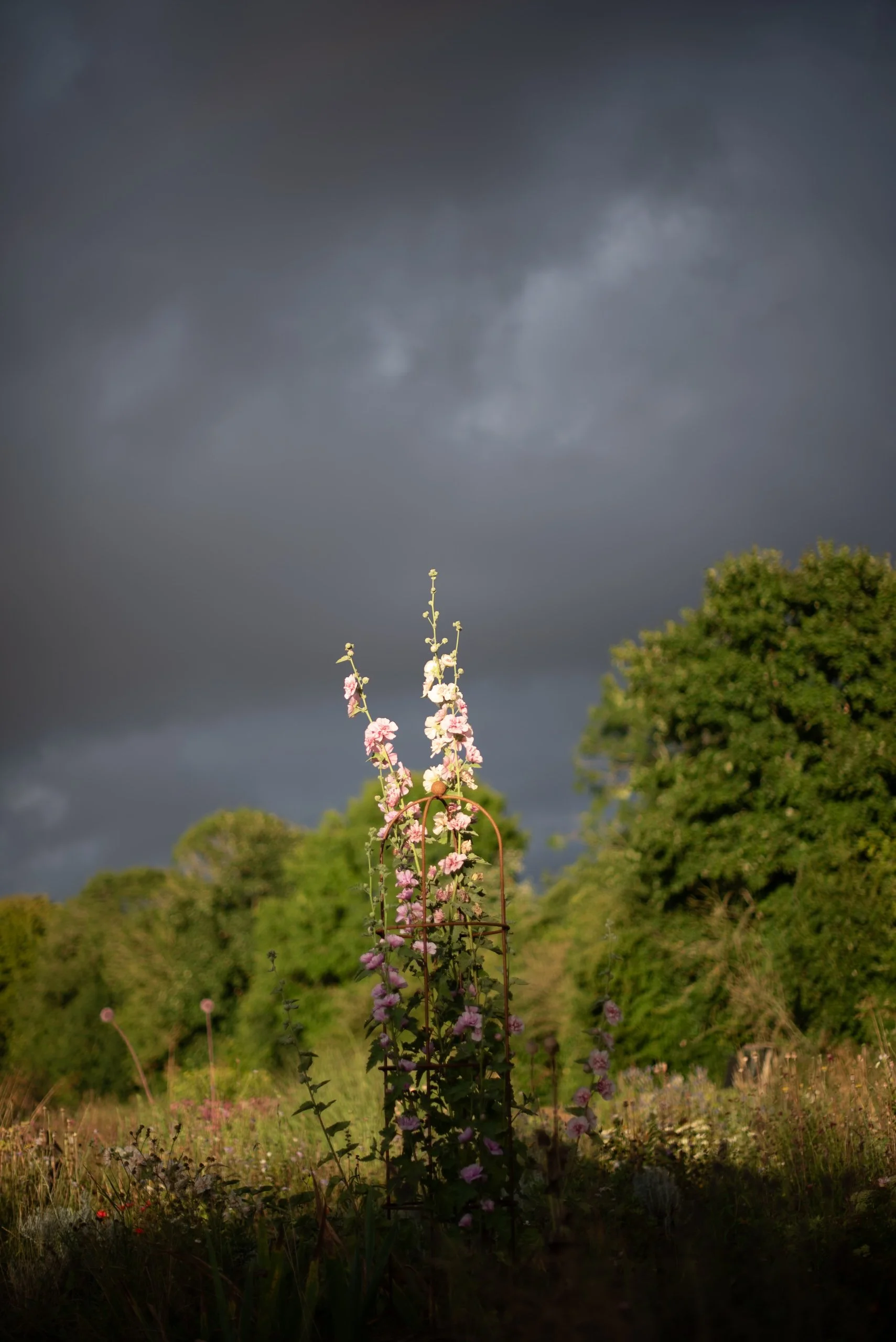
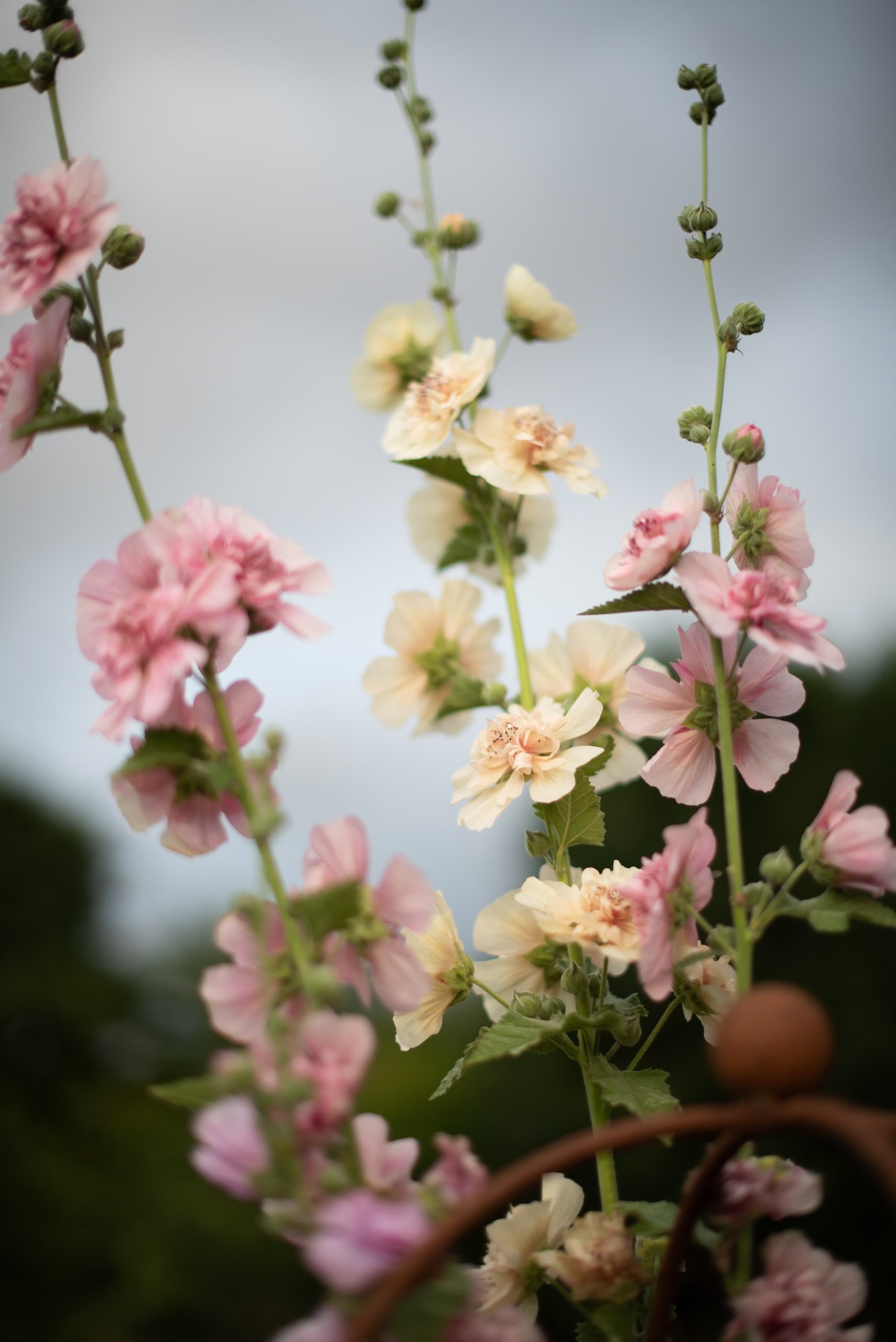
A few years ago Jess planted some Alcalthaea suffrutescens. Shrubby hollyhock is the common name, in fact a cross of Alcea rosea (hollyhock) and Althaea officinalis (wild marshmallow) that was bred in 1953 in Hungary by Professor Zoltan Kovats who wanted to breed a hollyhock that would be resistant to the rust (Puccinia malvacearum) that so often corrupts them.
They grew (and grew and grew) and we gave them stakes and support against the wind that whips across the open field. From their towering, slender spires unfurled grey-green leaves and rosettes of bowl-shaped flowers with a double centre. As a flower arranger, from a design perspective, their architectural merits were immediately obvious - the stature useful for large-scale work, the colours gorgeously subtle with petals that have a slight sheen, like a pearl. But there isn’t a way to describe these flowers to match the way you feel when you look at them. Every year about this time they arrive just when I need them to remind me.
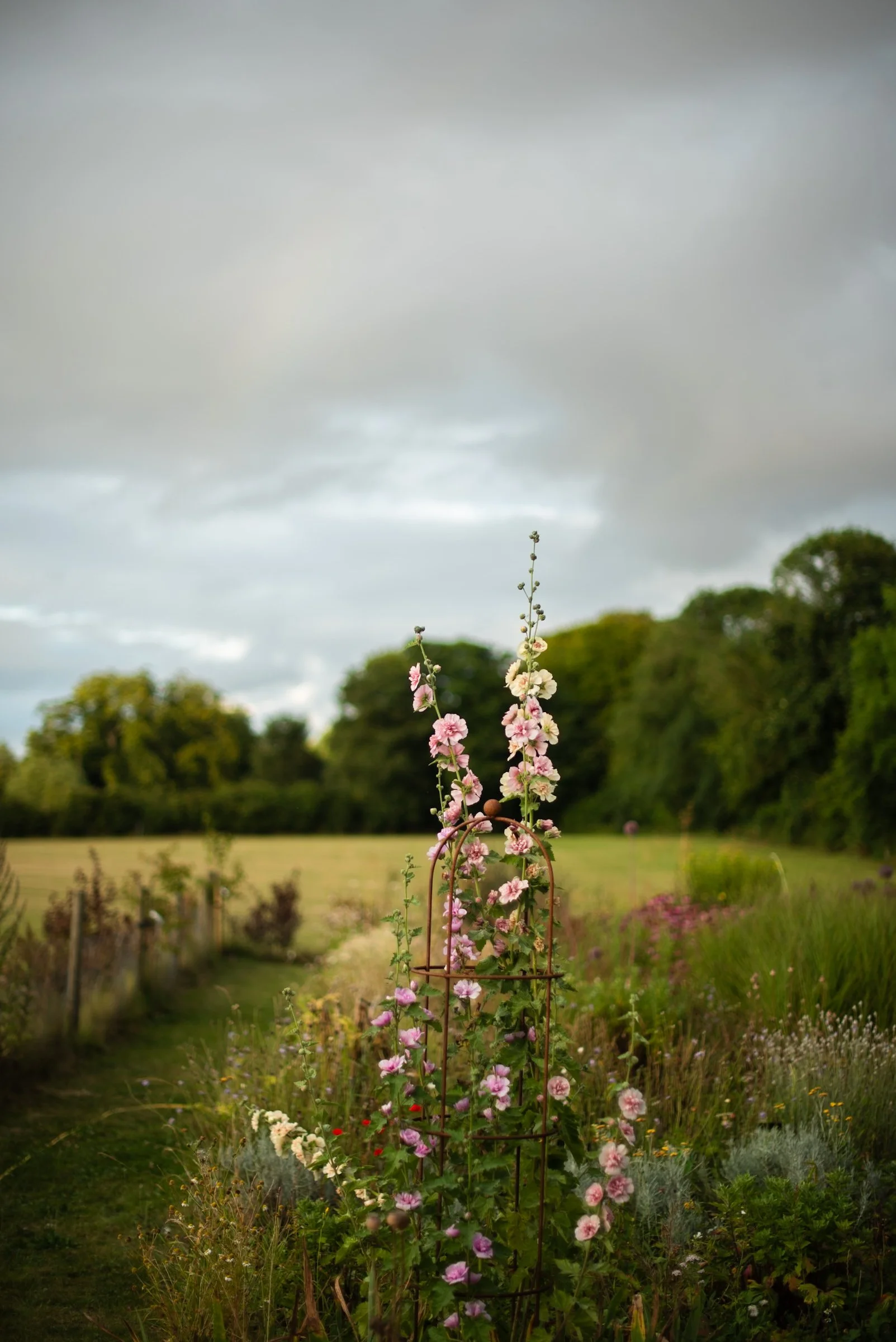
Flowers are language, poetry, a conduit for human connection. They have a rare gift of enabling us to see the world through the eyes of a child, to ‘re-see’ that it is magical and miraculous and that our hearts’ desires are still possible if only we work towards them. Perhaps in their brevity there is a reminder of our own mortality, an invitation to grasp this very moment and to make those we love know it.
So, when people ask me, or even occasionally when - burnt-out, questioning, late summer - I ask myself: what is the purpose that flowers serve? The answer remains the same.
Flowers help us to live.