WILLOW, ARUM, BOXWOOD
Balearic box (Buxus balearica)
Black willow (Salix nigra)
Italian lords and ladies (Arum italicum subsp. ‘Marmoratum’)
Japanese spindle (Euonymous japonicus)
Pussy willow (Salix discolor)
Rosemary-leaved box (Buxus sempervirens ‘Rosmarinifolia’)
Variegated box (Buxus sempervirens ‘Elegantissima’)
Wire-netting bush (Corokia)
Tenmoku glaze vase by Cara Guthrie
Small kenzan
Loose scrunch of chicken wire
FEBRUARY
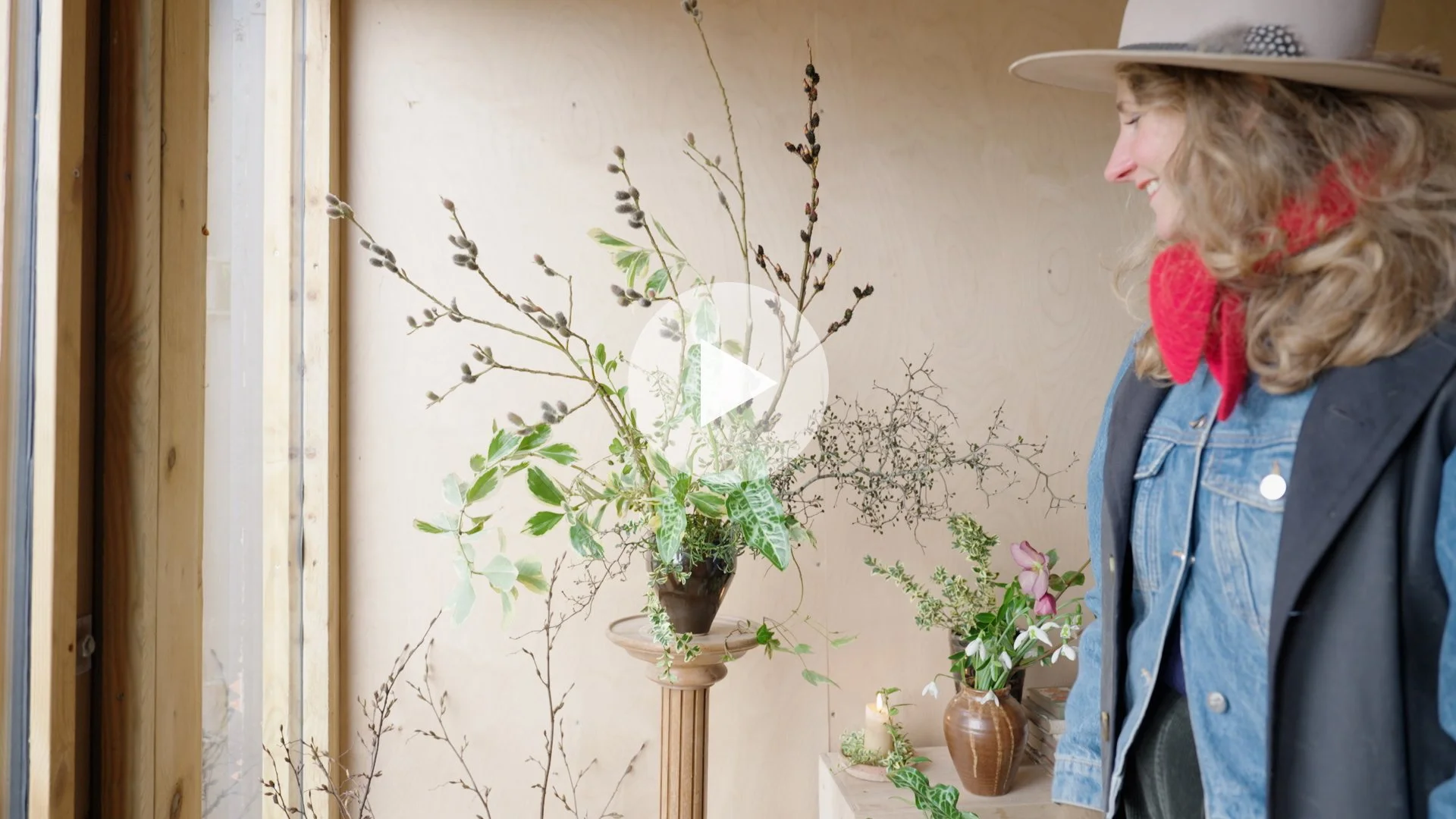
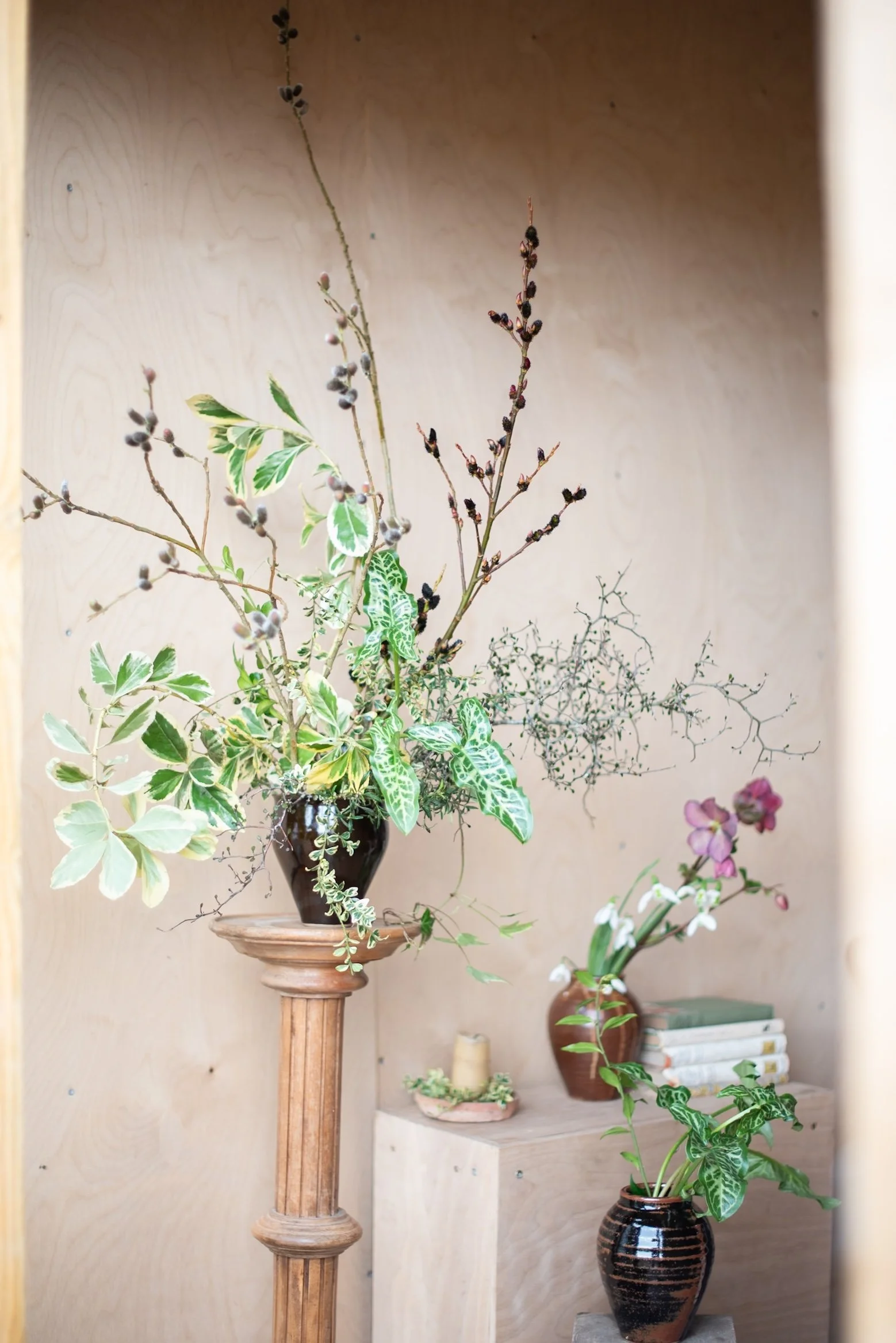
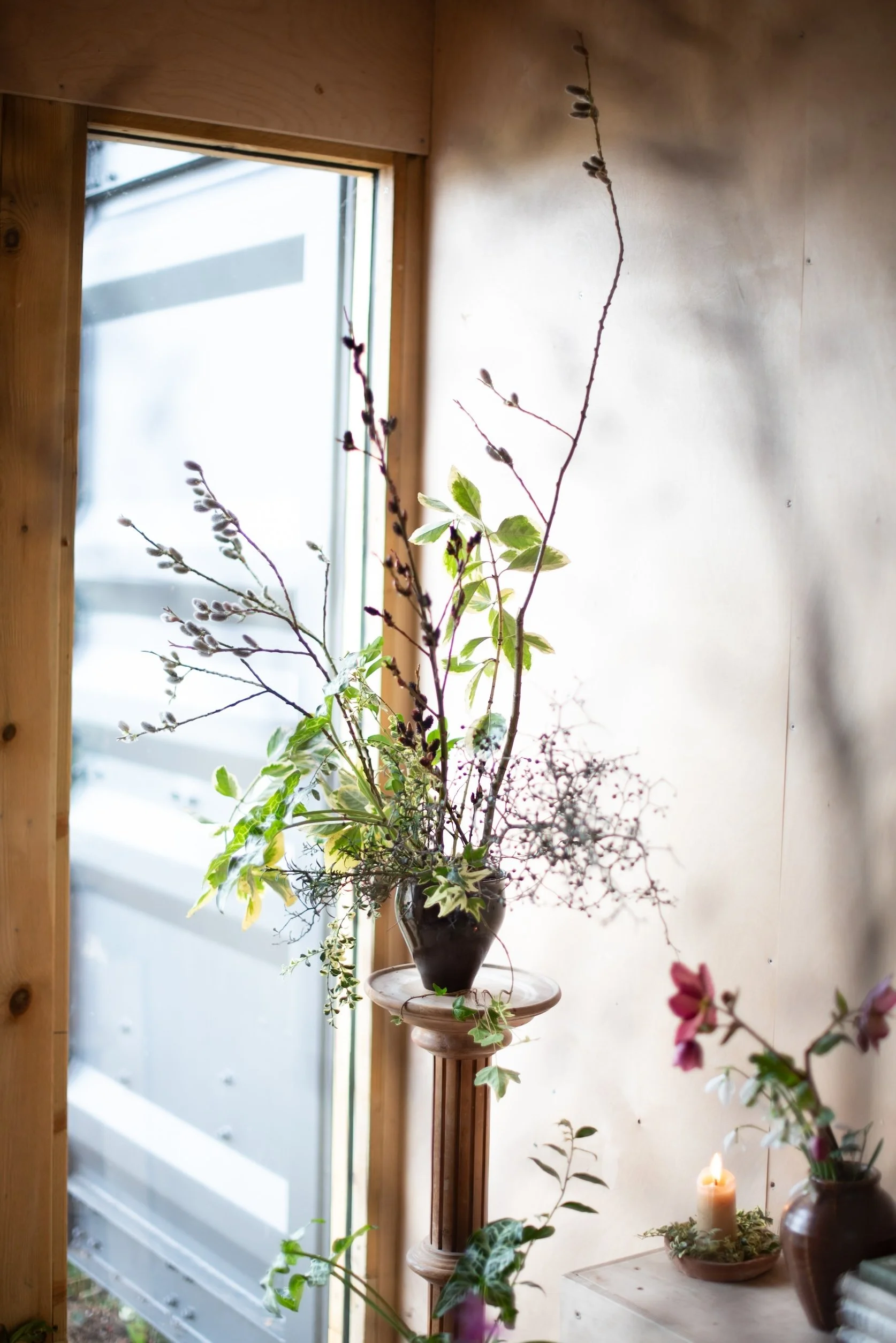
This arrangement inspired by Balmoral Cottage for Flowers on Film was an exercise in restraint, in using materials cut only from this particular place and creating a composition entirely made up of branches and leaves. The variegated foliage provided some interest and contrast but without colour as the overriding focus the sculptural forms and texture of the ingredients came to the fore.
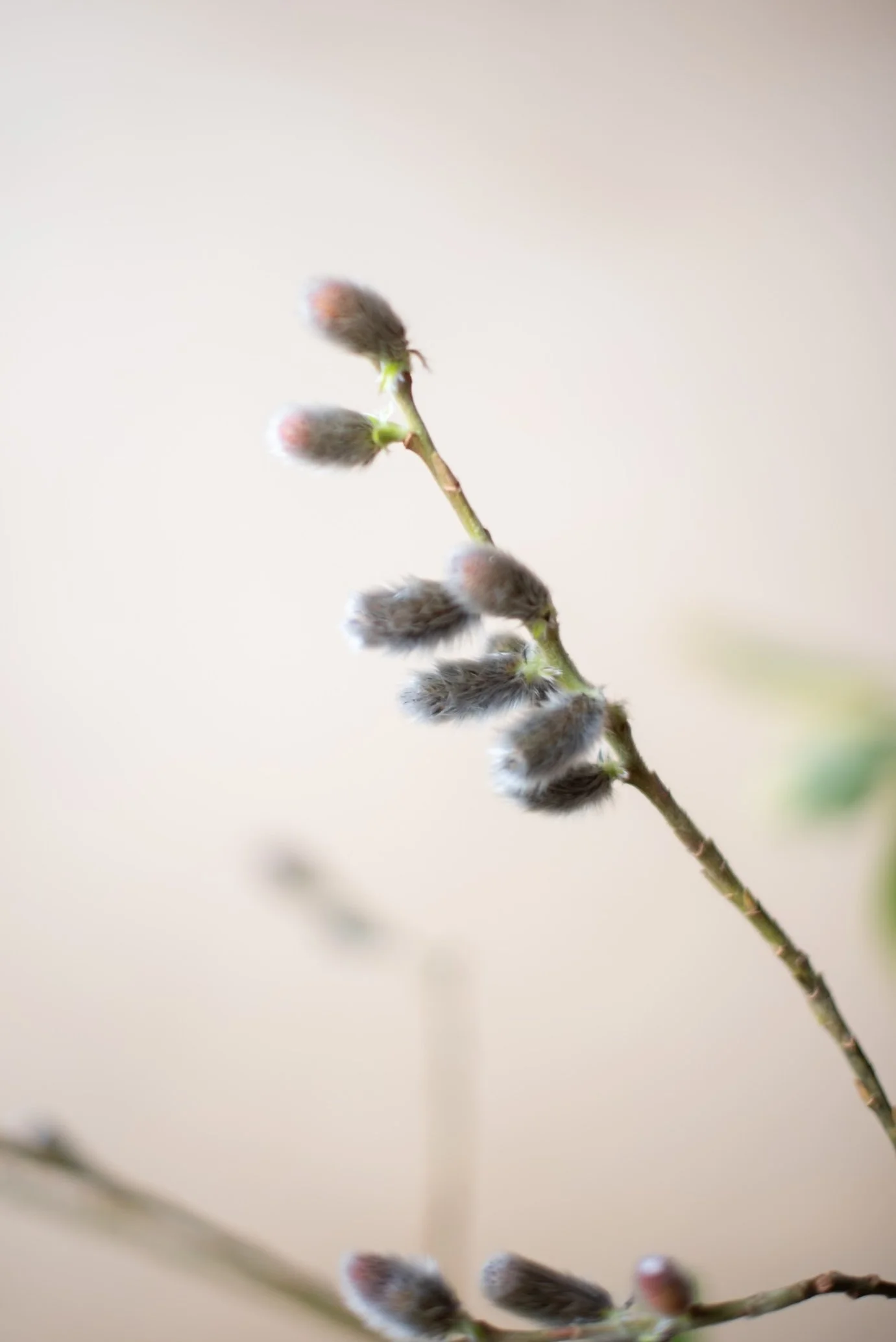
I used two varieties of willow as the foundational branches, one with soft grey catkins suffused with pink and the other black tipped with raspberry. I was really excited to get my hands on the wire-netting bush (Corokia) which is native to new Zealand and has these extraordinary interlacing wiry stems.
The large Japanese spindle grows at the centre of the garden and I found the stems satisfied the urge to soften and provide gentle curves to the parameters of the arrangement and then I couldn’t not incorporate the boxwood - Charlotte’s favourite, the variegated ‘Elegantissima’ as well as ‘Balearica’ and ‘Rosmarinifolius’. I was surprised by how lovely these were to arrange with and likewise the Italian arum, native to the UK, with its arrow-shaped leaves traced with pale veins, which Charlotte swears by and says is very long-lasting in arrangements.
Charlotte and Donald very generously loaded us up with cuttings and transplants which Johnny will be rehoming for us in the damp soil of our Hampshire cutting garden! I’m looking forward to seeing them (hopefully thrive) there in the years to come. No doubt they will remind us of that day in Kent, of feeding sorrel leaves to the sheep and drinking coffee in slanting sunlight that held the promise of spring. Read more about our day with Charlotte and Donald here.
“Variegation has been popularised by the flower arranging movement which has been a notable social and (perhaps we might claim with such modesty we can muster) artistic feature of post-war Britain. Variegated leaves have contributed importantly to the range of material available to the flower arranger, who saw more to them than had been apparent to the gardener, but who has induced the gardener to take another look at them and their role in the garden. Cross-fertilisation between the arts has always been productive.” Christopher Lloyd, Foliage Plants