
POET'S DAFFODIL
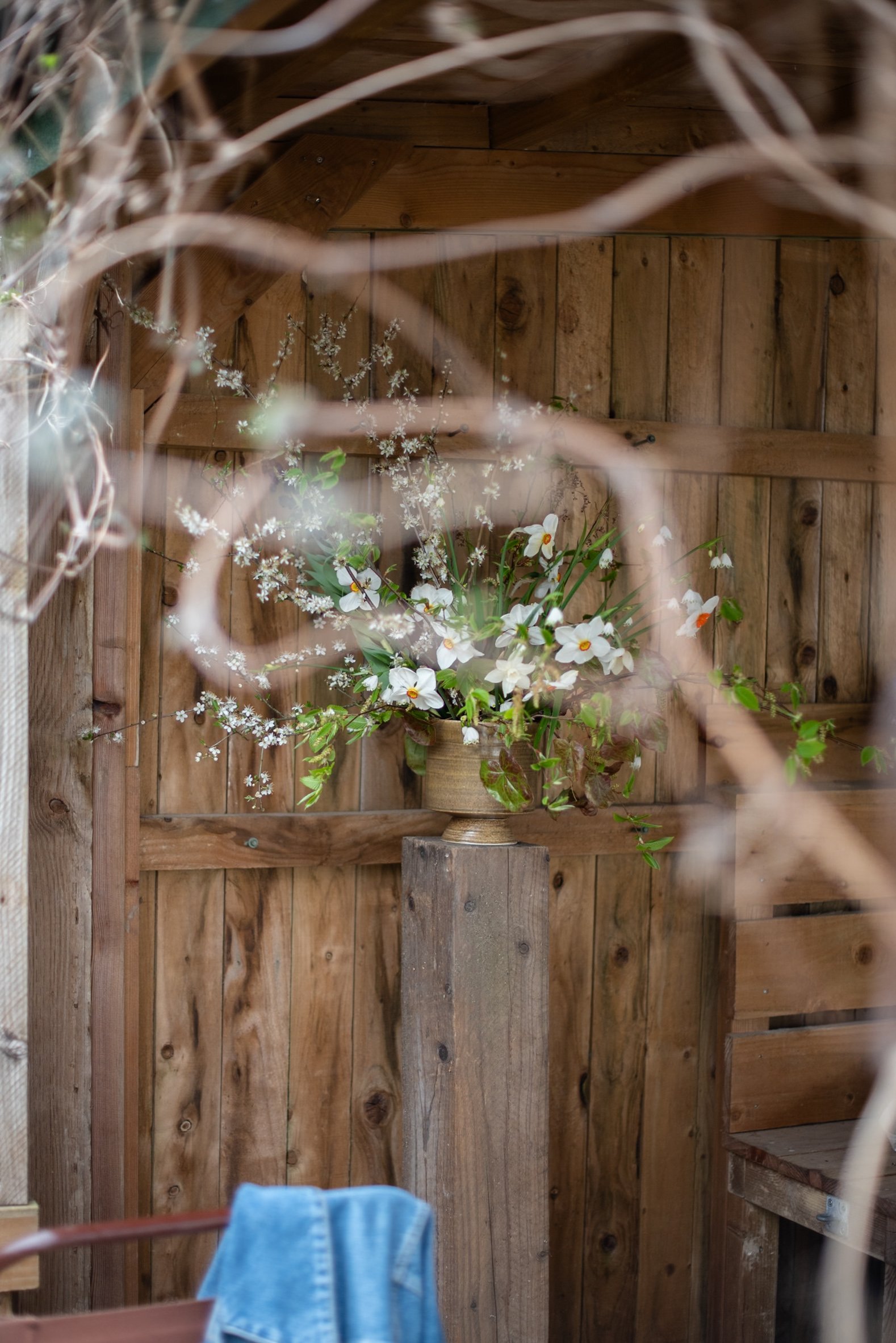


American hornbeam (Carpinus caroliniana)
Barrenwort (Epimedium x warleyense)
Blackthorn (Prunus spinosa)
Great wood-rush (Luzula sylvatica)
Persian lily (Fritillaria persica)
Poet’s daffodil (Narcissus 'Actaea')
Snowflake (Leucojum aestivum)
Ceramic footed urn
Hana Kubari technique
APRIL
It's hard to believe we are already into April. Suddenly everything seems to be happening at once: blossoming trees, wild garlic, daffodils, bluebells, anemones, the first of the tulips. There is a new energy to the way each day breaks and the momentum it carries with it. Here in London it's been a week of blue skies and uninterrupted sunshine with a cold easterly wind. This hung around last year all season so that even in the summer sun it often felt cool. Let's hope we’re not in for a repeat. Good weather for gardening, though, and we've been doing a lot of that lately.
This week I wanted to practice the Japanese hana kubari method in a prototype vase we've designed for the studio. It's based on one that we bought in Nairobi and is a useful, attractive shape, somewhere between an urn and a vase, ceramic, with a speckled tobacco glaze.
To begin I lay out my tools and prepare the vessel and mechanics. The hana kubari technique is used in seika arrangements, a form of Ikebana. I hasten to add that I do not practice Ikebana, or claim to. But I do have an interest in it and feel an affinity with certain processes. I suppose I always aspire to a higher level of skill and that is a part of my motivation as an arranger, a certain striving to ‘master’ my craft. Many of our tools and vessels are Japanese and I pilfer the odd tip and trick here and there from a collection of very old Ikebana books that I dig out of the ‘household / miscellaneous’ section in charity shops.
The hana kubari technique entails the use of sticks, twigs or branches inserted into the vase to provide support to the stems as you arrange, so it’s a natural alternative to using chicken wire. Today my simple Y-shaped fork divides the surface of the vase into three 'compartments', though you can weave a more complex lattice frame if you have some thin willow twigs to hand. The wood needs to be supple (I try a bamboo cane at first which is too old and dry and quickly breaks in two) but a length of the freshly cut American hornbeam (Carpinus caroliniana) works well. I insert it horizontally into the mouth of the vase, a couple of centimetres below the rim.
This technique differs from using a kenzan, which is what I tend to rely upon for events when I want the assurance of the arrangement maintaining its shape during transport. There is a control and precision that comes with arranging onto a kenzan that I love but sometimes I feel I lean on it too much, playing it safe. Regularly mixing in other techniques helps to flex our design muscles, especially when we're in a rut or feeling a little stale. The hana kubari method is one I would use at home or for arranging 'in-situ' because it relies entirely on natural materials, careful placement and balance. Consequently, it's a nice one for personal practice or as a mindfulness exercise, but not something to try to do in a rush - the positioning and balancing of the stems takes a gentle hand and patience.
With this method I take time to contemplate the materials - a foundational stage in the process. Laying out the stems, examining their shapes and testing their natural 'bent' - the way they lean or curve, depending on where the weight of the stem takes them. Usually I make a cup of tea at this point, something herbal and soothing like a redbush or lemon verbena, as it forces me to slow down and take ten minutes to prepare and think. Then there’s the pouring of the water - a moment of calm and quiet. I love the ritual of lifting the jug or flask, watching the water pool and settle. The first branch is structural, selected for strength and shape. The second creates a tension, layered across and in front. With this technique I try not to force materials in directions they don't want to go. There is a yielding, a sensation of 'rightness' when a stem naturally finds its home.
I start with the sloe. These are the last branches still in flower; the blossoms are tiny, snow-white and almond-scented. Later in the year there will be inky black fruits - here in the UK we steep them in alcohol and sugar to make ‘sloe gin’. The thorns are long and cruel, and I carefully remove them. Next the hornbeam - gosh, this is a beautiful foliage. The leaves are simple and serrated, with pendulous catkins. Now the crispy leaves of barrenwort and a bunch of greater wood-rush, cut with the blade-shaped leaves still intact at the base of the stem. The flowers both have straight stems - poet’s daffodil (Narcissus ‘Actaea’) and snowflakes (Leucojum aestivum) - I group them together, cut at varying heights.
Being alone is important. Or rather, working in silence, because of course there are all the sounds of the world around and of what you are making - the slicing of the knife, the cutting of scissors, the rustle of leaves and falling offcuts. Beyond this there is birdsong in the garden, the wind in the trees.
If you have time in the coming days or weeks, if you can 'make time', I encourage you to spend an hour engaging in this simple, gentle practice. No distractions. Let the silence surround you, the materials guide you and your mind empty.