
NATURALISTIC FLORAL DESIGN
To practise naturalistic floral design is to honour your materials above all else. By doing so you sustain the fragile threads between your arrangement, the plants and the soil, to the insects, the weather and the season. It is a creative process that celebrates and respects the natural world and our place in its complex, miraculous structure.
This intensive eight day course is devoted to the art of arranging flowers in this way, and to developing a working ethos that is gentle and inquisitive.
Our teaching is characterised by a close observation of the natural world, by a reverence for every ingredient and a lightness of touch, allowing materials to display the individual character of the mother plant rather than contorting them into stifled designs.
This course is split into two modules: ESSENTIAL TECHNIQUES and ADVANCED DESIGN.
Over two weeks you will study the philosophy and practical techniques of naturalistic floral design. You will discover a wide range of seasonal plant material, learning about the broader process of working with organically-grown flowers from conditioning to composting. Every arrangement will be made using considerate and sustainable mechanics from delicate designs to arrangements at scale.
This course is eight days in total. Weeks run from Tuesday to Friday (the studio is closed on Monday while materials are harvested from the garden). If your schedule only allows for attending the first or second week we have a limited number of spaces available for attending each week separately.
Explore the full curriculum below by clicking the drop down arrows and scroll the page to find dates, prices and booking information.
ESSENTIAL TECHNIQUES
In week one we concentrate on the practical and structural techniques essential for creating effortlessly naturalistic flower arrangements.
The studio is filled with an array of seasonal branches and flowers freshly harvested from the garden in Hampshire. After getting to know one another over tea and coffee, we dive straight into the materials, editing stems and preparing them for use. Over four days we’ll cover vital mechanics - the kenzan or pin-holder, the ‘hand vase’ (an organic alternative to the traditional spiral bouquet), re-usable chicken wire and concealed water sources for installation work and natural materials including split branches for structure in the vase (also known as Hana kubari). You will learn how best to position and frame your arrangements for an atmospheric portfolio shot during our dedicated photography session. The week will finish with a free style creative session when you can choose to focus on a specific technique and put your new skills into practise.
At the end of this week you will have the confidence to create a variety of floral designs, from footed pedestals and hand-tied bouquets to large-scale installations. You will have encountered a wide range of different plants and studied specific conditioning techniques essential for garden-grown produce. And you will be filled with curiosity and excitement, ready to explore the endless possibilities of this beautiful art in week two: Advanced Design.
-
Conditioning is a vital part of using natural cut flower materials. We will demonstrate tried-and-tested methods for preventing wilting and maximising hydration, the removal of leaves and thorns, trimming and searing stems in hot water.
-
The Japanese kenzan (translated as ‘sword mountain’) is a metal pin-holder used for Ikebana that has been absorbed into the western floral designer’s toolkit. Allowing for the specific placement of stems, pin-holders are essential for creating airy arrangements that remain structurally secure.
We’ll ease into our creative practice with a naturalistic pedestal bowl and pin-holder arrangement.
-
The traditional ‘spiralling’ of stems is a bouquet method well suited to the use of commercially grown flowers that are uniform in stem length and straightness.
Alternatively, the ‘hand vase’ technique we teach is one more sympathetic to the use of characterful and quirky garden-grown or wilder materials. Layered, organic and gentle, it has the effortless look of a bunch of flowers gathered from the garden, composed with careful skill and utmost care for the ingredients.
-
To understand the effect of ‘setting’, we’ll be photographing our arrangements in different places around the studio, exploring the effect of coloured backdrops, natural light and shadows.
There is no need to have a professional camera or equipment or any prior knowledge of photography - a smartphone camera will suffice and we’ll be covering the basics of exposure and framing during this creative playful session.
-
As a group we will build a three-dimensional floral display to evoke a cutaway scene from the garden. Using chicken wire for support and concealed water sources, our focus will be on how to achieve an effortlessly naturalistic design on a larger scale so that it appears to be growing in-situ.
We’ll carefully consider how to use the natural forms of ingredients to achieve height, depth and volume - taking cues directly from the plants themselves to accurately represent natural sparsity or abundance. We’ll talk through takedown and the preparation of materials for composting - a vital part of the garden-to-vase-to-garden cycle. This session will be led by floral artist Alice Donadoni of Mora Studio.
-
Hana kubari (花くばり) is a Japanese floral technique that translates directly to "flower" (hana) and "support/distribute" (kubari).
We’ll explore the use of natural materials - branches, roots or leaves - as a structure for keeping flowers in place within the vase.
-
A time to bring the week to a holistic conclusion during an open creative session, practising any of the techniques you have learned.
You’ll choose a vessel, select your materials and refine the colour palette. Anything goes, with one proviso: step out of your comfort zone!
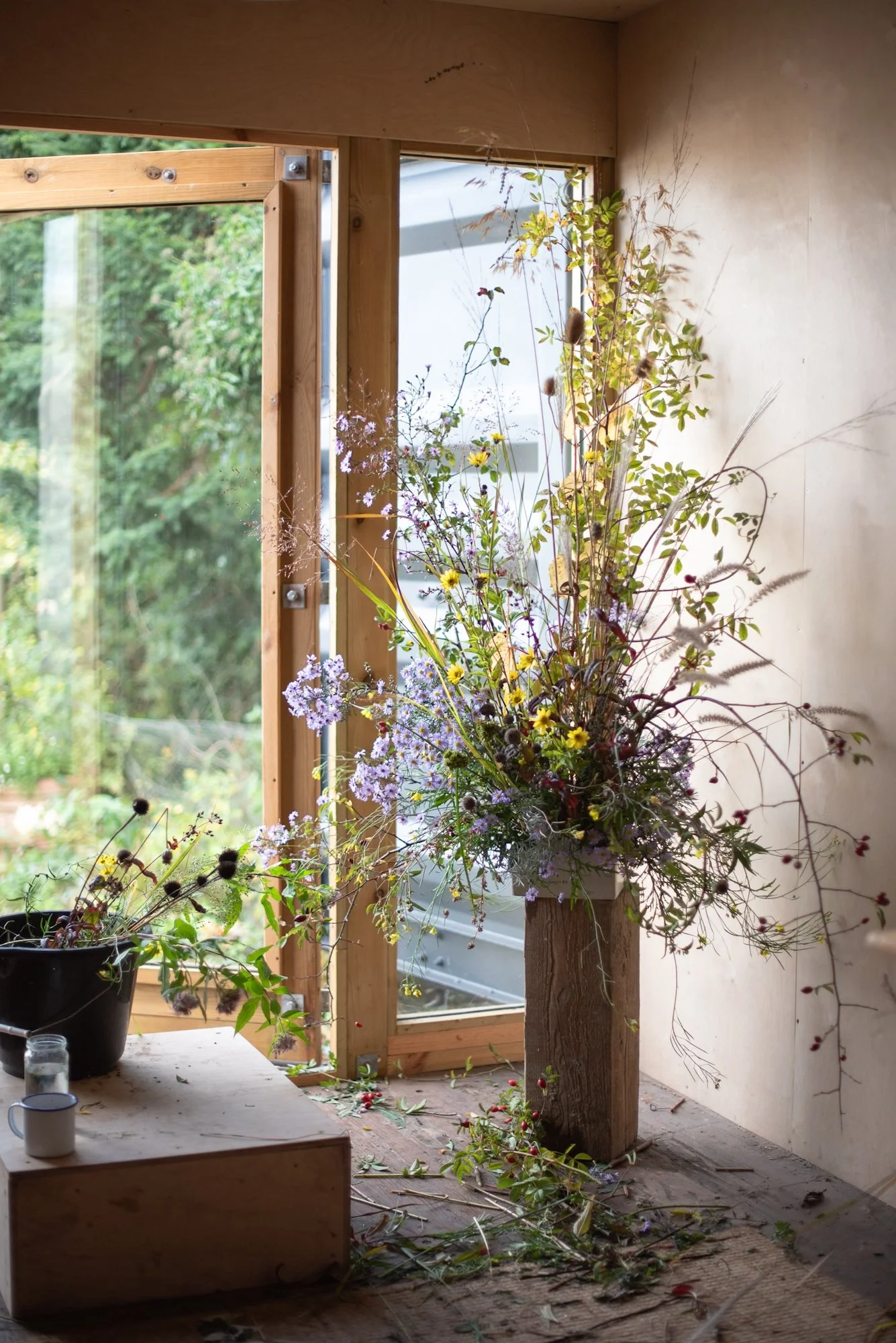
ADVANCED DESIGN
We build on the foundations from week one to examine each of the elements of naturalistic floral design in turn.
Naturalistic floral design is about instinct and individual expression - it is not about following set rules or trying to achieve perfection. That being said, having a solid knowledge of each of the seven elements of design - the fundamental keystones to all artistic work - is invaluable. Without this, it can be all too easy to overwork flower arrangements, repeat the same mistakes or simply feel overwhelmed in knowing where to start. A combination of design theory and a close observation of the natural world will allow you to achieve your creative potential as a designer.
Over four days we’ll explore each of the elements in turn - the natural shapes and tendencies of plants in a delicate tea bowl design, organic forms (and characterful stems) in a garden-inspired bouquet, how to draw out the colour palette for an entire tablescape from a single leaf, the powerful effects of tone in moody Dutch Masters-style creations, how to intentionally and effectively leave space in an asymmetric massed vase, how to distill the essence of a garden or landscape in shallow, linear containers, and finally how to build a textural naturalistic installation that speaks of the season. Advanced Design includes an additional photography session focused on using natural light. Throughout the week we will be utilising the foundational basics covered in Essential Techniques, including pin-holders, chicken wire and the hand vase bouquet.
At the end of this course you will leave with a clear understanding of the philosophy of naturalistic floral design, a solid grounding in the practical techniques required to create arrangements and confidence in your craft. You will have been introduced to a wide range of seasonal plant material and gained an understanding of the broader processes of working with garden-grown flowers from conditioning to composting. Most importantly you will leave with a deep appreciation of the beauty and complexity of flowers, a desire to share this awareness with those around you and a lifelong love of plants.
-
Understanding how to achieve certain shapes in a vase begins with looking closely at your materials and assessing how the whole plant looks and behaves, in the soil, at the source. Close observation of the natural world allows us to absorb the subtleties of plants and flowers – heights and breadths, the angles they grow at, whether they spread of climb, clamber up through others, clump together in dense clusters, self-seed and pop up at odd intervals here and there.
For our first element we’ll ease into our creative practice with a sweet little bowl design, starting with a sphere of chicken wire moulded for support, and layering leaves and dainty stems.
-
You can use all parts of a plant for decorative or practical purposes, not just the flowers. Roots, bulbs, stems, leaves, blades, buds and seedheads can all be useful and beautiful when included in the right way. Often the addition of something unpredictable, even a little ugly – like crossed stems (supposedly a no-no in traditional ‘spiral’ bouquets but evident in nature everywhere) - can all bring character and a sense of naturalism to an arrangement.
For this session the ‘hand vase’ technique allows us to honour the natural forms and tendencies of the ingredients, gently but purposefully layering and grouping the floral material before tying off and ribboning for an elegant hand-held bouquet.
-
This is an exercise in close observation, discovering the intricate subtleties of colour in the flowers and leaves we have selected, from petals and thorns to veins, stamens and buds. We will experiment and explore the inclusion of contrasting temperatures to enliven, disrupt, tone down or introduce an element of surprise.
In this session we will style a range of table flowers with different props, looking at the natural materials to develop a harmonious colour palette for each design.
-
As a creative exercise we will take inspiration from the 18th century paintings of the Dutch and Flemish Masters who used the vanitas genre to evoke the fleeting nature of life on earth, capturing the ephemeral beauty of flowers and fruit. We will create Dutch Masters-inspired arrangements that capture this precise moment in time, celebrating the quirks, imperfections and signs of ageing - mottled leaves, fading petals - that are evidence of a natural life cycle.
In a separate photography session we’ll be exploring the effects of tone as we photograph our Dutch Masters arrangements against dark and moody backdrops. Using natural light we will examine the effect of depth - how lighter materials advance and darker flowers recede - play with props like pearlescent shells and edit arrangements in situ to capture the most dramatic image.
As with the previous week’s session there is no need to have a professional camera or equipment or any prior knowledge of photography - a smartphone camera will suffice and we’ll be covering the basics of exposure and framing during this creative and playful session.
-
Without space, we can lose sight of individual flowers as they visually merge together in an arrangement. Leaving space is a simple concept. Intentionally doing so, particularly when you have lots of lovely materials to choose from, is a challenging exercise in precise placement and restraint.
For this session, a simple vase holding a pinholder provides the basis for an asymmetric, massed arrangement utilising a limited number of ingredients. Every stem will be assessed and added or removed with a focus on accommodating negative space.
This session will be led by the brilliant Alice Donadoni of Mora Studio.
-
We’ll begin by discussing what constitutes a worthy ingredient (why do we revere a rose and dismiss a buttercup?) and the opportunities presented by an anti-hierarchical approach to produce by cultivating a naturalistic growing space.
Taking inspiration from Albrecht Durer’s exquisite painting ‘A Piece of Turf’ (1503) we’ll focus on distilling the essence of the garden or a particular landscape in a shallow, linear container, explore the presence of line as design element. This session is all about capturing the beautiful disorder of the natural world with precise realism in low level arrangements that appear to be growing.
-
On our final afternoon we will plan and build an installation with a specific focus on texture.
In naturalistic displays texture often contributes to the essence of seasonality in a design - late spring is frothy, late summer fruity. We’ll explore ways in which texture can add character and individuality to a design and to heighten the ambience of a setting.
2026
autumn
SEPTEMBER
full course
15 - 25 SEPT
£3800
essential techniques
15 - 18 SEPT
£1800
advanced design
22 - 25 SEPT
£2000
2027
spring
APRIL
full course
13 - 23 APRIL
£3800
essential techniques
13 - 16 APRIL
£1800
advanced design
20 - 23 APRIL
£2000
summer
JUNE
full course
8 - 18 JUNE
£3800
essential techniques
8 - 11 JUNE
£1800
advanced design
15 - 18 JUNE
£2000
autumn
SEPT
full course
7 - 17 sept
£3800
essential techniques
7 - 10 SEPT
£1800
advanced design
14 - 17 SEPT
£2000
ADDITIONAL INFORMATION
DEPOSIT
You can pay in full for this course at the time of booking or reserve your place with a 50% deposit. The remaining balance is due six weeks before the course start date. If your schedule only allows for attending the first or second week we have a limited number of spaces available for attending each week separately.
TIMINGS
This is an eight day workshop which will run from 10am to 3.30pm each day with a short break for lunch. Please note weeks run from Tuesday to Friday (the studio is closed on Monday while materials are gathered from the garden). Please arrive no earlier than 10 minutes before the start of the class.
LUNCHES
We do not provide lunch. Teas, coffees and water are provided throughout the day. We have a small kitchen area with a fridge if you would like to bring a packed lunch and there are lots of cafés nearby to choose from.
WHAT TO WEAR
The studio is in a converted railway arch that is shady and cool (perfect for the flowers!) We recommend bringing additional layers, wearing comfortable shoes and to bear in mind that you will be handling organic flower material throughout the day.
EQUIPMENT
Snips, aprons, flowers, vases and mechanics are all provided.
We stock a small range of our own brand ceramics and Japanese tools in our studio shop as well as our book, Naturalistic Flowers.
Ts & Cs
Please read our Terms and Conditions in full before booking.