
AMARYLLIS, TUFTED HAIR GRASS
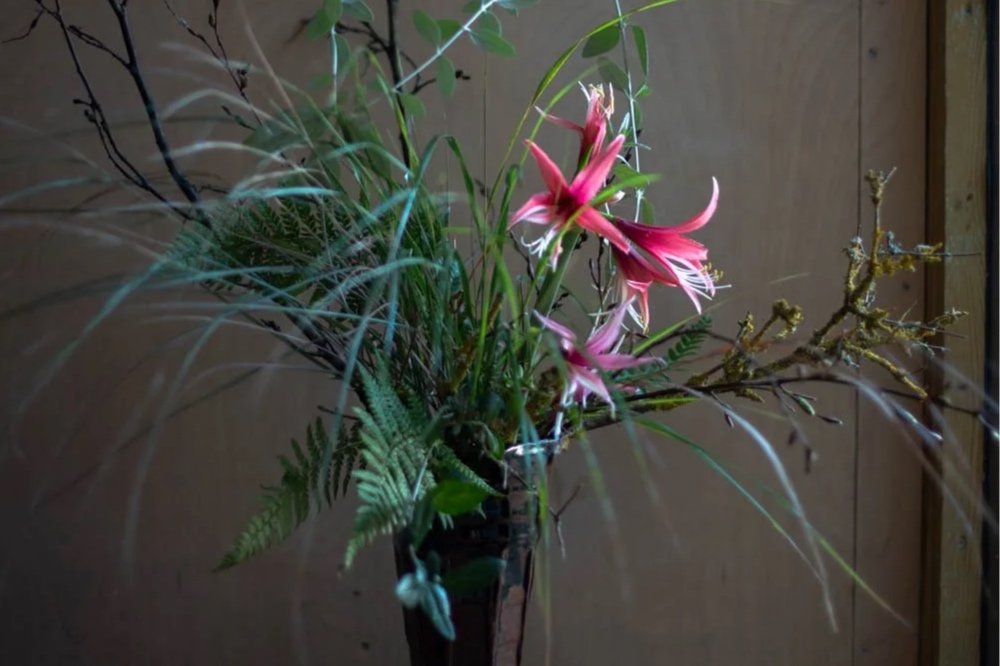
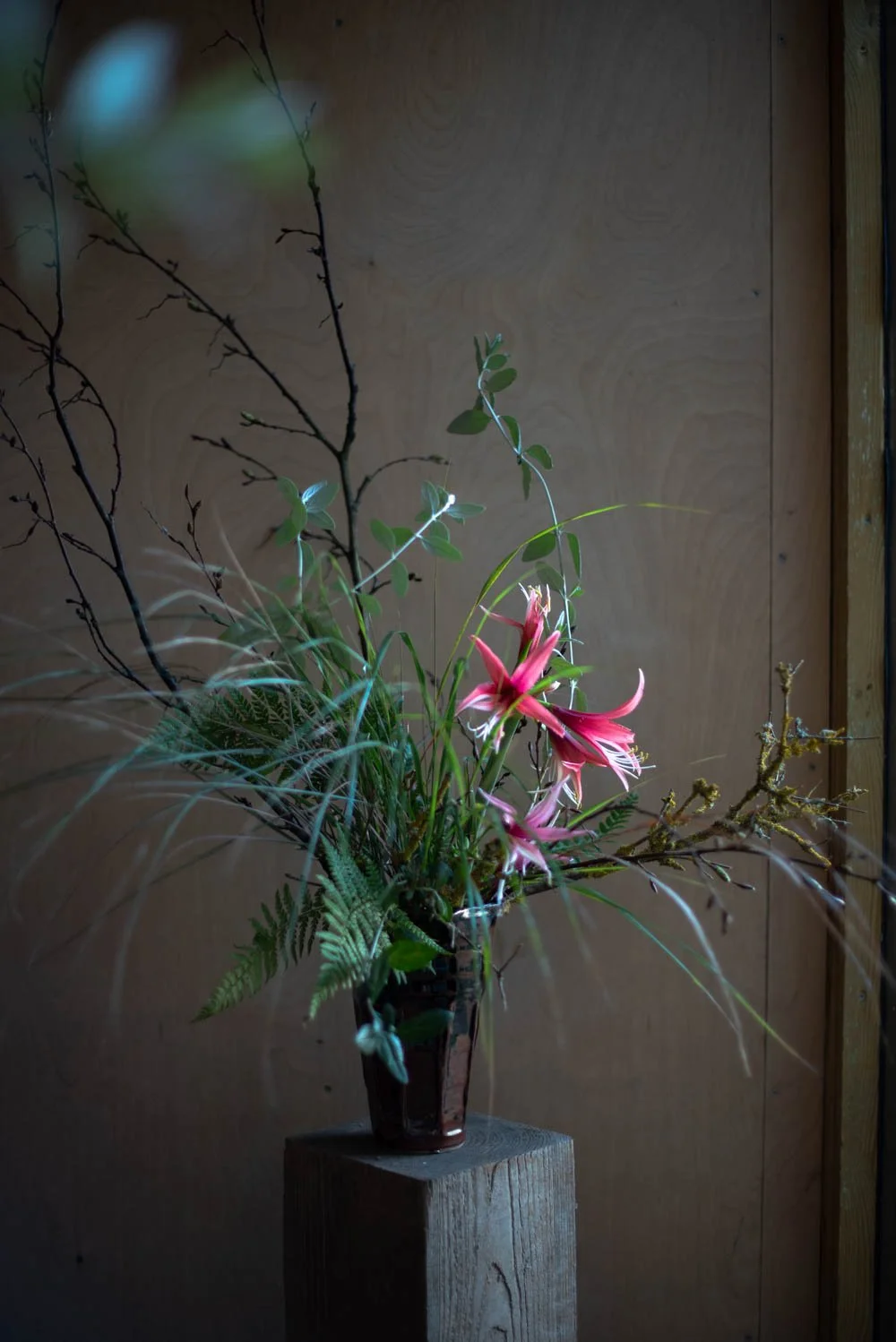
Amaryllis are difficult to arrange, with thick, hollow stems so they are best placed as they grow, upright or slightly leaning, with space around them so that any buds have room to open.
Amaryllis (Hippeastrum ‘Cybister Rose’)
Japanese lace fern (Polystichum polyblepharum)
Maidenhair fern (Adiantum aleuticum)
Tree germander (Teucrium fruticans)
Tufted hair grass (Deschampsia cespitosa)
Tall vase in tenmoku glaze by Made in Cley pottery
FEBRUARY
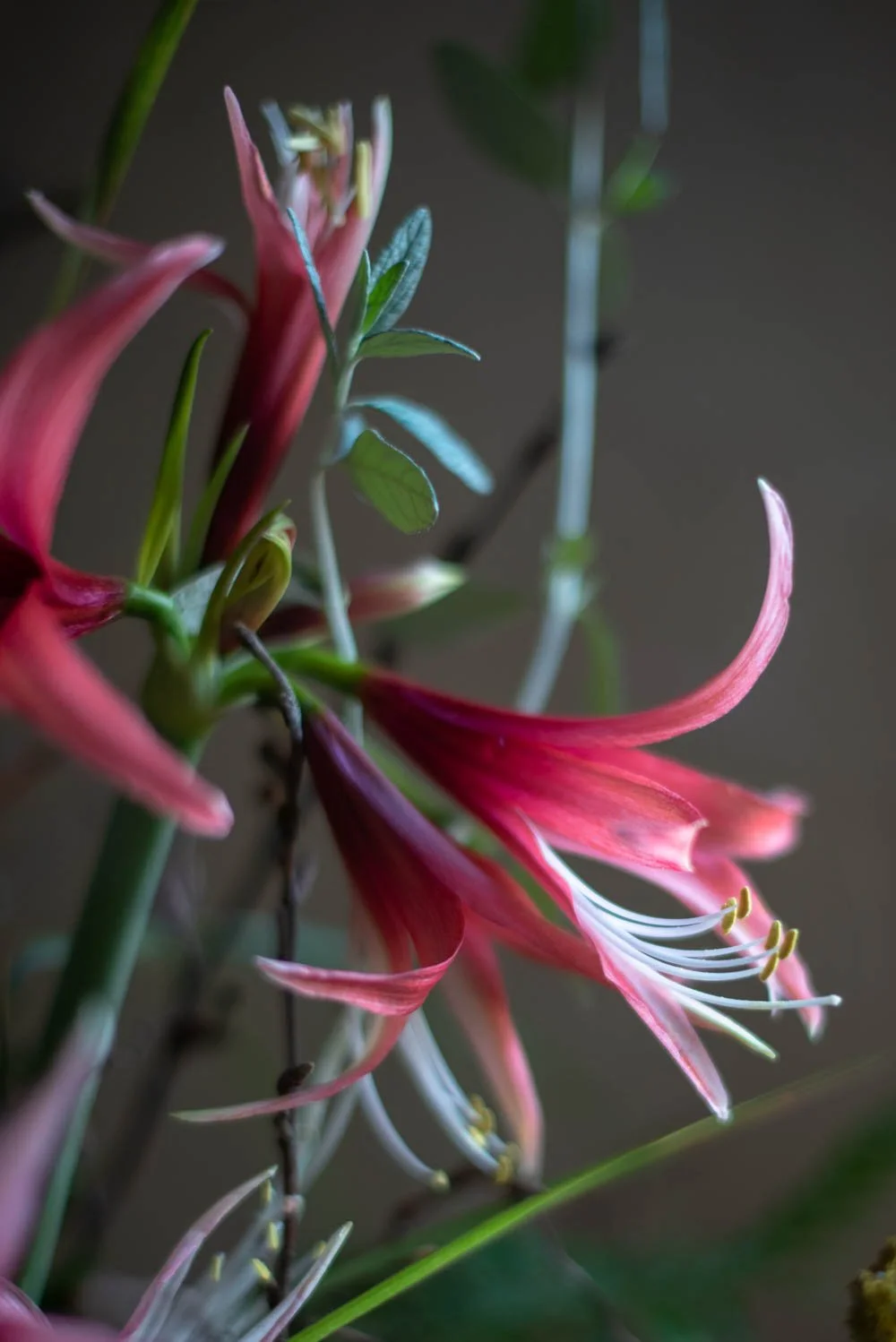
I started this arrangement with an attractive branch selected from a pile of hornbeam prunings, trimming it down where any side stems were fussy or crossing over one another. Amaryllis are difficult to arrange, with thick, hollow stems so they are best placed as they grow, upright or slightly leaning, with space around them so that any buds have room to open. This variety - ‘Cybister Rose’ - has slender, swept-back petals in a rosy salmon. The size and shape of the flowers I find much more ‘wieldy’ than some of the larger varieties and seems to work when arranged with other lighter elements like the tufted hairgrass. To fill and soften the base of the arrangement I added in a few feathery ferns and the tree germander for curve and colour contrast.
AZALEA, GERMANDER, NARCISSUS
Tree germander is one of my favourite foliages, for the grey-green leaves that, used backwards, display a flash of white underbelly - the stems are slim and curve in all sorts of weird and wonderful ways so they are a great filler and useful for adding height and width too.
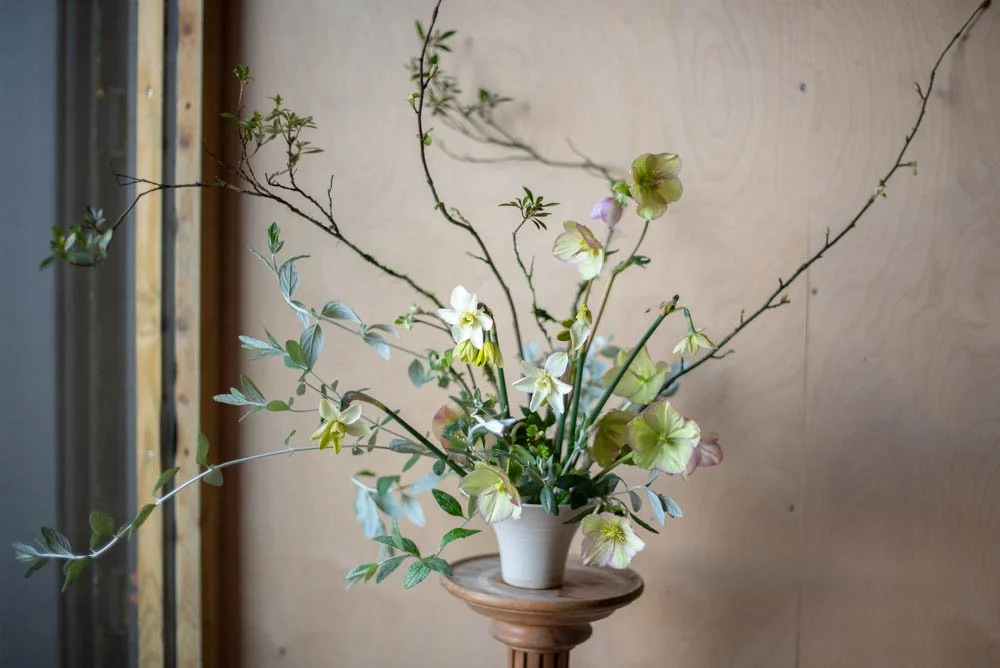
Azalea (Rhododendron, variety unknown)
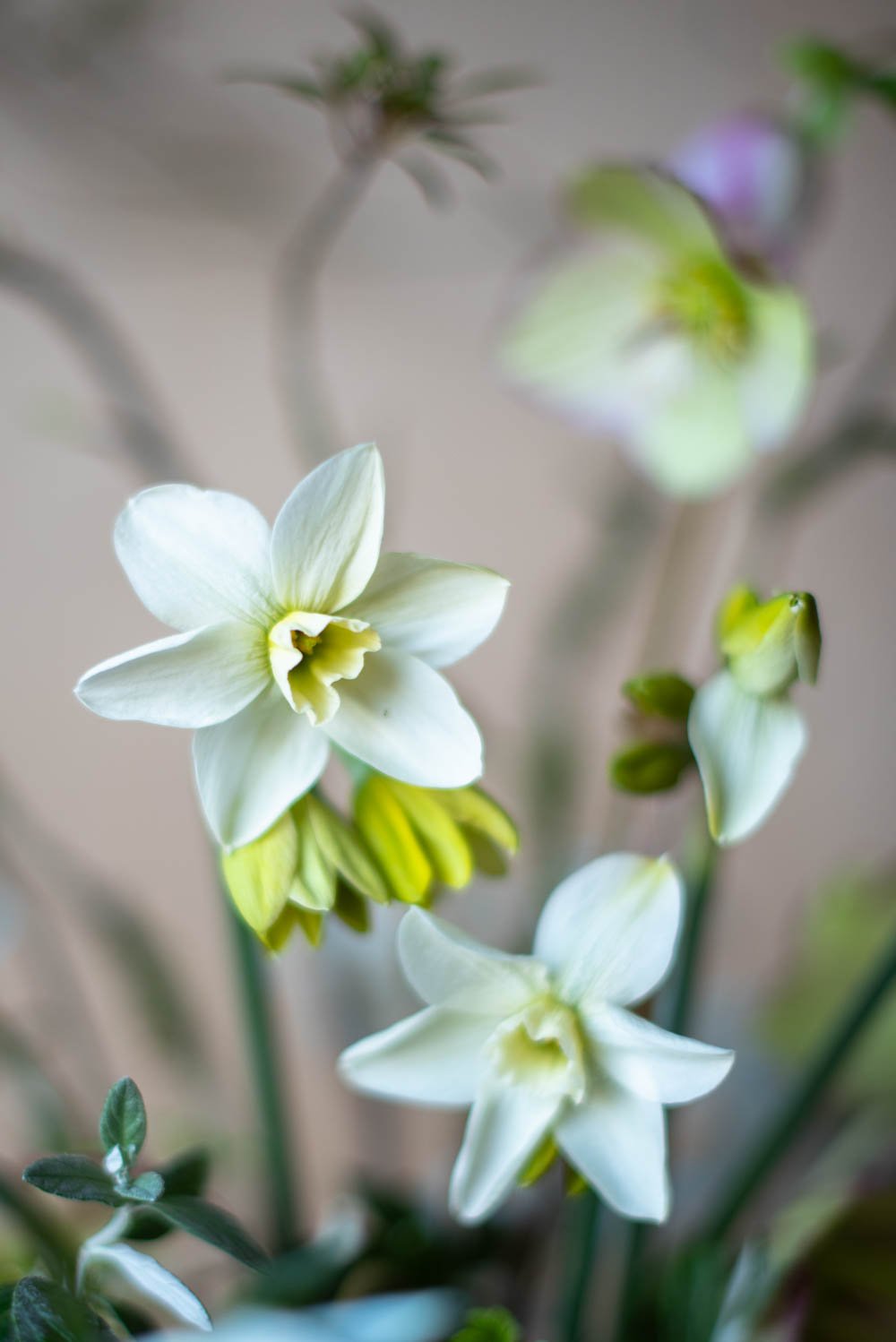
Daffodil (Narcissus ‘Polar Hunter’)
Flowering currant (Ribes sanguineum ‘White Icicle’)
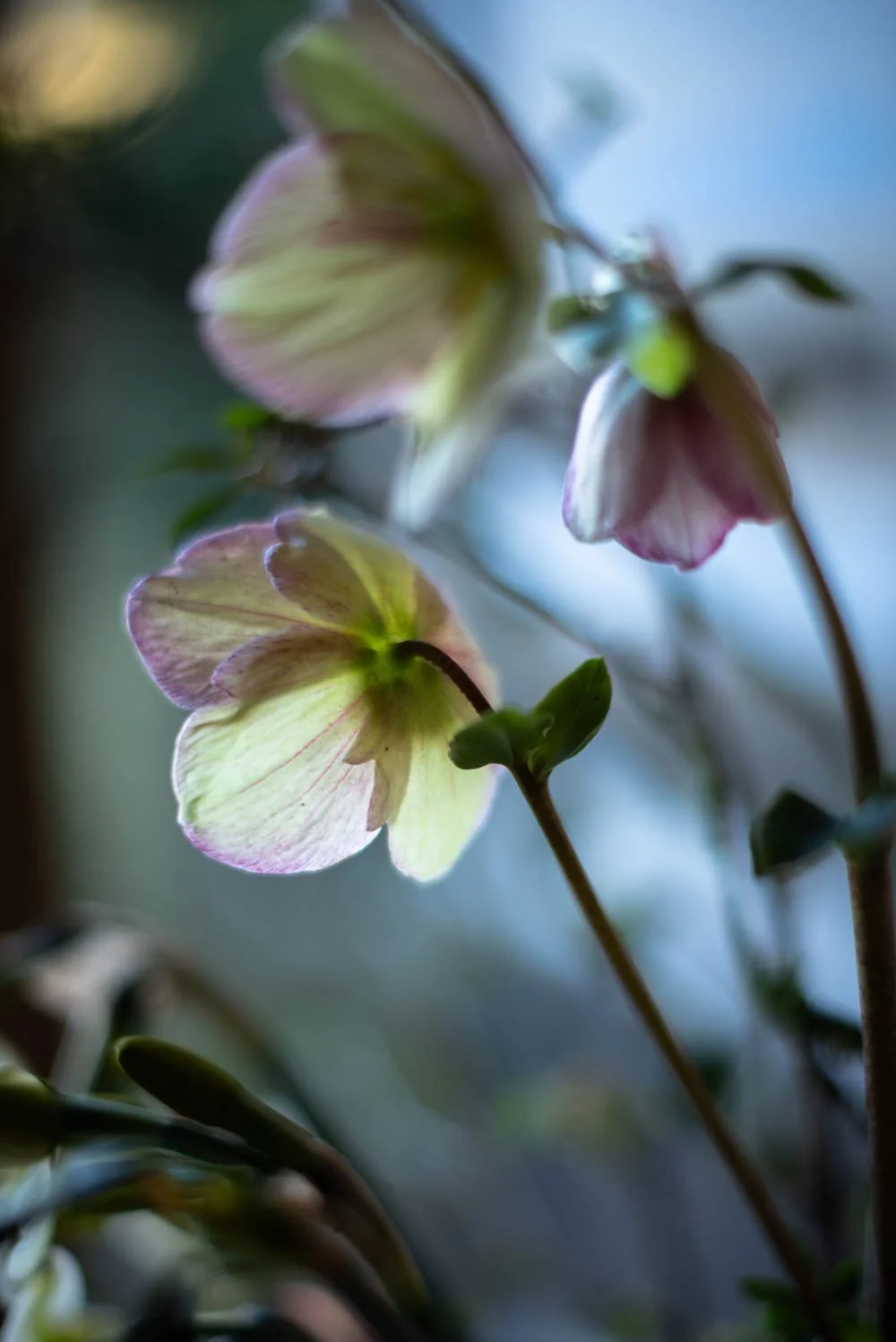
Hellebore (Helleborus ‘Ice n’ Roses Picotee’)
Tree germander (Teucrium fruticans)
Seika bowl design by Aesme Studio
Small kenzan
FEBRUARY
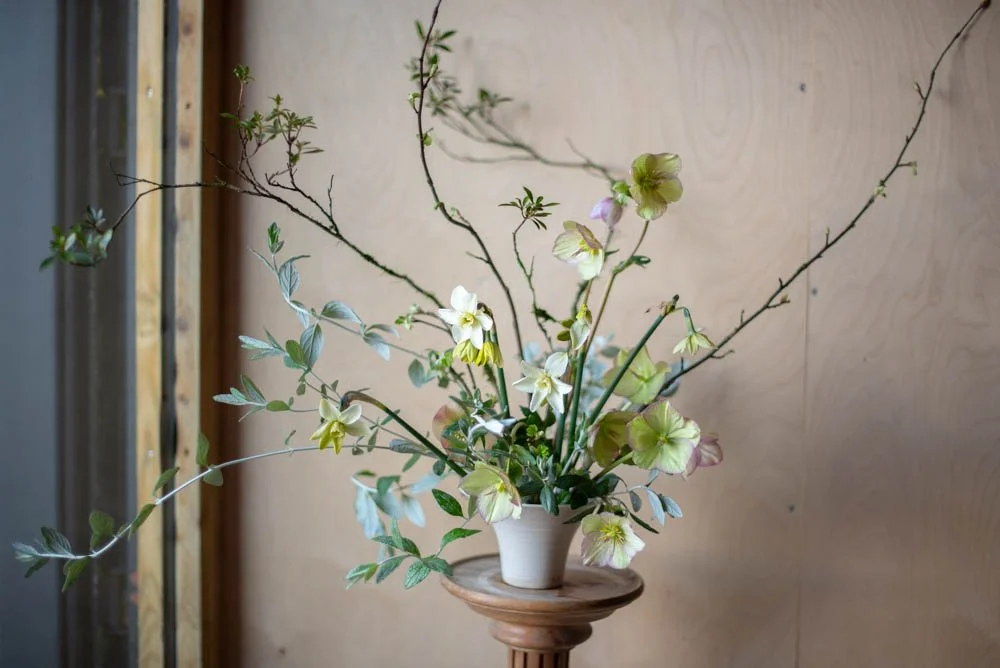
The idea for this bowl shape came from a very old book I found somewhere on Ikebana. The narrow base perfectly fits a small pin holder but necessitates restraint in terms of the quantity not only of ingredients, but of stems it is possible to use. The azalea branch came from a pile of prunings in the park so I’m not sure of the variety but the forked shape and drifts of lichen were, I felt, a good a start to an arrangement as any… The flowering currant were Johnny’s prunings from our own shrubs and I took them home to force them - within days they were opening to reveal their dangling creamy earrings of flowers, which have a sharp, lemony scent - so good! Tree germander is one of my favourite foliages, for the grey-green leaves that, used backwards, display a flash of white underbelly - the stems are slim and curve in all sorts of weird and wonderful ways so they are a great filler and useful for adding height and width too. The ‘Ice n’ Roses’ hellebore has a white flower streak with raspberry pink at the edges but as the flower heads age they darken to a murky pinky lime - this was the colour I was after, to pair with the chartruse Narcissi - a new addition to our ‘Wabi Sabi’ garden this spring. An early flowering variety ‘Polar Hunter’ is here to stay - the powerful perfume, long stem length and exquisite colouring make this a really special one - add it to your list!
WILLOW, ARUM, BOXWOOD
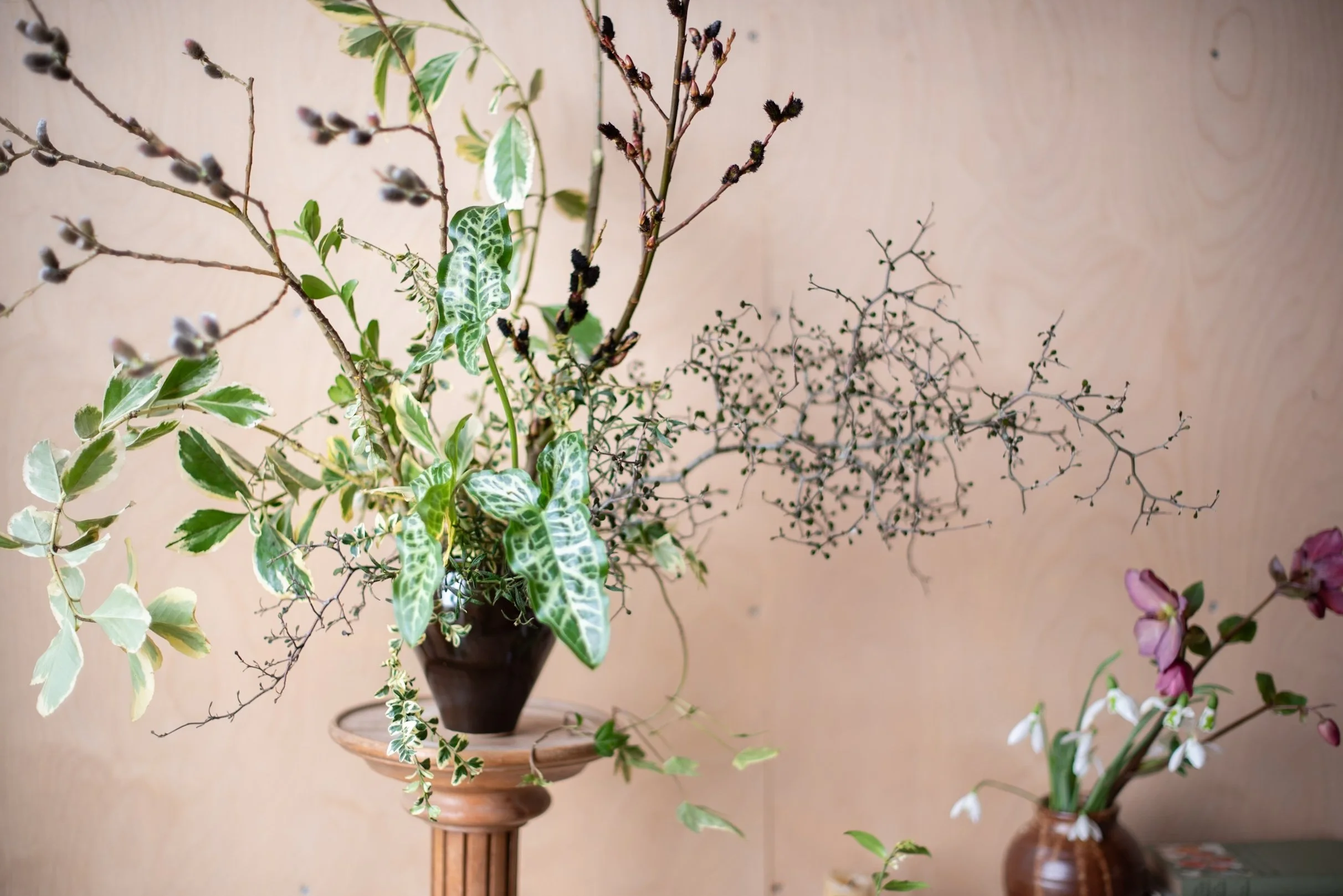
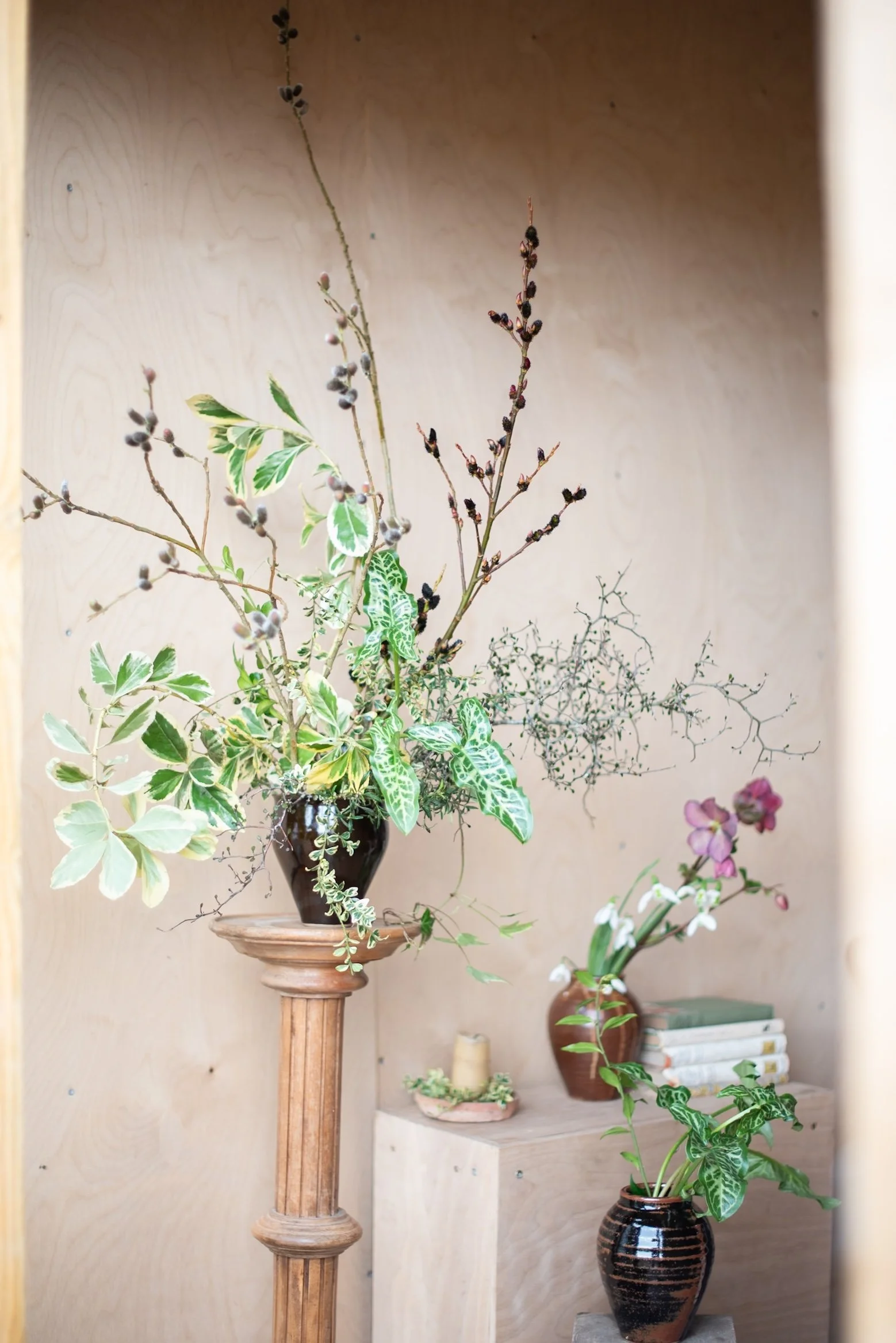
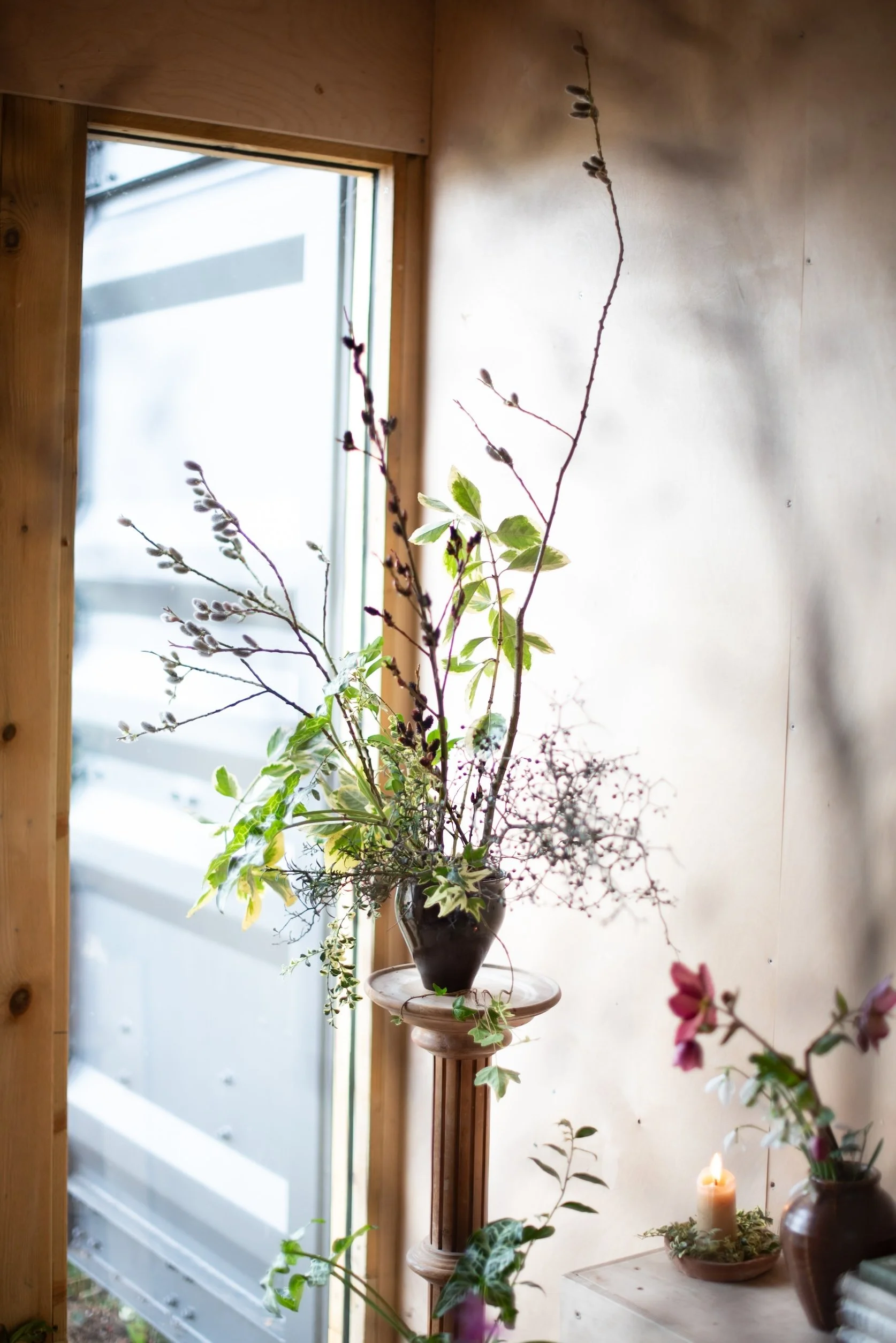
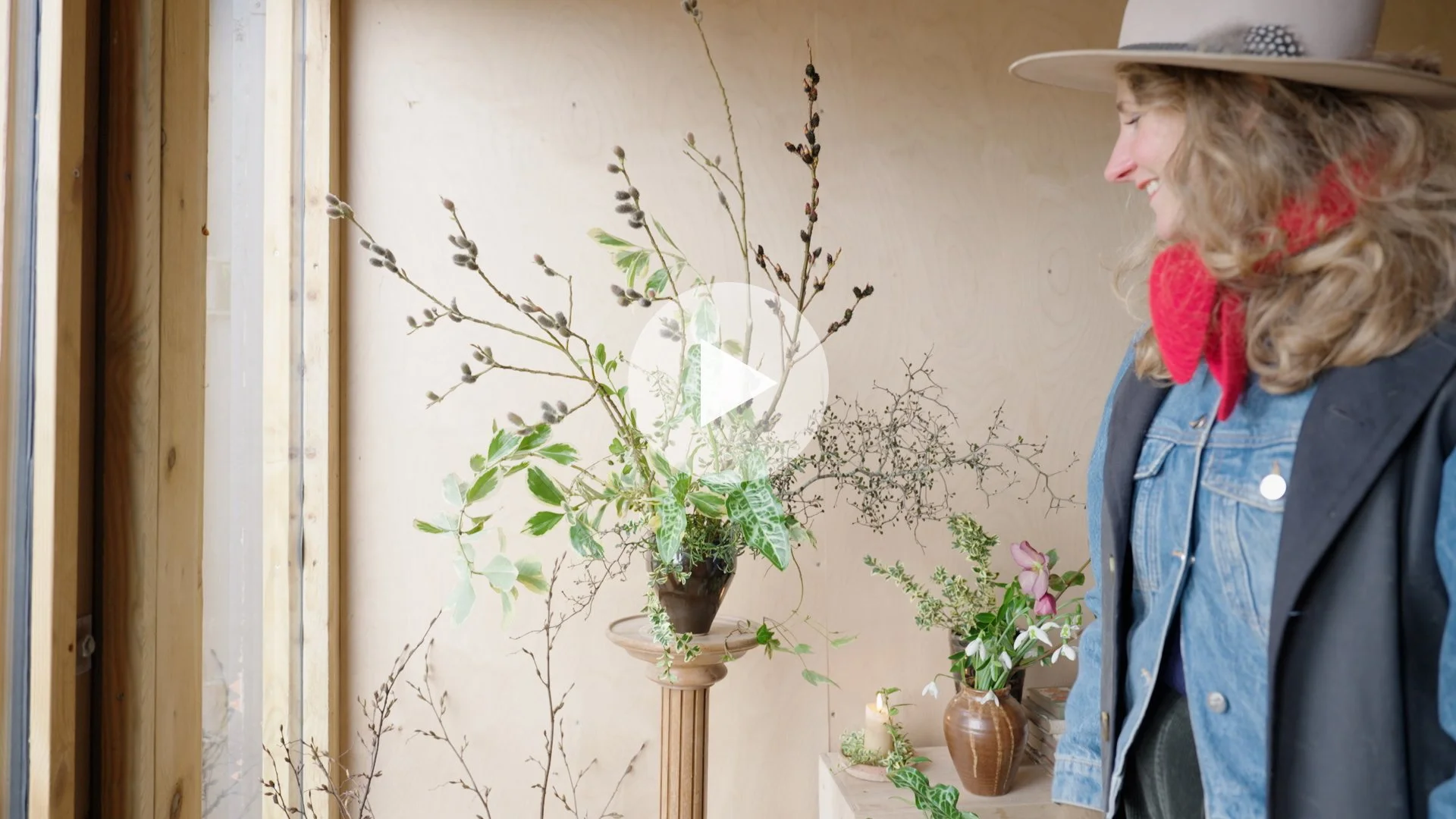
This arrangement inspired by Balmoral Cottage for Flowers on Film was an exercise in restraint, in using materials cut only from this particular place and creating a composition entirely made up of branches and leaves.
Balearic box (Buxus balearica)
Black willow (Salix nigra)
Italian lords and ladies (Arum italicum subsp. ‘Marmoratum’)
Japanese spindle (Euonymous japonicus)
Pussy willow (Salix discolor)
Rosemary-leaved box (Buxus sempervirens ‘Rosmarinifolia’)
Variegated box (Buxus sempervirens ‘Elegantissima’)
Wire-netting bush (Corokia)
Tenmoku glaze vase by Cara Guthrie
Small kenzan
Loose scrunch of chicken wire
FEBRUARY
This arrangement inspired by Balmoral Cottage for Flowers on Film was an exercise in restraint, in using materials cut only from this particular place and creating a composition entirely made up of branches and leaves. The variegated foliage provided some interest and contrast but without colour as the overriding focus the sculptural forms and texture of the ingredients came to the fore.
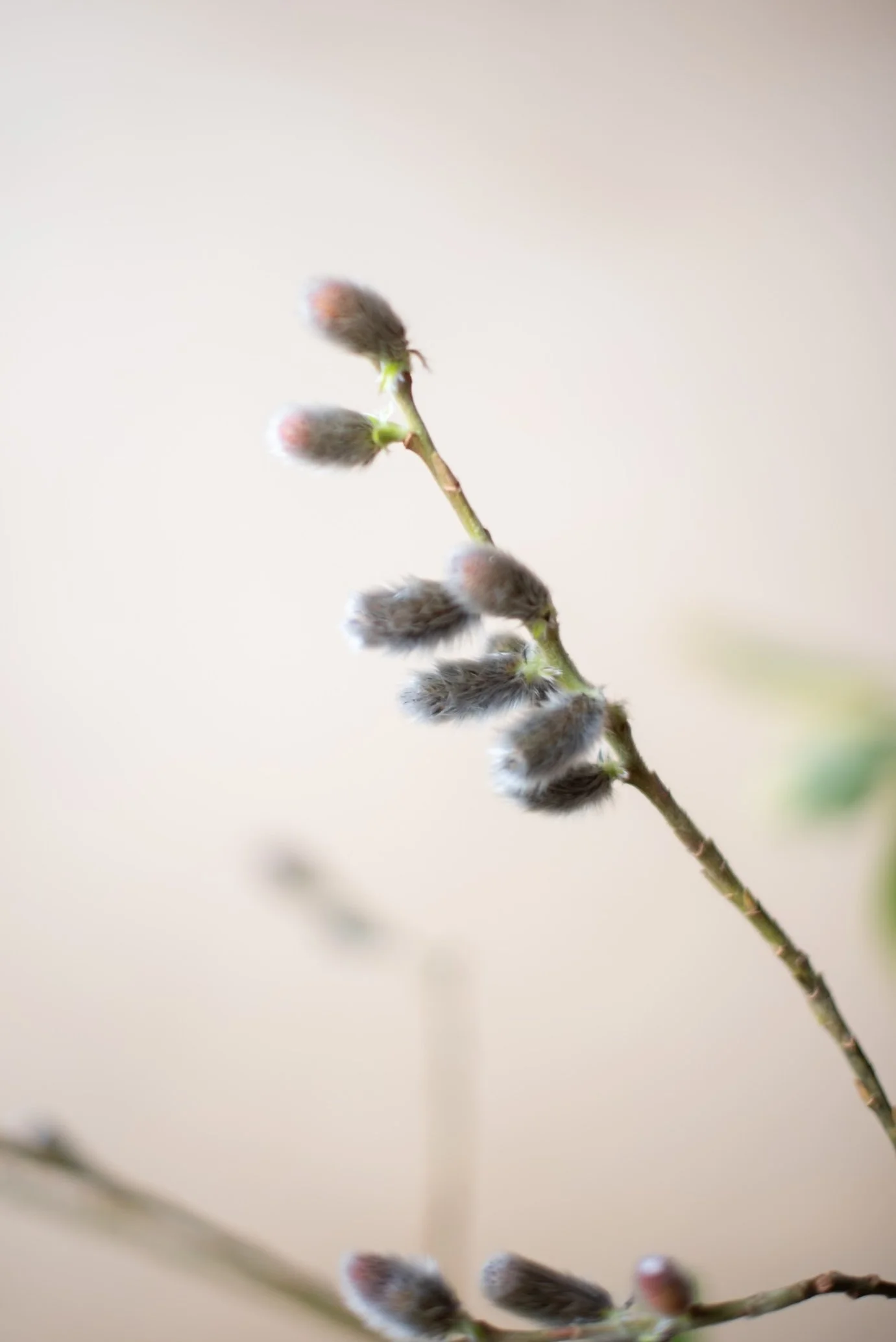
I used two varieties of willow as the foundational branches, one with soft grey catkins suffused with pink and the other black tipped with raspberry. I was really excited to get my hands on the wire-netting bush (Corokia) which is native to new Zealand and has these extraordinary interlacing wiry stems.
The large Japanese spindle grows at the centre of the garden and I found the stems satisfied the urge to soften and provide gentle curves to the parameters of the arrangement and then I couldn’t not incorporate the boxwood - Charlotte’s favourite, the variegated ‘Elegantissima’ as well as ‘Balearica’ and ‘Rosmarinifolius’. I was surprised by how lovely these were to arrange with and likewise the Italian arum, native to the UK, with its arrow-shaped leaves traced with pale veins, which Charlotte swears by and says is very long-lasting in arrangements.
Charlotte and Donald very generously loaded us up with cuttings and transplants which Johnny will be rehoming for us in the damp soil of our Hampshire cutting garden! I’m looking forward to seeing them (hopefully thrive) there in the years to come. No doubt they will remind us of that day in Kent, of feeding sorrel leaves to the sheep and drinking coffee in slanting sunlight that held the promise of spring. Read more about our day with Charlotte and Donald here.
“Variegation has been popularised by the flower arranging movement which has been a notable social and (perhaps we might claim with such modesty we can muster) artistic feature of post-war Britain. Variegated leaves have contributed importantly to the range of material available to the flower arranger, who saw more to them than had been apparent to the gardener, but who has induced the gardener to take another look at them and their role in the garden. Cross-fertilisation between the arts has always been productive.” Christopher Lloyd, Foliage Plants
ROSES OF WINTER
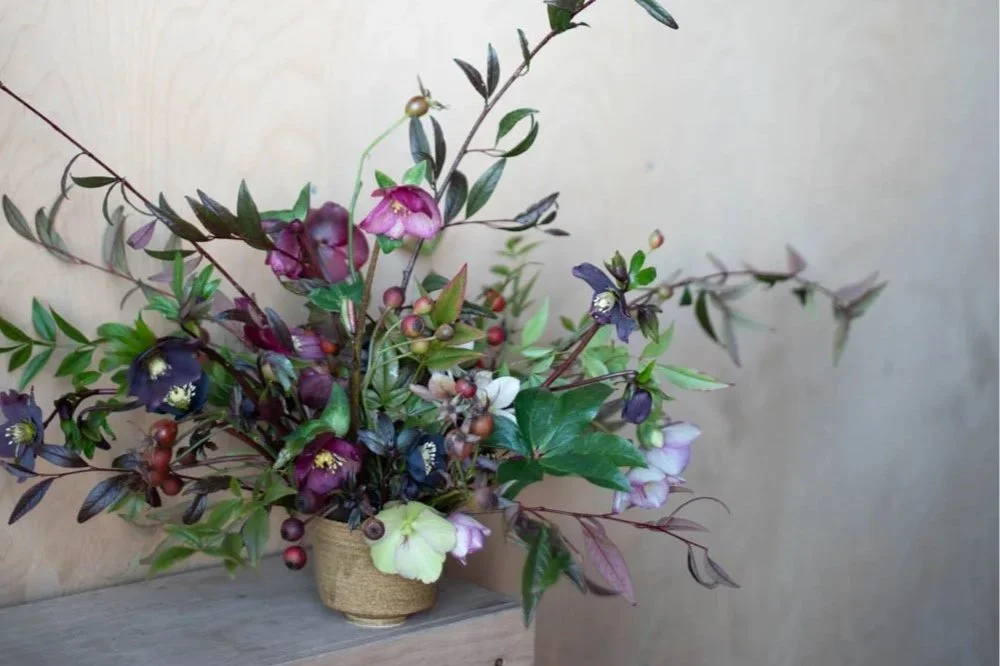
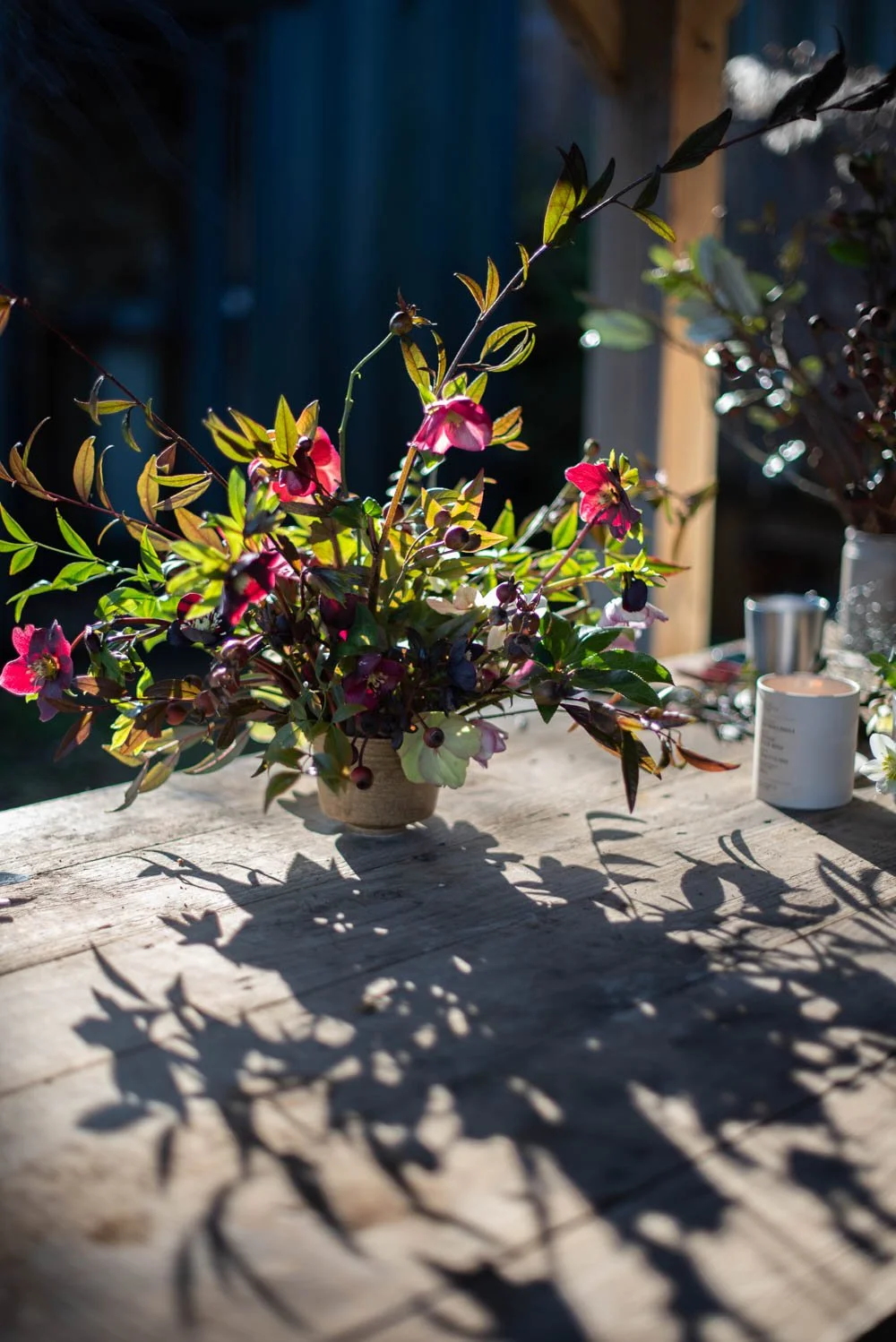
Johnny has been busy pruning roses this week and saved me a generous bucket of hips - those of Rosa ‘Desdemona’ are like plump, rosy little apples, again with that slight smokiness to the colour
Cotoneaster (Cotoneaster frigidus 'Cornubia')
Christmas rose (Helleborus niger)
Lenten rose (Helleborus x ballardiae 'Maestro')
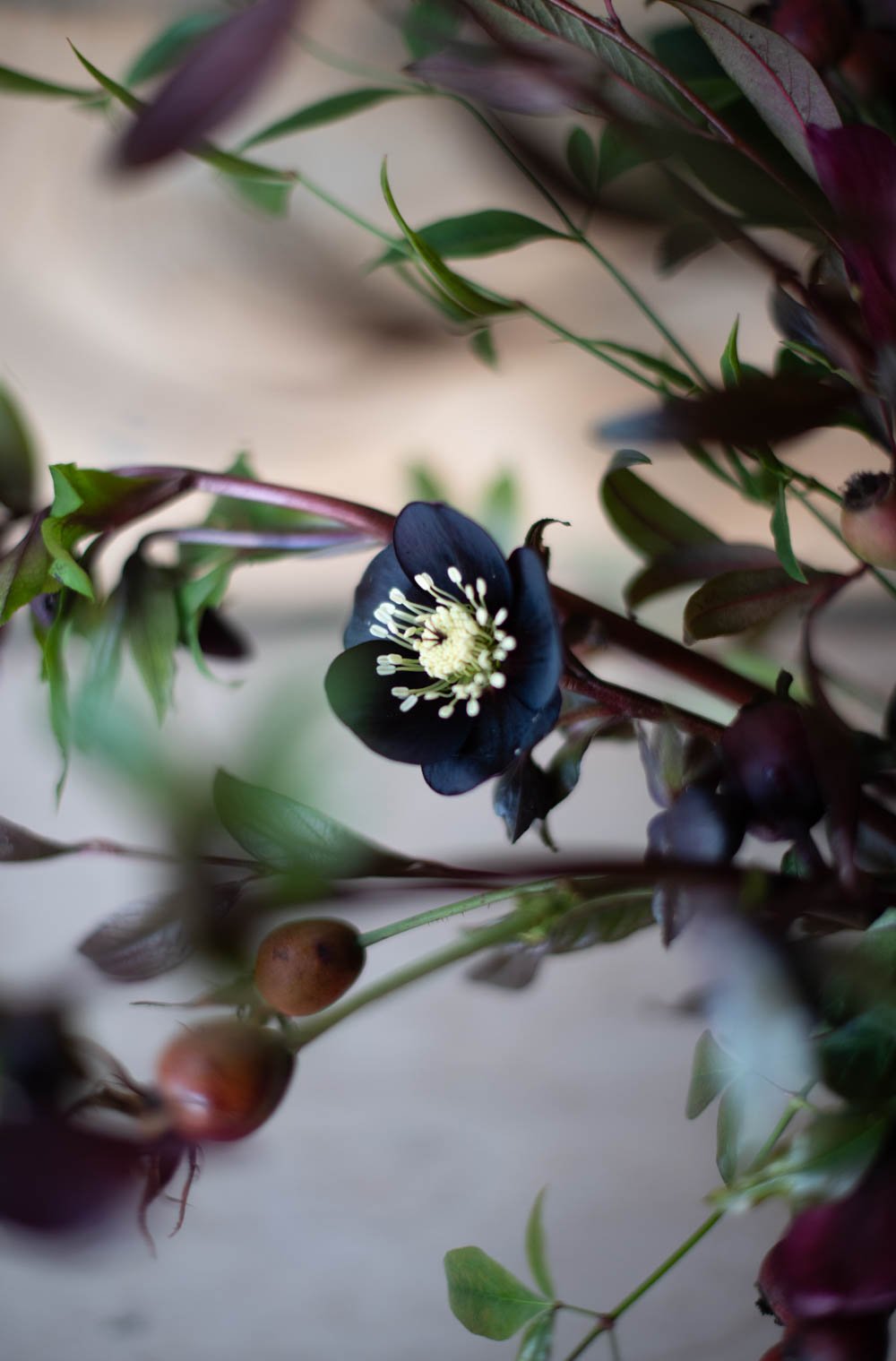
Lenten rose (Helleborus x hybridus 'Harvington Black')
Rose (Rosa 'Desdemona')
Sacred bamboo (Nandina domestica 'Obsessed')
Snow rose (Helleborus x glandorfensis 'Ice N' Roses Picotee')
Snow rose (Helleborus x glandorfensis 'Ice n' Roses Red')
Matcha bowl
Small kenzan
Small scrunch of chicken wire
FEBRUARY
The true winter rose is not one that is flown across continents, grown in equatorial sunshine. Here in the Northern Hemisphere we are still ever so slowly clutching towards lighter days and while the bulbs are inching week by week it will be another four months before the roses are in their first flush. And yet the flower industry is still flogging that dead horse in the lead-up to Valentine’s Day next weekend - from the single stem to the massed bouquet of roses imported from Kenya, Ecuador and Columbia, impossibly pert, rigid, uniform, chemically enhanced and wrapped in plastic. The antithesis of romance. Will we ever learn?
Hellebores, on the other hand, are right here under our noses and two of the primary species - Helleborus foetidus and Helleborus viridus - are native to the UK. They might not make the best cut flower in the world (much better once the papery seed capsules have developed at the centre of the sepals) but they do make an excellent gift as a living plant to be popped into the garden or potted up to soften a shady corner.
Hellebores are a miracle, really. They basically flower in the dark, in the shadows, and in the right conditions, with the right amount of love, they’ll do so cheerfully and quite prolifically from Christmas through to the spring. No matter how few hours of daylight they get or how cold they are they just “keep on buggering on”. I remember our Grandfather, who was stationed in Kenya during WWII, using this expression, one of Churchill’s, I believe, for rallying morale during that time of horror and uncertainty. Newly engaged our Grandmother waited for him for several years, not knowing whether he would come home. Now that’s romance. The hellebore is far more seasonally and symbolically appropriate, conjuring patience and hope and longing far better than any imported rose. She might not be fragrant but she doesn’t smell faintly of chemicals either. We can’t have it all and that’s what living seasonally teaches us - to wait, to be patient, to adapt and to hope for a brighter future.
In this simple arrangement I used several different varieties of hellebore in a gradation of colour from light to dark. To keep it uncomplicated in the foliage department I picked two different foliages - slim, arching branches of cotoneaster for shape and structure and sacred bamboo as a filler - specifically chosen for the elegance of the leaf shape, which are both oval with pointed tips and the colour, suffused with a dusty red darkening to maroon. The hellebores were seared in boiling water for 30 seconds to prevent them from wilting and arranged onto the kenzan by variety, starting with the palest: a picotee snow rose which is a bicolour white and pink, followed by the creamy Lenten rose ( x ballardiae named after the '“Queen of the Hellebores”, Helen Ballard who crossed Helleborus niger with Helleborus lividus to produce a number of our favourite varieties including this one (‘Maestro’) as well as ‘Merlin’ and ‘Camelot’, all of which we have around the garden and plan to consolidate together in our part-shade ‘Wabi-Sabi’ area. I like the look of ‘Pink Frost’ too - on the ever-lengthening plant wish-list!
I continue working through the red and plum flowers shade by shade until I reach ‘Harvington Black’ which has the dusty look of black grapes. The snow roses have a robustly thick stem and large flowers that I would usually cut short but it seems a shame to waste such great stem length at this time of the year. Johnny has been busy pruning roses this week and saved me a generous bucket of hips - those of Rosa ‘Desdemona’ are like plump, rosy little apples, again with that slight smokiness to the colour, and the spherical forms go some way to balancing the weight of the hellebores. I add them liberally, taking the chubbiest clusters off short and gently nestling them between the Nandina and the flower heads and saving the finer stems and the cuter, more petite fruits for elevated, more prominent positions.
RETURN TO RECIPES
SILVER GRASS, ORACLE ROSE
In Saxon England, January was known as ‘wulfmonath’ (wolf month). At this coldest time of the year hungry packs of wolves would leave the forests in search of food.
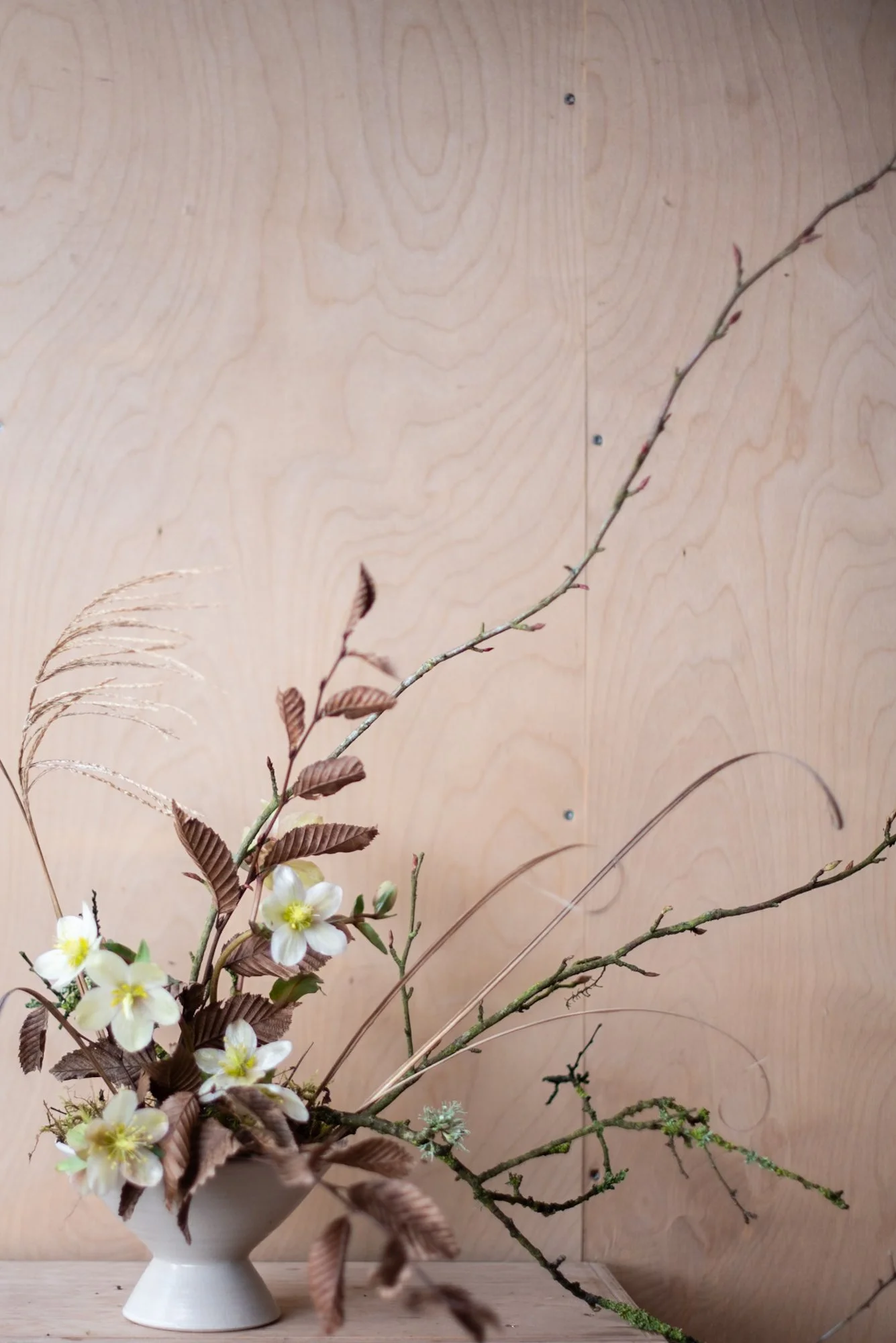
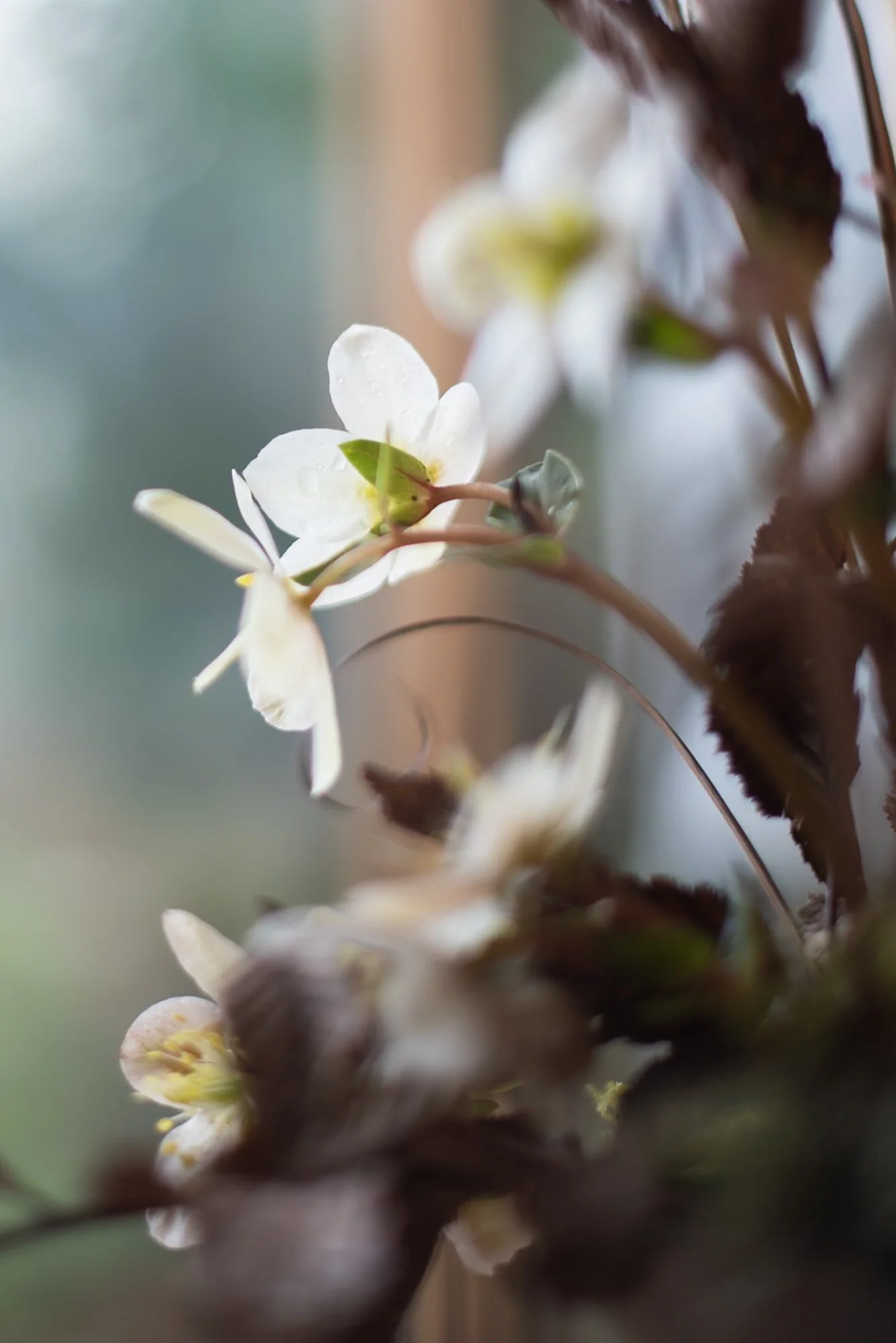
Blackthorn (Prunus spinosa)
Flowering currant (Ribes sanguineum ‘White Icicle’)
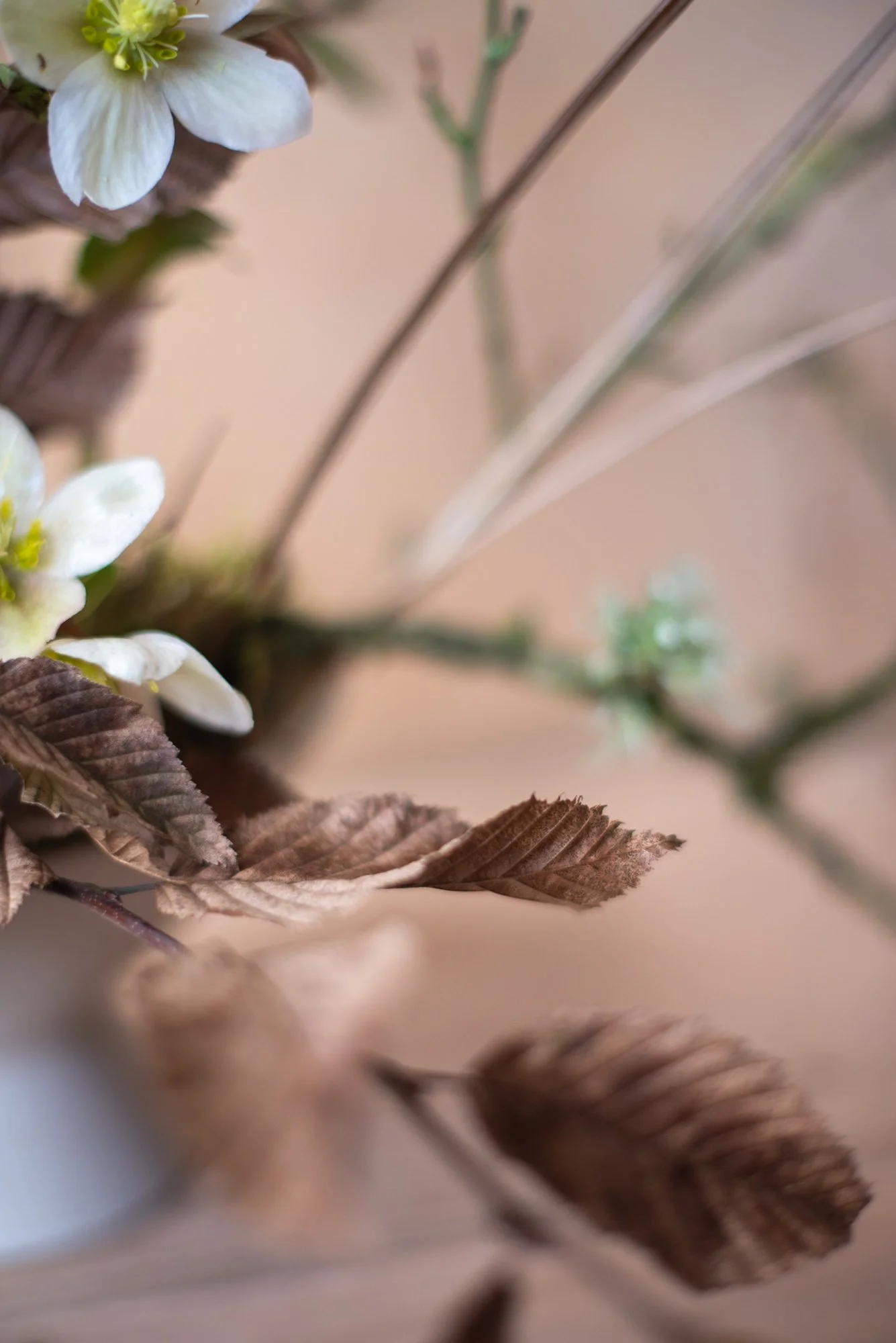
Hornbeam (Carpinus betulus)
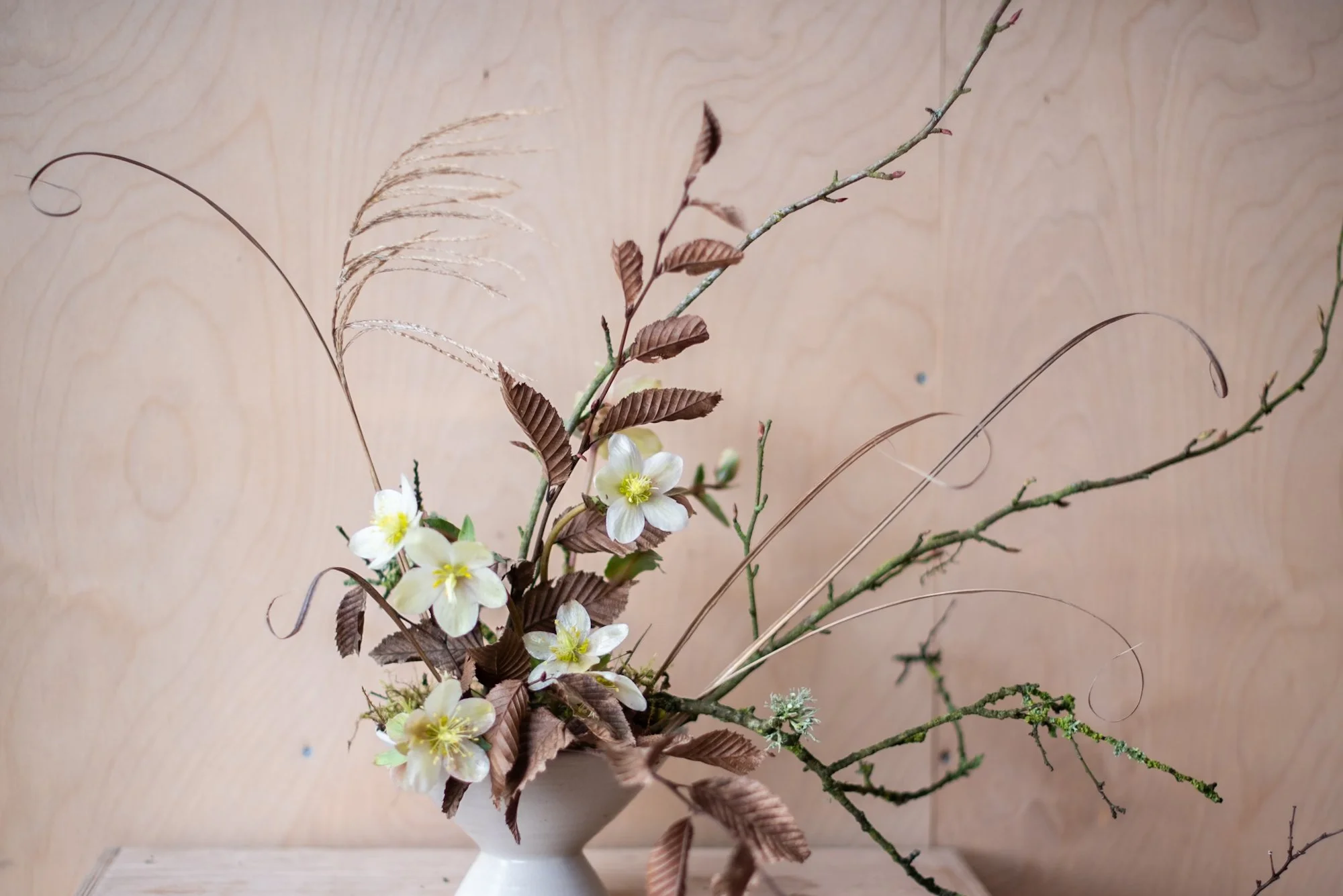
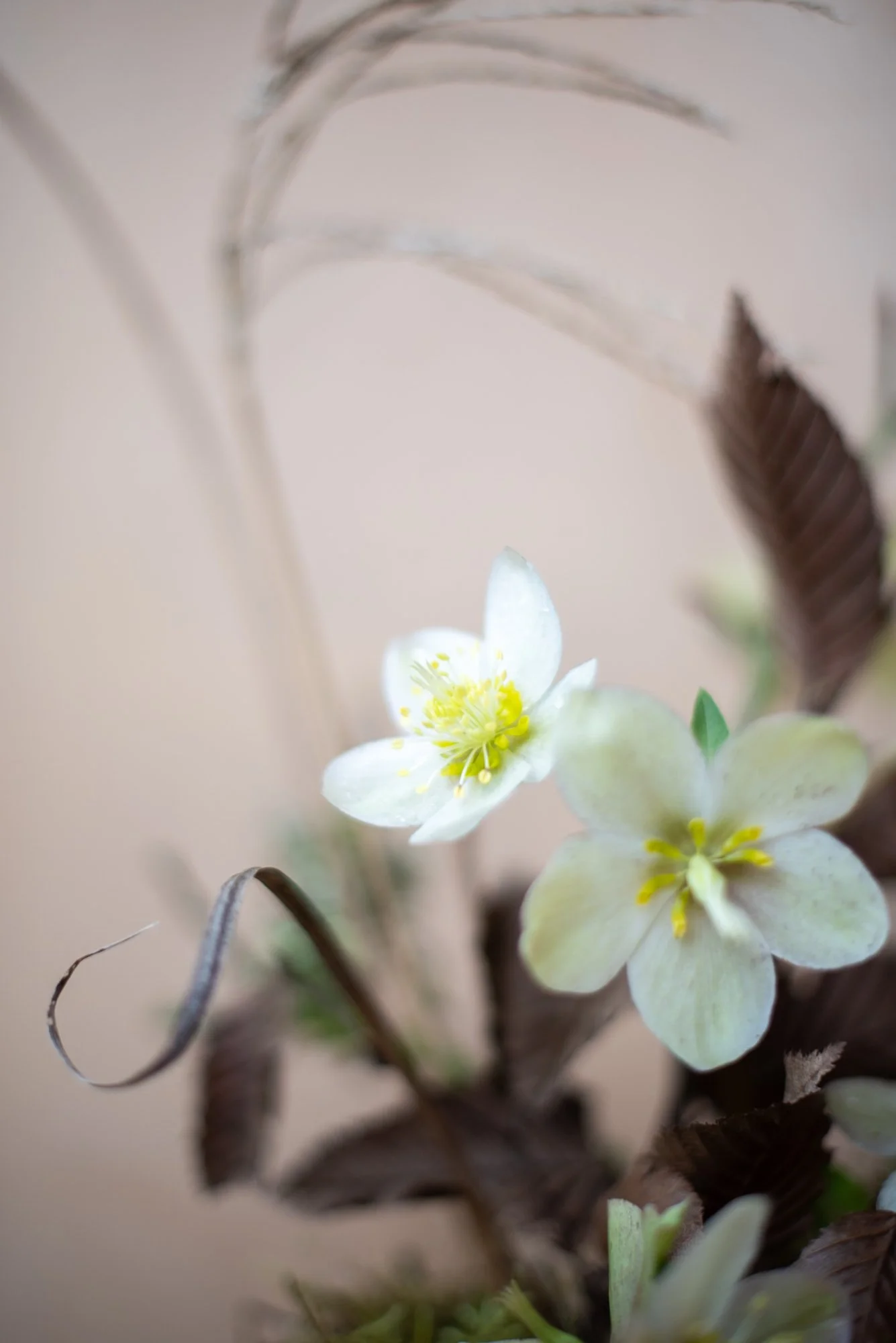
Oracle rose (Helleborus x ballardiae ‘Maestro’)
Silver grass (Miscanthus sinensis 'Kleine Fontaine')
Footed bowl
Small kenzan
JANUARY
In Saxon England, January was known as ‘wulfmonath’ (wolf month). At this coldest time of the year hungry packs of wolves would leave the forests in search of food. In their desperation they would attack villages, picking off livestock and people. I find it helpful to remind myself of this towards the end of January when it has been raining and grey for weeks on end and the garden is a sea of mud. We’re not under attack by wild, starving wolves and there is much to be grateful for.
I’m grateful for hellebores, especially. Because in this sparsest of months in the garden, there they are, taking up the baton. Hellebores are the floral lifeline that carries us through all the way from before Christmas until spring gets its feet under the table in March.
What I love about arranging flowers is just that - the active arranging, the creation in the moment. I value the process over the fait accompli which is by then passive, a static object no longer in motion. Arranging is dynamic, and exciting, because with the addition or subtraction of every individual stem it changes fundamentally from the arrangement it was before.
This arranging session for Flowers on Film was experimental, rather than intended to produce a specific outcome. I wanted to explore how minor amendments would impact the form and energy of the composition. The accompanying photographs here show the final iteration - v. 3 - but in truth most arrangements are a series of actions, layers of editing, and they have multiple interpretations.
Multiple narratives, too, because arranging is also a time to dwell upon the past. If you love history, myth and legend, every botanical material is an invitation to marvel at these extraordinary plants, their long parallel existence with the human race and their origins, uses and symbolism, whether factual or imagined.
I began with a forked, lichen-wrapped branch for structural integrity. Blackthorn - in Celtic folklore a ‘faery tree’ and liminal boundary to the otherworld.
Hornbeam, from which the Romans built their chariots. A tall tree of ancient woodlands whose seeds are a favourite of the Hawfinch, the largest finch and one of the rarest of Britain’s woodland birds.
Flowering currant. Sanguineum the Latin for ‘blood red’ though the buds are a dusky terracotta and this variety has creamy-white flowers when it blooms in early spring. First introduced to us Brits by an adventurous Scot in 1826 who sent the seeds were sent back from Fort Vancouver on the north bank of the Columbia river in Oregon - they flowering in 1828.
Hellebore, nicknamed the ‘Christmas rose’, for the bloom that sprung from the tears of a poor shepherdess travelling to pay homage to the newborn Christ in Bethlehem, and lamenting her lack of a gift and ‘Lenten rose’, since they continue to flower through the forty days of Lent to holy week. I rather like the common name of ‘oracle rose’ originating from the tradition of putting twelve hellebore flower buds in a glass of water, each representing one month of the following year, the idea being that if a bud opens to a flower by Christmas Eve, the weather is predicted to be good for that particular month, whereas if it remains closed, you can expect poor conditions!
My final ingredient: Miscanthus, the fountainous ‘silver grass’, here serving as a gestural flower. Referred to as ‘susuki’ in Japan, where it is native to, and celebrated as far back as the 8th-century, appearing in the Man’yōshū (‘Collection of Ten Thousand Leaves’) - the oldest and most revered anthology of Japanese poetry compiled around AD 759.
Flower arranging has been practiced for thousands of years; the first record dating back to 2,800 BC when the ancient Egyptians arranged flowers in vases to honour their deities. Through the cornucopias of the ancient Greeks, the evolution of Ikebana in Japan, the shadowed churches of the Middle Ages, through the still-life paintings of Renaissance Europe and the strict floral etiquette of the Victorian age, flower arrangement has been used as a means of celebrating the beauty of the natural world, exploring and documenting our place within it. It has been a means of honouring the divine, a means of creative expression and even meditation. Whether we are perceiving its two-dimensional form via the medium of photography or film, or experiencing it in real time, every arrangement is a conduit to stories of plants, places and people. So, here’s to another year of discovery and learning. And in the meantime here’s to hellebores!
RETURN TO RECIPES
WISTERIA, HOPS, CYCLAMEN
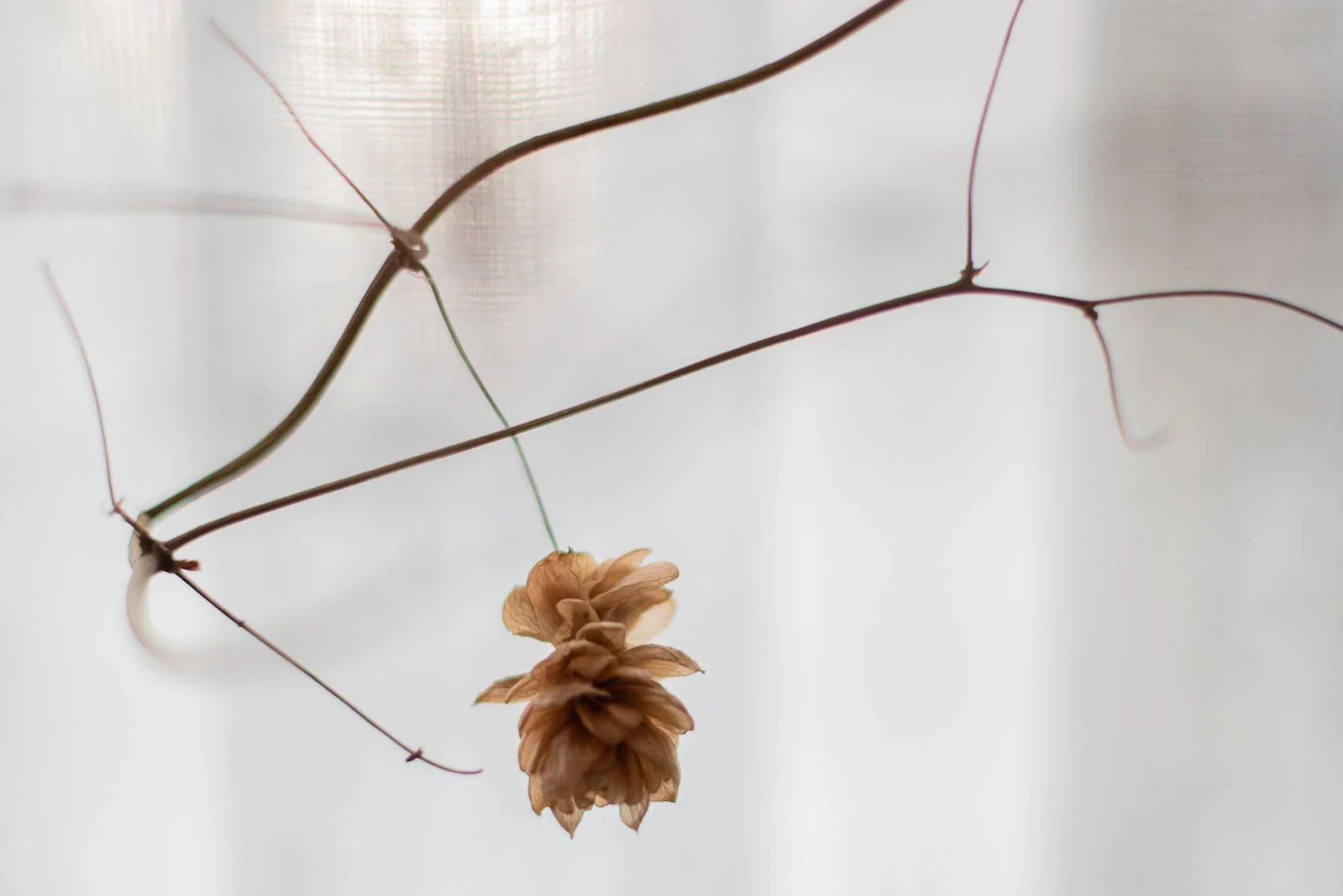
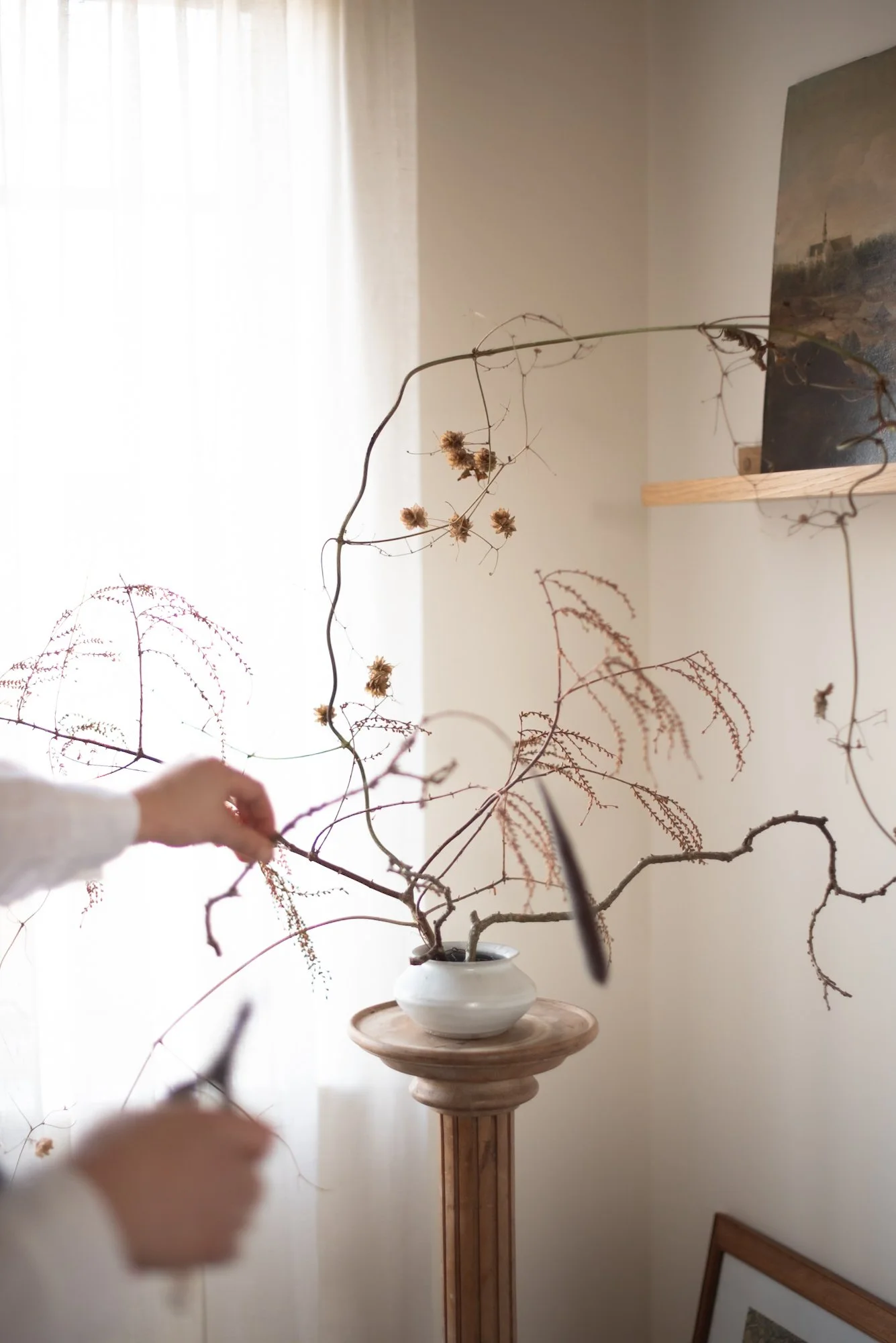
The first arrangement of the year - light and tentative with fine branches and vines and ice-white cyclamen.
Cyclamen (Cyclamen coum)
Dawn redwood (Metasequoia glyptostroboides)
Hops (Humulus lupulus)
Ivy (Hedera helix variegata)
Japanese wisteria (Wisteria floribunda)
Persian cyclamen (Cyclamen persicum 'Leopardo')
Bowl by Chloe Rosetta Bell
Small kenzan
JANUARY
In the inky days of January there is a moving away from the over-saturation of the festive period - the rich colours and glitter and noise - to a simpler state of being. There is a craving for a more pared-back existence somehow that seems to echo the natural world around us - the cleanliness of ice and bare branches, the clarity of the light. There is a ritualistic feeling to the shedding of the previous year, to slowly packing it up and putting it away. This can be accompanied by moments of melancholy - for many this is the most austere and the hardest time of the year. But embracing this space can allow us much-needed room to breathe, to declutter both physically and mentally to make room for new movement and ideas.
The hops vine is trimmed and edited of dross foliage and straight stems leaving beautifully long, curving stems which are fixed directly onto the kenzan to provide a scribbly outline shape. I choose one single redwood branch with a forked stem and add the wisteria branches short to allow their exquisite seedpods to hang down ovbe rthe front and sides of the bowl. Cyclamen and wispy stems of variegated ivy are gently layered into the water between the branches for a naturalistic ‘ground cover’ effect.


SLOE, SNOWDROP
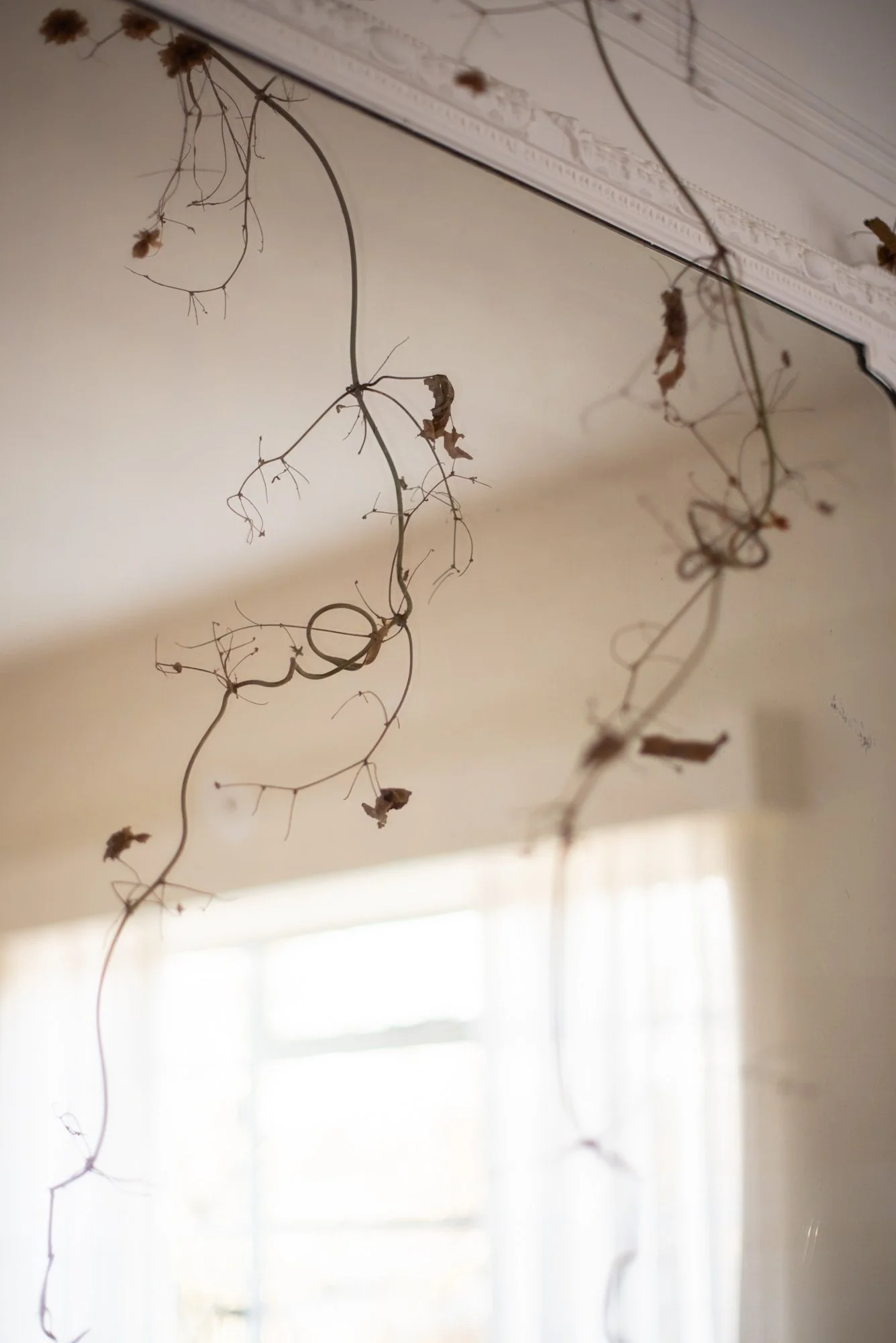
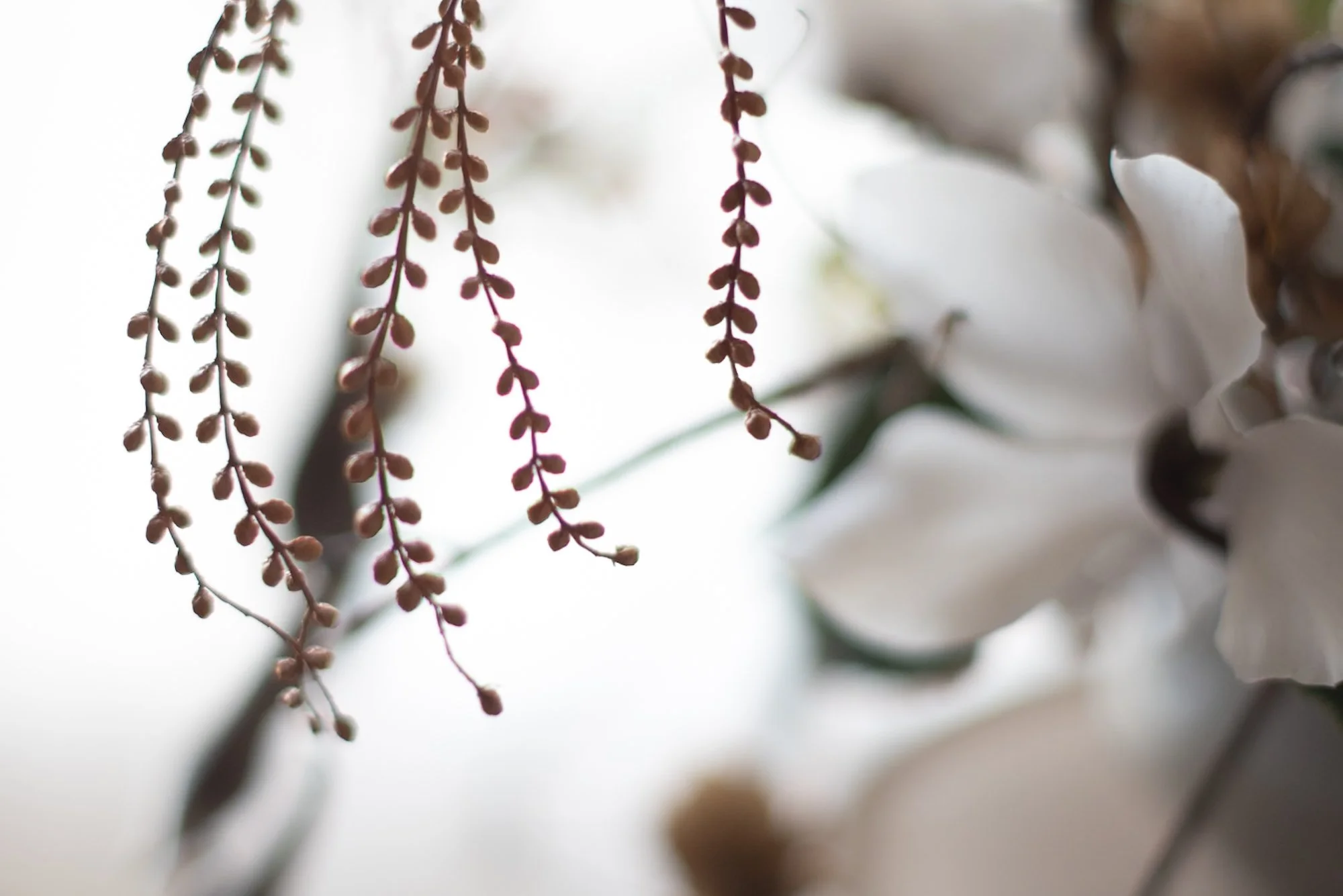
A silvery, seasonal arrangement inspired by a midwinter visit to Chelsea Physic Garden. Featuring muted foliage, sculptural winter skeletons, Majorcan hellebores and a sprinkling of snowdrops.

Cheesewood (Pittosporum tenuifolium ‘Variegatum’)
Cinquefoil (Potentilla)
Coral bells (Heuchera ‘Plum Pudding’)
Majorcan hellebore (Helleborus lividus)
Sloe (Prunus spinosa )
Snowdrop (Galanthus nivalis ‘Melvillei’)
Tree germander (Teucrium fruticans)
Ceramic bowl by Chloe Rosetta Bell (approx. 10cm diameter)
Kenzan
JANUARY
A silvery, seasonal arrangement inspired by a midwinter visit to Chelsea Physic Garden. Featuring muted foliage, sculptural winter skeletons, Majorcan hellebores and a sprinkling of snowdrops.
At a time when there are very few flowers in the garden I want to celebrate the nuances in colour and variation in texture and shape in the foliage that is still available to us. I mix elegant branches of tree germander (the underbelly of the leaves are white and felty) with Heuchera ‘Plum Pudding’ and a variegated Pittosporum that combines both the silvery green and a warmer reddy brown - the leaves are margined with a dusky pink outline. The dried woody stems of Potentilla give a whiskery softness.
A few hellebores are dotted through the leaves. These are the short-stemmed lividus variety, which refers to the colour of the leaves (the direct translation is "lead-grey") and are native to Majorca. The buds and flowers are pinkish green, with a dull bloom like a grape.
A tiny drift of crisp white snowdrops to finish (the name comes from the Greek words gala meaning "milk" and anthos - "flower" and the species name nivalis means "of the snow". ) This snowdrop is believed to have been bred over one hundred years ago by David Melville, the head gardener of Dunrobin Castle. Five miles south of Brora, the castle is the most northerly of the great houses of Scotland and the largest in the Northern Highlands. It has a formal Victorian garden designed by Sir Charles Barry inspired by those at the Palace of Versailles and today arrangements are still displayed throughout the castle with ingredients cut straight from the garden.
Tips: Instead of snowdrops and hellebores you could try this with primula, crocus, aconite, cyclamen - any of the diminutive late-winter / early spring flowers.
RETURN TO RECIPES

DESICCATED BLACKBERRY
Foraged botanical treasure in a Japanese tea-bowl featuring intricate bramble stems with the desiccated, rusty berries still clinging to thorny branches.

Blackberry (Rubus fruticosus)
Couch grass (Elymus repens)
Cowslip (Primula veris)
Dwarf daffodil (Narcissus 'Tête-à-tête’)
Goose grass (Galium aparine)
Ivy (Hedera helix)
Netted iris (Iris reticulata ‘Katherine’s Gold’)
Peat moss (Sphagnum girgensohnii )
Japanese hand-painted tea-bowl (approx. 10cm diameter)
Kenzan
FEBRUARY
Foraged botanical treasure in a Japanese tea-bowl featuring intricate bramble stems with the desiccated, rusty berries still clinging to thorny branches.
Flower arranging in miniature - an experiment! Using the first radiant yellow flowers, their stem-length not exceeding 15 centimetres, I search the cutting garden for interesting seasonal ingredients to combine them with and find them at the periphery - wispy grasses, trails of ivy and a perfectly preserved dried blackberry bramble leftover from the autumn. Always worth a quick scan of the hedgerow.
A tip: use a small handful of moss to conceal your flower frog or chicken wire supporting the taller stems. It makes for a fragrant, textural ‘filler’.
RETURN TO RECIPES

QUINCE, HONEYSUCKLE, SQUILL
Taking inspiration specifically from Monet’s garden at Giverny, I choose to use a palette of muted greens and drifting soft pastels interspersed by flaming pops of red from the ornamental quince.

Cardoon (Cynara cardunculus)
Christmas rose (Helleborus ‘Double Helen’, ‘Harvington Picotee’, ‘Ice n’ Roses’ and ‘Maestro’)
Honeysuckle (Lonicera periclymenum)
Japanese quince (Chaenomeles japonica)
Radde's fritillary (Fritillaria raddeana)
White squill (Scilla mischtschenkoana)
Ceramic bowl (approx. 14cm diameter)
Kenzan
FEBRUARY
An arrangement commissioned by Exhibition on Screen to celebrate the launch of‘PAINTING THE MODERN GARDEN: MONET TO MATISSE’, a film by Seventh Art Productions.
Taking inspiration specifically from Monet’s garden at Giverny, I choose to use a palette of muted greens and drifting soft pastels interspersed by flaming pops of red from the ornamental quince (so called as it is commonly grown for its decorative flowers, rather than for the fruit which is tough and sour).
Directed by David Bickerstaff, PAINTING THE MODERN GARDEN: MONET TO MATISSE takes the audience on a magical journey from the gallery to the gardens of the world’s best loved artists. It explores the beautiful spaces that we’ve come to know through the masterpieces they inspired. Claude Monet was an avid horticulturist and arguably the most important painter of gardens in the history of art, but he was not alone. Great artists like Van Gogh, Bonnard, Sorolla, Sargent, Pissarro and Matisse all saw the garden as a powerful subject for their art. The film discovers how these artists built and cultivated their gardens to explore contemporary utopian ideas and motifs of colour and form. Guided by passionate curators, artists and garden enthusiasts, the film explores the gardens of Giverny and Seebüll, it reveals the rise of the modern garden in popular culture and the public’s enduring fascination with gardens today.
A tip: consider how the colour of your foliage will affect the composition - there are so many greens. Here I used silver and grey greens because I wanted the overall effect to be soft, cool and dream-like. Had I used a dark green the contrast would have produced a less peaceful, more dramatic effect.

PINE, FERN & MOKUBA RIBBON
A sprawling, textural hand-tied from the garden as winter turns to spring tied with embroidered silk ribbon.

Lenten rose (Helleborus x ballardiae ‘Maestro’Helleborus x ballardiae ‘Maestro’)
Lodge-pole pine (Pinus contorta)
Sacred bamboo (Nandina domestica)
Wood fern (Dryopteris)
Black silk ribbon embroidered with flowers from Mokuba
FEBRUARY
Inspired by a garden we visited in Japan - minimal selection of just four ingredients are gently balanced for a textural bouquet using the hand-vase technique. This involves creating a circle between your thumb and fore or middle finger, then layering up the stems of foliage to create a supportive network for the flowers.
This ribbon is something of a talisman and has been with us since the beginning. I remember the afternoon I bought it in the Mokuba ribbon store in New York. It was a chilly April day. That morning I had been interning for Nicolette Camille, helping to deliver some flowers from her Williamsburg studio to an event in Manhattan. I remember looking over into the backseat of Nicolette’s truck, crossing the bridge, with the soft pastel yellows and plum spring flowers gently jostling together in the morning light. After years of changing jobs I remember distinctly thinking, at that moment: ah okay, I think I’ve finally found what I want to do with my life! Every time I see this embroidered silk band slither out of the ribbon box I remember how new and exciting it all was, on the very brink of beginning. And I can honestly say it is no less new and exciting now.
A tip: make use of your prunings! I always cut back the ferns in my London courtyard by mid February and love to use them as collars for bouquets or as filler foliage in arrangements at this time of the year.
RETURN TO RECIPES

SNOWDROP & ICE BLUE SILK
A delicate bouquet for Valentine’s - a clutch of tiny stems with an oversized swathe of silk taffeta ribbon in palest blue.

Netted iris (Iris reticulata ‘Alida’ and ‘Frozen Planet’)
Petticoat daffodil (Narcissus bulbicodium)
Sacred bamboo (Nandina domestica)
Snowdrop (Galanthus nivalis )
FEBRUARY
A delicate bouquet for Valentine’s - a clutch of tiny stems with an oversized swathe of silk taffeta ribbon in palest blue.
A mesh of the sacred bamboo and then individual stems carefully nestled and woven through. A sweetly scented, thoughtful posy for a small vase on the table or beside the bed.
A tip: use jute / hemp twine instead of florist tape to tie your bouquet - it’s compostable.
RETURN TO RECIPES

PETTICOAT DAFFODIL, ROSE LEAF
Black (or almost-black) flowers can be challenging because they can look like dark holes in an arrangement, especially in dim light.
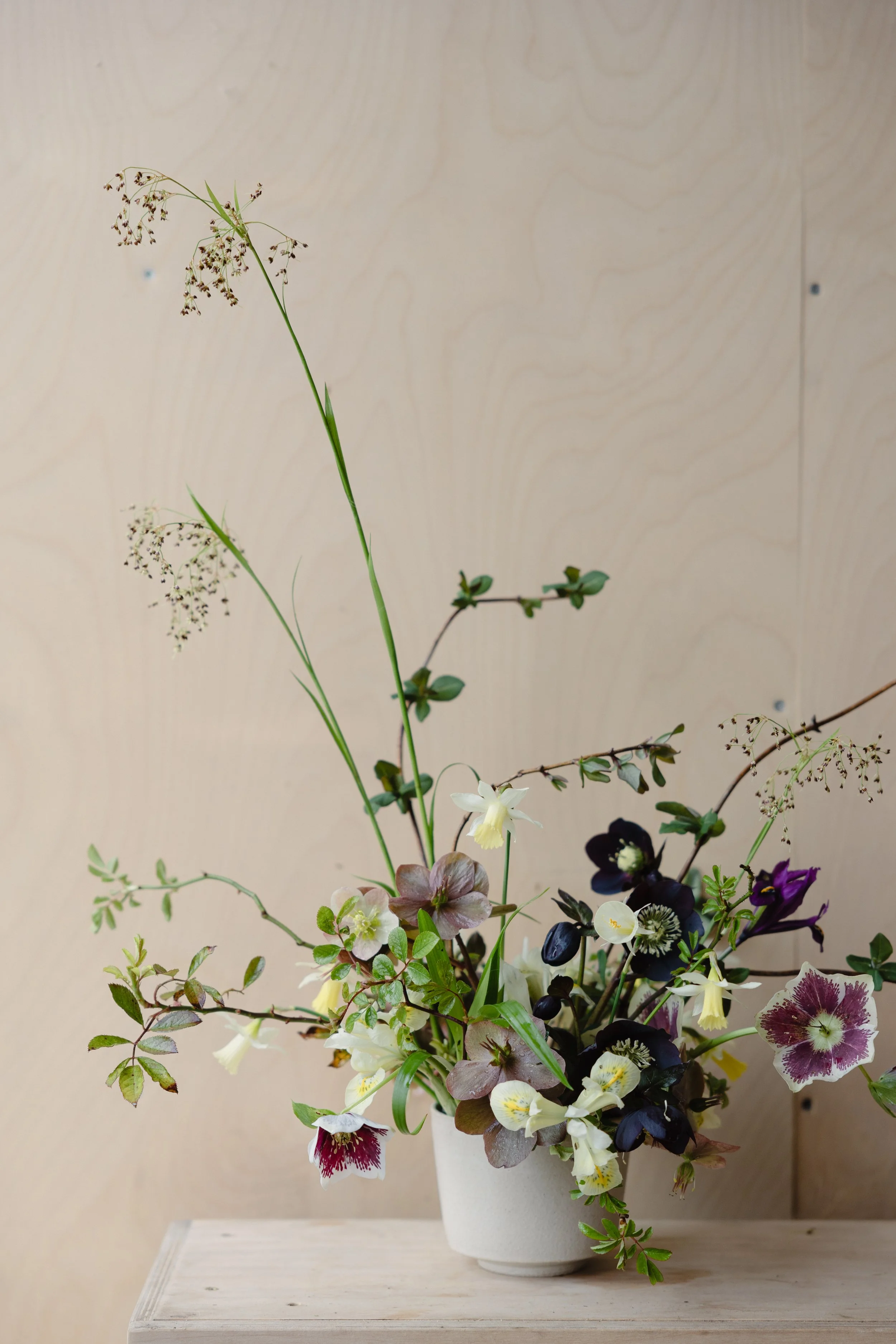
Christmas rose (Helleborus x hybridus ‘Harvington Black’, ‘Harvington White Speckled’, ‘Merlin’)
Daffodil (Narcissus ‘Elka’)
Greater woodrush (Luzula sylvatica)
Honeysuckle (Lonicera periclymenum)
Netted iris (Iris reticulata ‘Blue’ and ‘Katherine’s Gold’)
Petticoat daffodil (Narcissus bulbicodium)
Aesme Studio Seika bowl
Small cap of chicken wire
FEBRUARY
Black (or almost-black) flowers can be challenging because they can look like dark holes in an arrangement, especially in dim light. The early- blooming, pale lemon daffs and iris are a good foil - soft but also picking up the yellow stamens of the hellebores. To bridge the gap I ensure the other ingredients are muted and dusky - plum hellebores and the small grey leaves of honeysuckle which are just beginning to unfurl.
We transplanted the woodrush to our cutting garden from our parents’ old garden in Oxford and they are now thriving in the damp shade of a tree, happily ensconced among ferns.
Tips: Once you’ve finished placing flowers use up any leafy off-cut stems to fill in holes around the edges of your arrangement - waste not, want not.
RETURN TO RECIPES

HELLEBORE, CRABAPPLE, RUE
An arrangement of fresh leaves and flowers combined with dried umbels and skeletal stems from the midwinter garden in a speckle-glazed Korean bowl.

Calamint (Calamintha nepeta)
Christmas rose (Helleborus niger)
Common rue (Ruta graveolens)
Crabapple (Malus)
Glossy abelia (Abelia x grandiflora)
Ground ivy (Glechoma hederacea)
Panicled hydrangea (Hydrangea paniculata)
Ceramic bowl (approx. 12 cm diameter)
Kenzan
JANUARY
An arrangement of fresh leaves and flowers combined with dried umbels and skeletal stems from the midwinter garden in a speckle-glazed Korean bowl.
I make an asymmetric shape (one side tall, the other wide) with the leafy branches and dried stems. The flowers are placed lower, ensuring they are affixed to the kenzan and following the asymmetric shape. The shorter foliage stems are used to fill in around the base of the bowl - the rue has a gorgeously citrus-y, herbaceous scent - then a smattering of crabapples balanced on this leafy base. You can also skewer the fruit onto fine sticks and gently fix them to the kenzan to vary the height.
Tips: Cutting your hellebores when the anthers have fallen and the seedpod is mature you will find they are less prone to drooping. If you are using younger flowers with fresh anthers and pollen still evident (as I have here), searing your hellebores will help to ensure they last longer in the vase. Cut the stem end at a sharp angle and submerge the bottom couple of centimetres in just-boiled water for twenty to thirty seconds. This disperses any air bubbles blocking the stem and forces water up to the flower head. Place the stems into tepid water and leave overnight before arranging.