
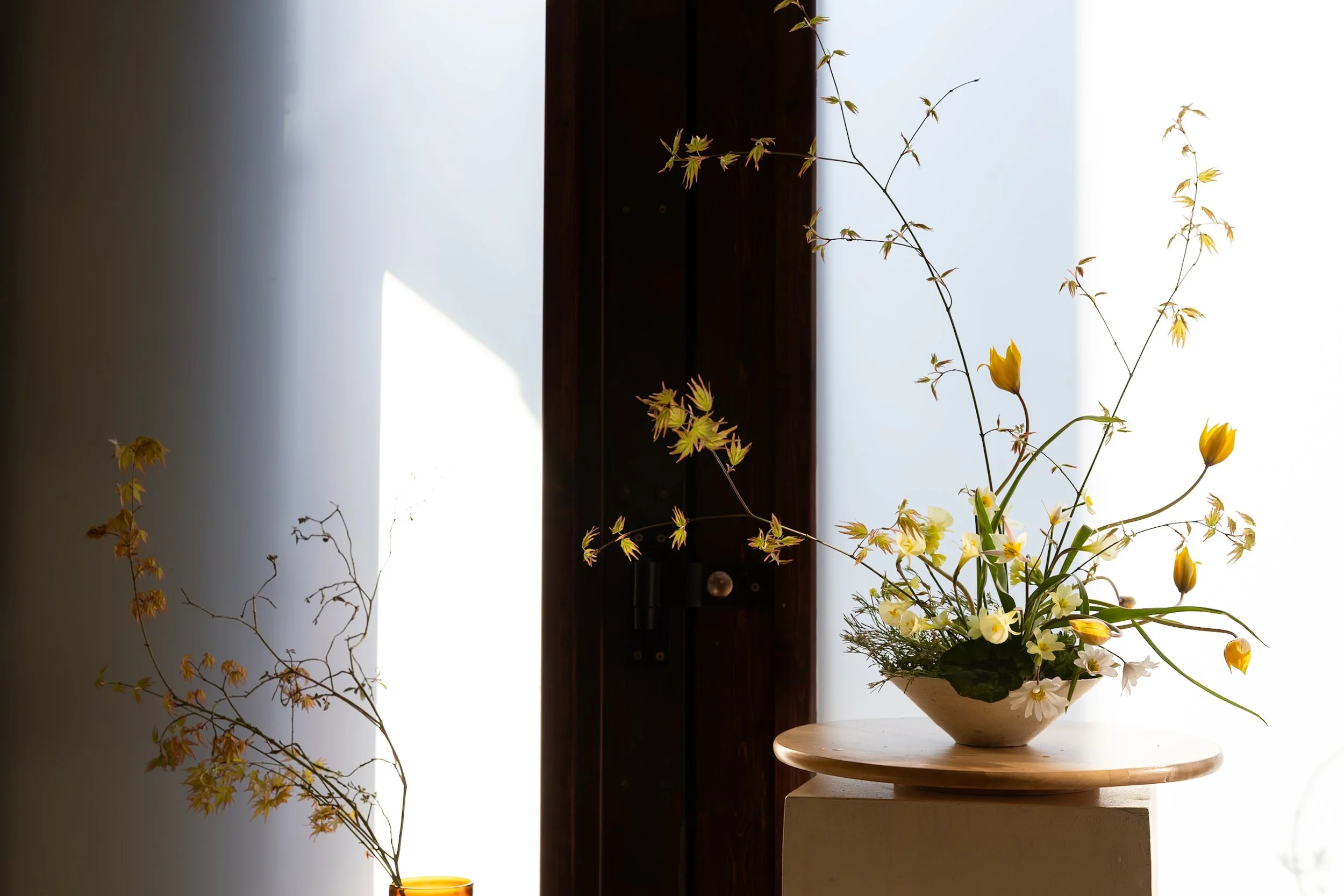
WILD TULIP, COWSLIP
The diminutive flowers that emerge as spring unfolds appear almost impossibly fragile and are somehow all the more precious for it. Arranging these tiny stems is a meditative process - very specific, very gentle.

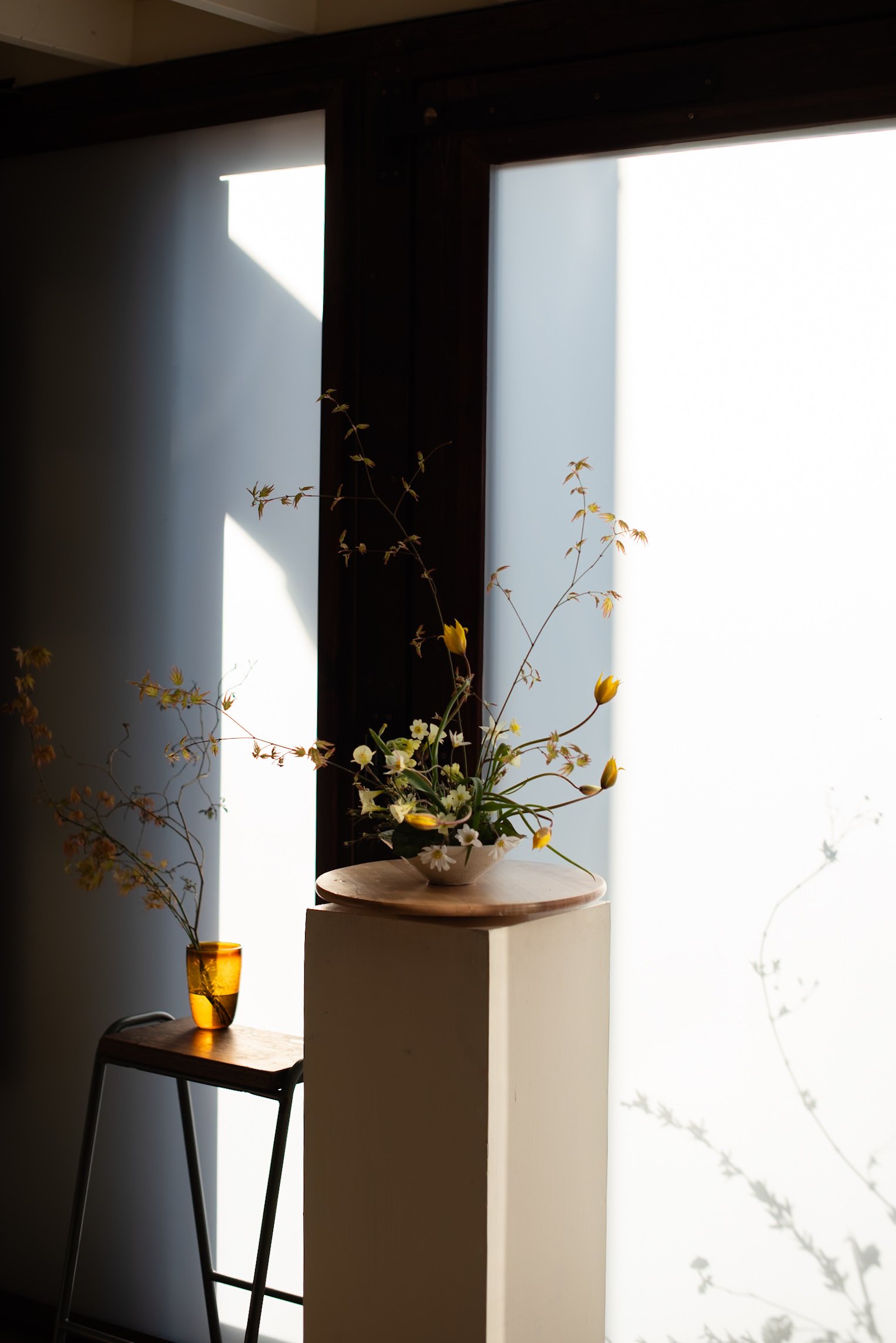
Cowslip (Primula veris)
Cyclamen (Cyclamen coum)
Hairy bittercress (Cardamine hirsuta)
Japanese maple (Acer)
Miniature daffodil (Narcissus 'Elka')
Petticoat daffodil (Narcissus bulbicodium 'Spoirot')
Tazetta daffodil (Narcissus 'Minnow')
Turkestan tulip (Tulipa turkestanica)
Wild primrose (Primula vulgaris)
Wild tulip (Tulipa sylvestris)
Wood anemone (Anemone nemerosa)
Low ceramic bowl from Japan
Medium kenzan (pinholder)
MARCH
The diminutive flowers that emerge as spring unfolds appear almost impossibly fragile and are somehow all the more precious for it. Arranging these tiny stems is a meditative process - very specific, very gentle. The Cardamine hirsuta (hairy bittercress) is an edible weed that crops up all around the garden and we often harvest clumps to use as filler / ‘ground cover’ in arrangements to disguise mechanics and tuck into void spaces. I love the species tulips which are the first to appear - Sylvestris, the wild or woodland tulip, have dancing stems that seem to have a life of their own and bring a sense of spirit to any arrangement. They yawn open in the sun, close again in the shade and have a sweet citrus scent, like lemony honey.
RETURN TO RECIPES
FLOWERING CURRANT, BLACK IRIS
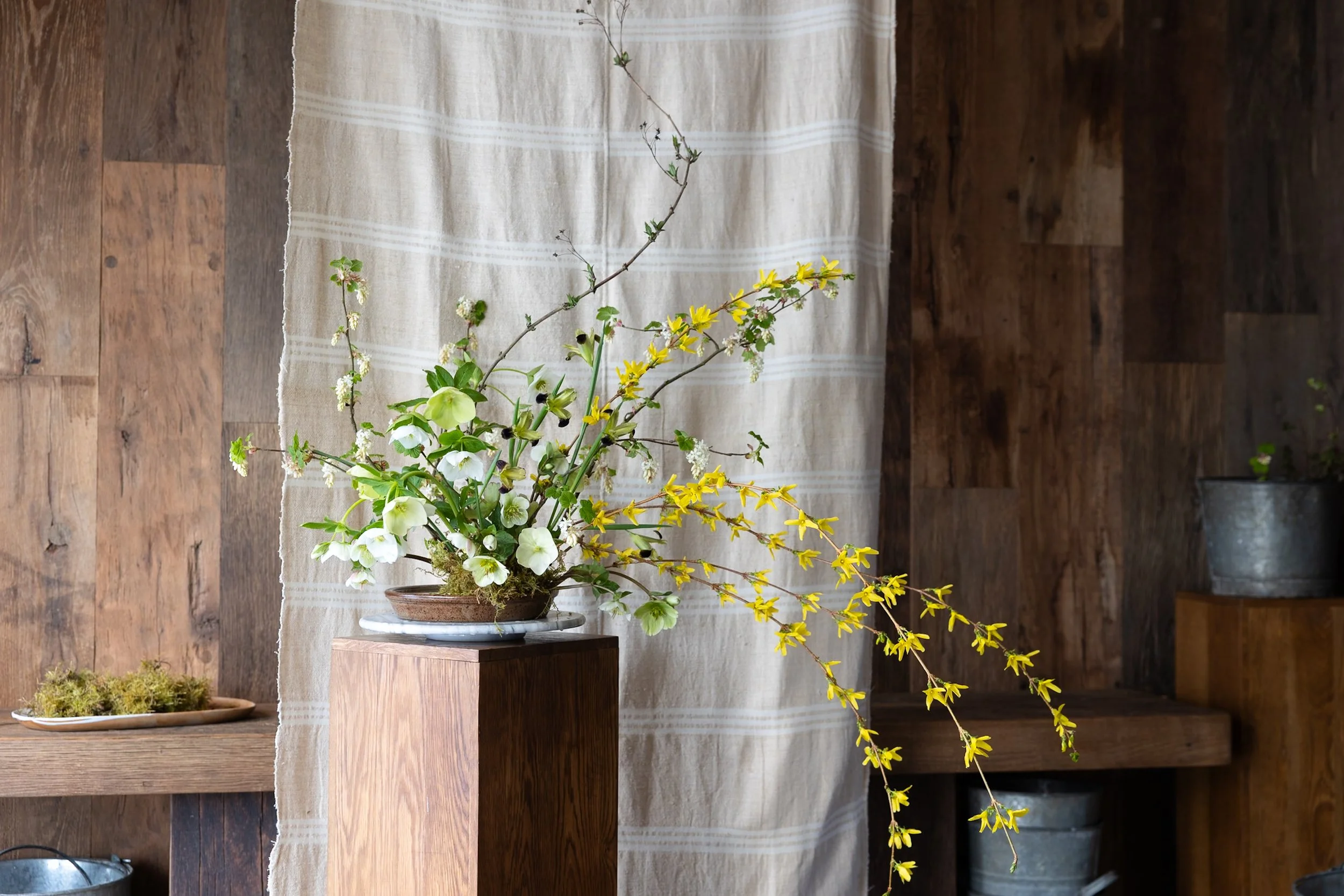
Feels like spring is finally on the way! This week in the studio - waves of bright yellow Forsythia, scented Ribes and velvety widow iris.


Flowering currant (Ribes sanguineum 'White Icicle')
Golden bells (Forsythia)
Large cupped daffodil (Narcissus 'Mount Hood')
Lenten rose (Helleborus orientalis 'Iced Lime')
Moss (Hypnum cupressiforme)
Widow iris (Hermodactylus tuberosus)
Low ceramic dish in a speckled grey glaze
Triangular kenzan (pinholder)
MARCH
To honour the sculptural forms of the spring branches and iris I choose a triangular kenzan that is fixed to one side of the shallow dish. The materials are grouped by variety - the forsythia in a vibrant wave cascades outwards to one side, the flowering currant opposite. I cut these shorter to allow a view of the dish and the surface of the water below. My trusty ‘backwards S’ Deutzia (salvaged from last week’s arrangement) leads the eye up and away in a meandering journey and the hellebores and iris are staggered in a stepping stone formation through the middle front to back. Pinches of moss are used around the stems where they affix to the kenzan to soften the base.

RED ROOSTER
With the vernal equinox it is officially spring. To celebrate, a sculptural curation of branches just unfurling their first leaves.


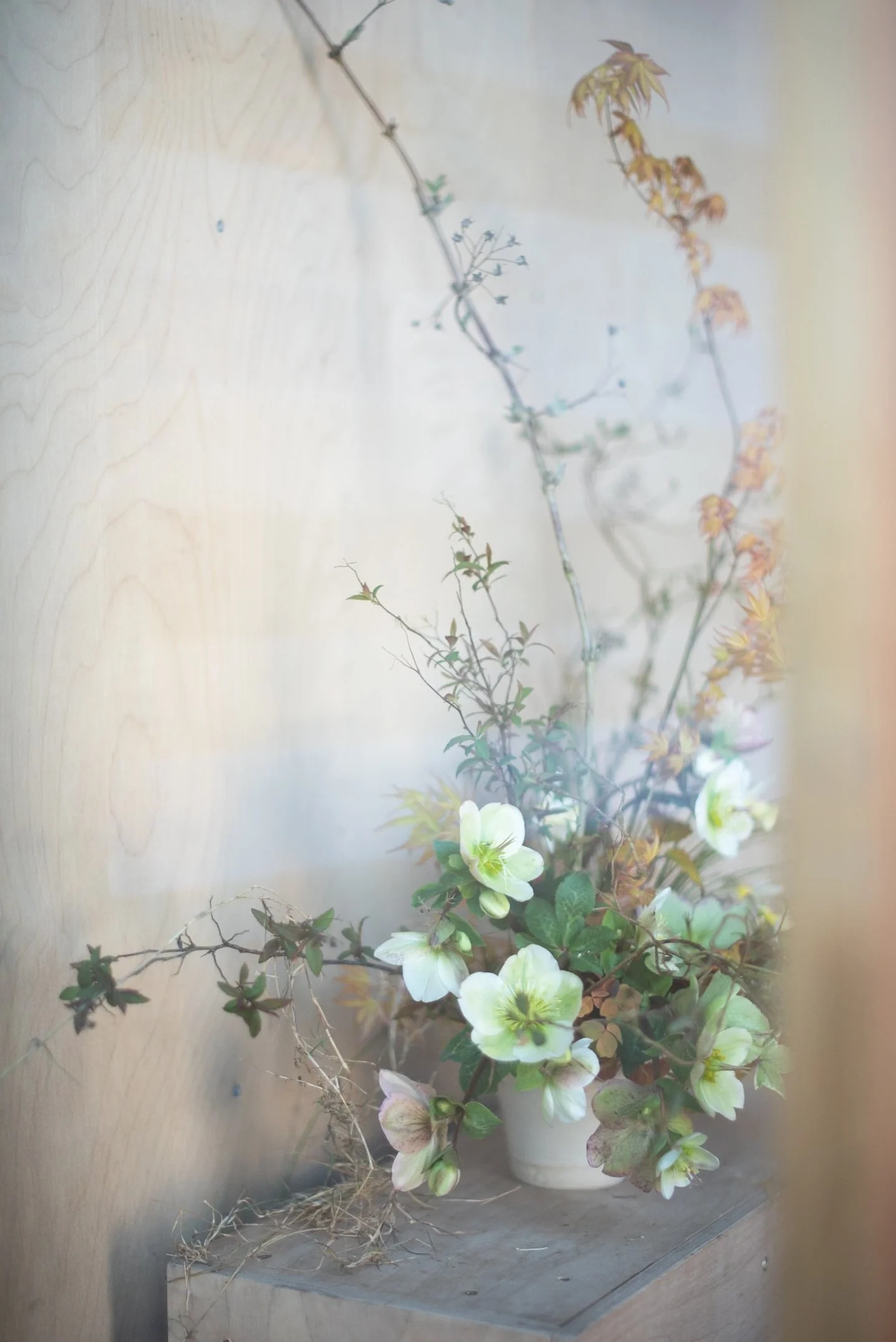

Azalea (Rhododendron)
Blackberry (Rubus fruticosus)
Christmas rose (Helleborus ‘Molly’s White’)
Deutzia (Deutzia x hybrida ‘Mont Rose’)
Ivy (Hedera helix)
Japanese maple (Acer palmatum ‘Katsura’)
Japanese spiraea (Spiraea japonica)
Leatherleaf sedge (Carex buchananii ‘Red Rooster’)
Miniature daffodil (Narcissus ‘ Elka’)
Volcanic sorrel (Oxalis spiralis vulcanicola ‘Gold’)
Aesme Studio ceramic ‘Seika’ bowl
Kenzan & chicken wire
MARCH
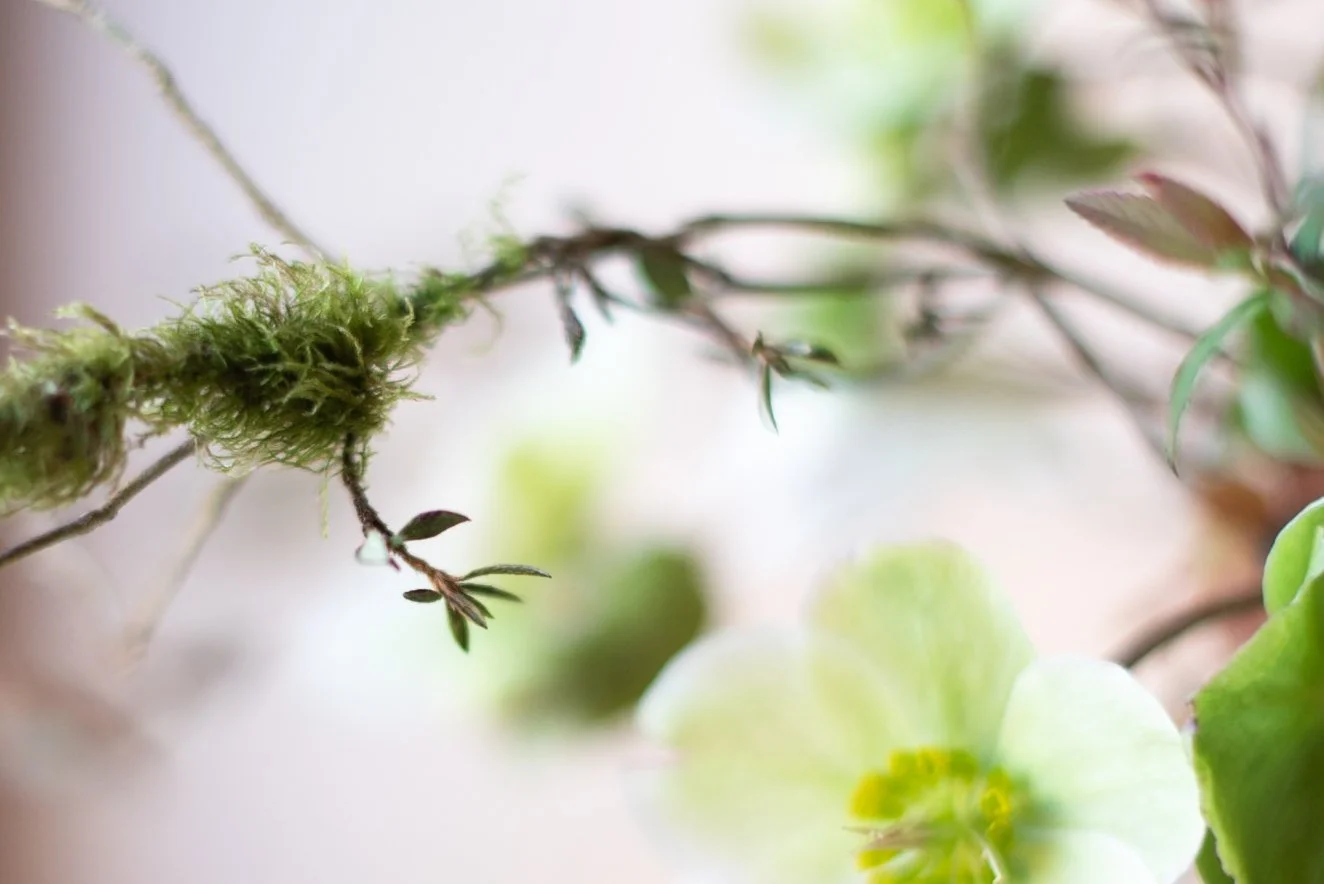
We all associate yellow with spring, orange with autumn, but they are the predominant colours of both seasons, at least in our garden, and we often find ourselves reaching for rusty, golden and bronze tinged leaves as the season begins in late March. This arrangement starts with one single briar of Rubus fruticosus (blackberry) - the leaves are lime and apricot, spotted with a dusky raspberry pink and I take it with me through the garden in search of other materials within the same colour families. The Deutzia branch catches my eye on the way - a gorgeous backwards ‘S’ shape that I affix to the kenzan so that it waves around like a wand over the lower flowers and leaves, as it naturally behaves in the garden. Each ingredient is grouped to evoke the individual plants with the tiny dwarf daffodils gently placed last, along with small pinches of moss to cover the chicken wire.
RETURN TO RECIPES
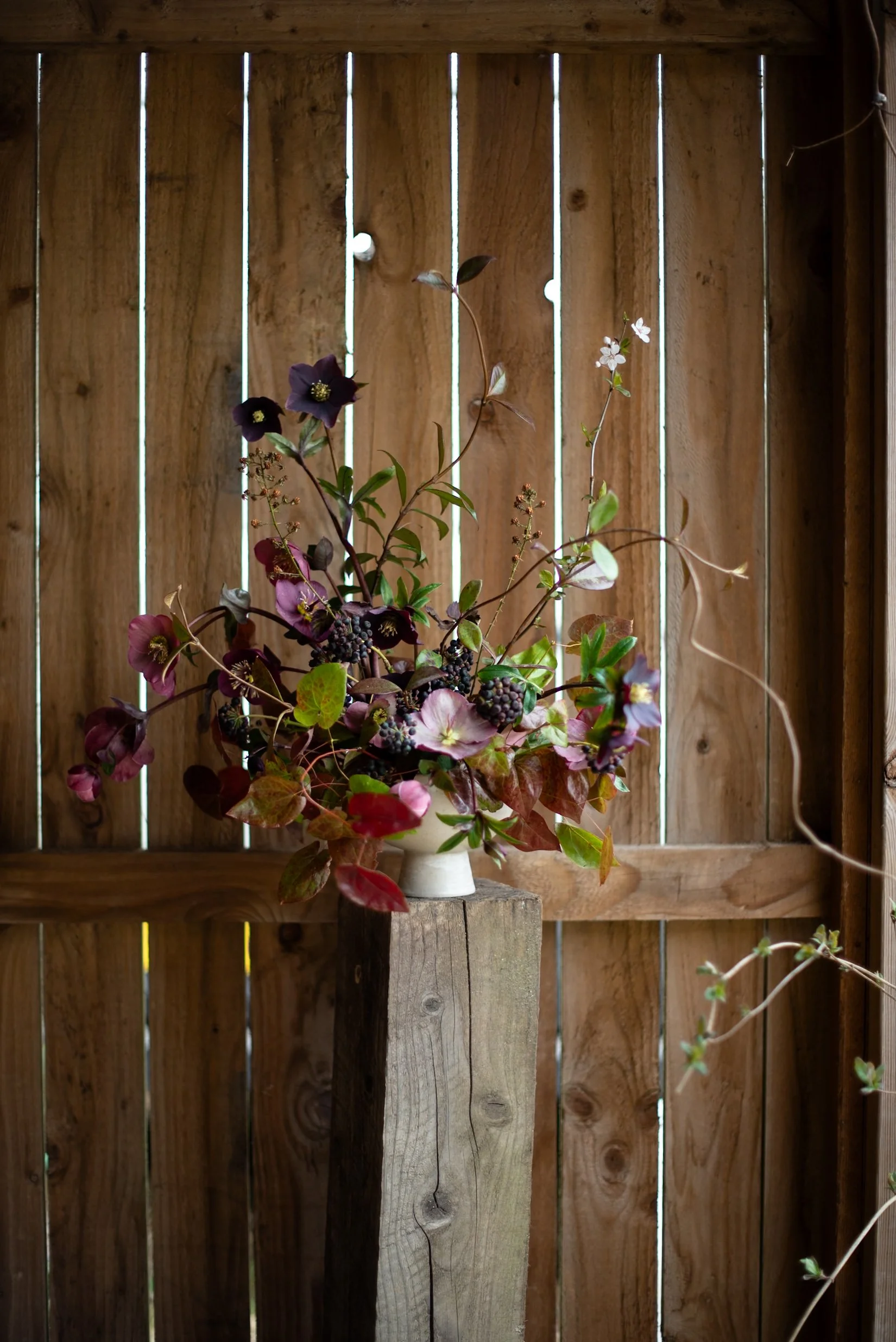
PLUM AND MOLASSES
We cannot sing the praises of Epimedium enough! We grow many different varieties in the cutting garden and they are low-maintenance, tough, excellent ground cover.


Barrenwort (Epimedium x versicolour ‘Sulphureum’)
Blackberry (Rubus fruticosus)
Cherry plum (Prunus cerascoides)
Christmas rose (Helleborus ‘Anna’s Red’)
Lenten rose (Helleborus ‘Shades of the Night’)
Ivy (Hedera helix)
Star jasmine (Trachelosermum jasminoides)
Aesme Studio ceramic footed bowl
Kenzan & chicken wire
MARCH
We cannot sing the praises of Epimedium enough! We grow many different varieties in the cutting garden and they are low-maintenance, tough, excellent ground cover. For the flower arranger they provide attractive colourful foliage with interesting mottling. A little fiddly to arrange because the stems are so skinny, they tend to move around until you have a full vase but they last very well in water and produce a mass of tiny, spurred flowers that are charming in early spring. The desiccated bramble is a favourite addition from the hedgerow - the birds never got to the berries and they have dried on the stem, fading to a beautiful copper colour. The ivy berries are a textural addition - like spherical clusters of peppercorns, the matt purple works well with the hellebores. I strip the leaves, which are bright green and glossy, preferring to allow the Epimedium the limelight.
RETURN TO RECIPES
CHERRY, HYACINTH, BERGENIA
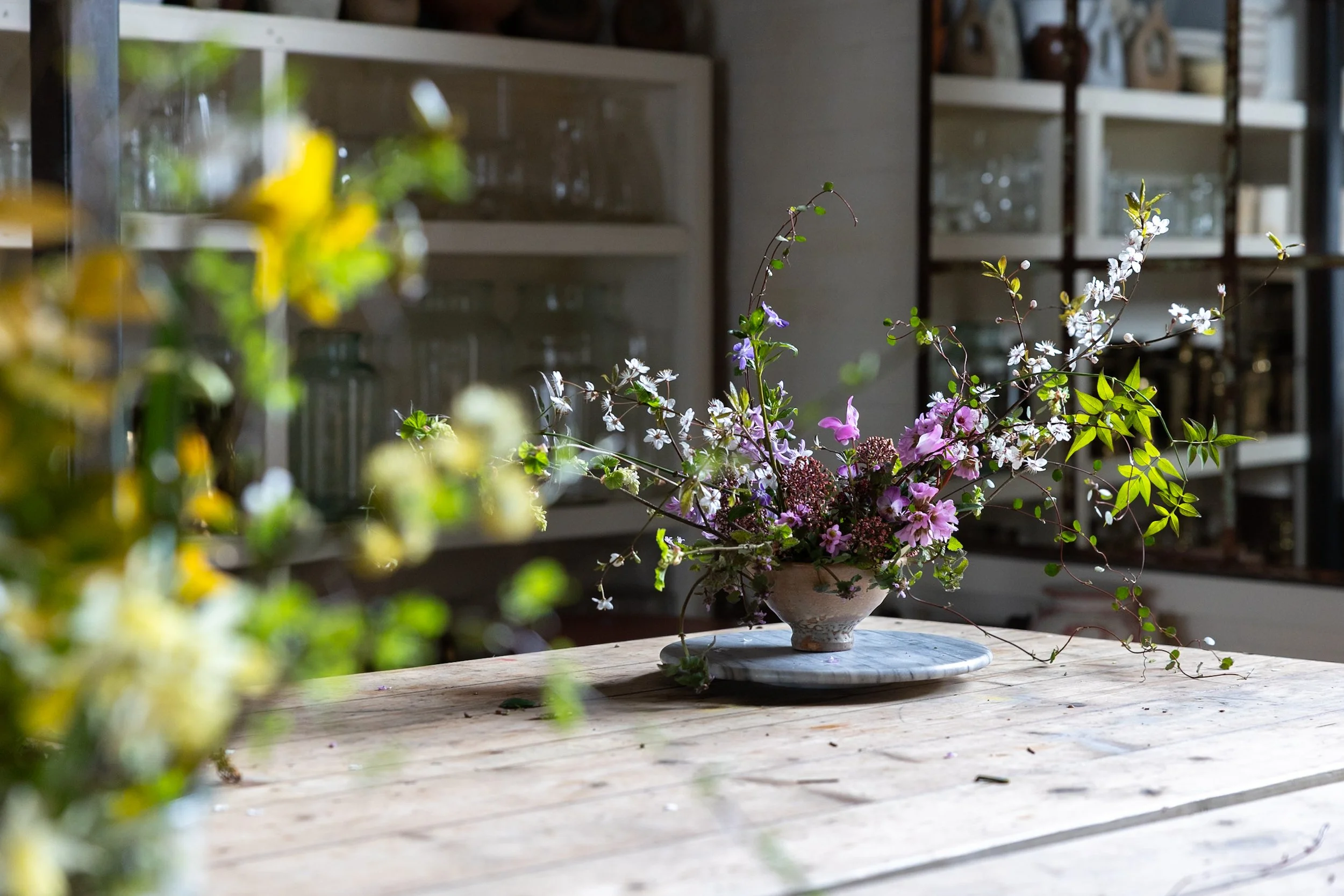
The flowers are all blue-pinks, purple and lilac and with the white cherry the effect is predominantly cool, however the yellow-green and lime foliage adds an uplifting splash of warmth that keeps it interesting.


Cherry plum (Prunus cersifera)
Cleaver (Galium aparine)
Eastern sowbread (Cyclamen coum)
Hyacinth (Hyacinthus 'City of Bradford')
Flowering currant (Ribes sanguineum)
Japanese skimmia (Skimmia japonica 'Rubella')
Jasmine (Jasminum polyanthum)
Necklace vine (Muehlenbeckia complexa)
Pansy (Viola cornuta)
Pigs-squeak (Bergenia purpurascens)
Red dead nettle (Lamium purpureum)
Ceramic bowl from South Korea
Small kenzan and chicken wire
MARCH
A low-slung bowl arrangement using branches of blossom and flowering currant to create a loosely asymmetric outline shape, in-filling with short-stemmed flowers grouped in the central axis. The flowers are all blue-pinks, purple and lilac and with the white cherry the effect is predominantly cool, however the yellow-green and lime foliage adds an uplifting splash of warmth that keeps it interesting. The skimmia is used with leaves removed as a peppery filler and the dead-nettle, which is an attractive weed/wildflower that crops up in the garden, makes itself useful as ‘ground cover’ to fill the bowl and cover mechanics. It’s a great food source for pollinators at this time of the year when there is limited nectar available, particularly for bees who rely on the pollen for protein to create their nests.
RETURN TO RECIPES
MAPLE QUEEN
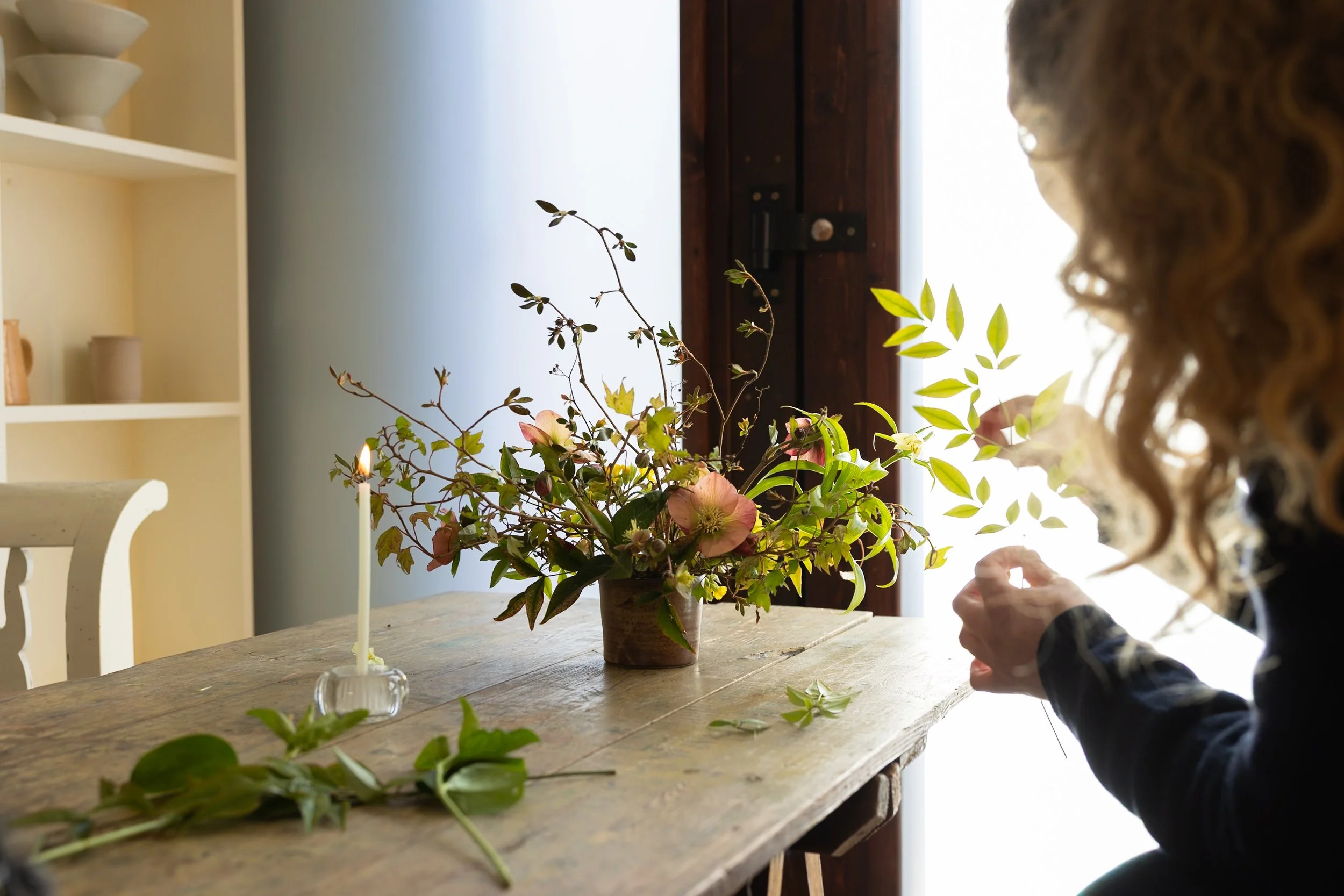
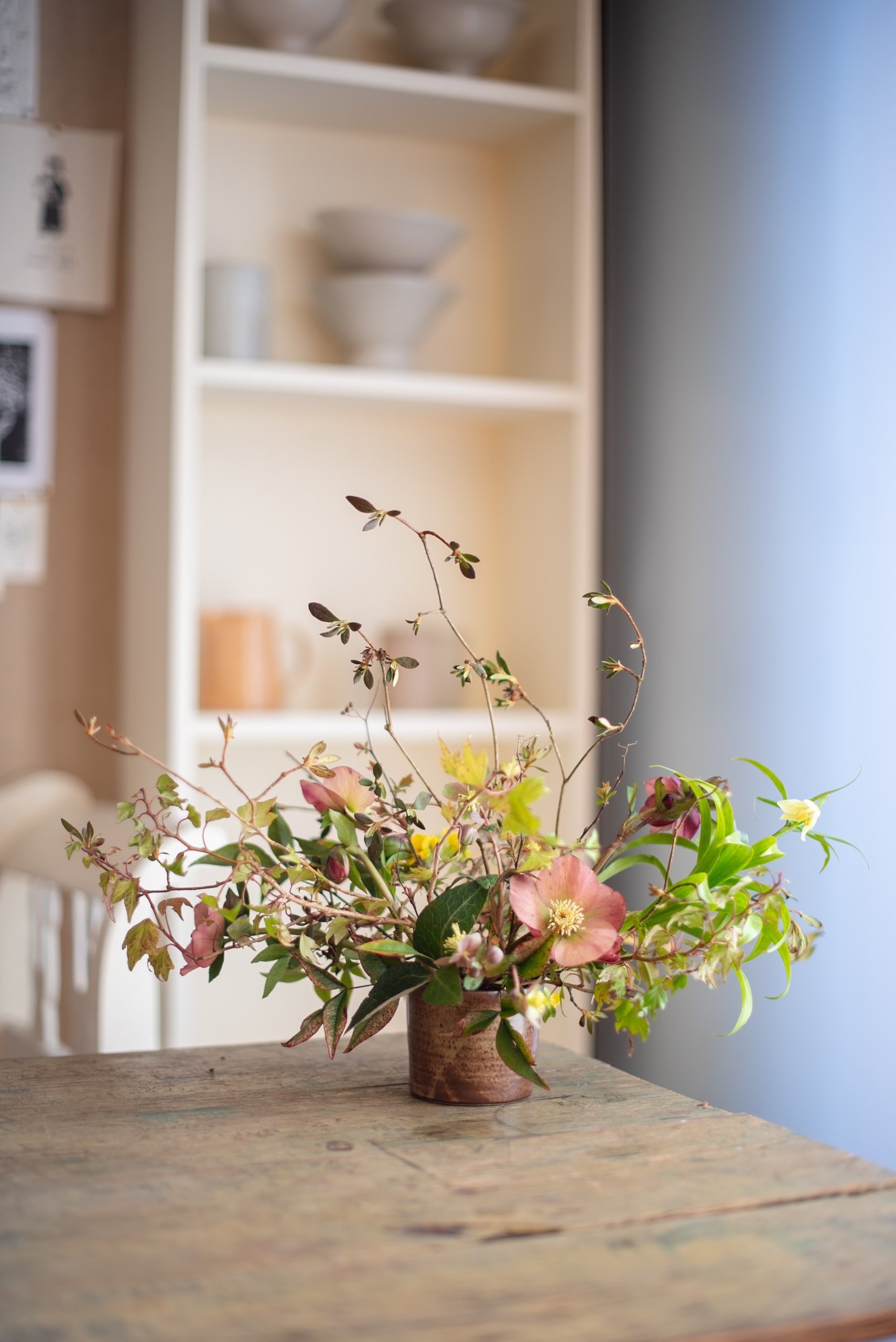
A very simple, easy arrangement to make at home - take any bowl, jar or low dish, pop a kenzan and/or chicken wire in the bottom and you only need 20-odd stems to make a pretty centrepiece.
U
Cowslip (Primula veris)
Heavenly bamboo (Nandina domestica 'Obsessed')
Ivy (Hedera helix 'Maple Queen')
Japanese meadowsweet (Spiraea japonica 'Autumn Princess)
Lenten rose (Helleborus x hybridus 'Harvington Single Apricot')
Majorcan hellebore (Helleborus lividus)
Radde's fritillary (Fritillaria raddeana)
Ceramic bowl from Made in Cley, Norfolk
Small kenzan and chicken wire
march
A very simple, easy arrangement to make at home - take any bowl, jar or low dish, pop a kenzan and/or chicken wire in the bottom and you only need 20-odd stems to make a pretty centrepiece. For a table I tend to use a lazy Susan to remind me to the spin the bowl and ensure it’s beautiful from 360 degrees and that the flowers are positioned at varying angles and heights - nestled low, reaching upwards and outwards and dangling over the lip of the vessel.
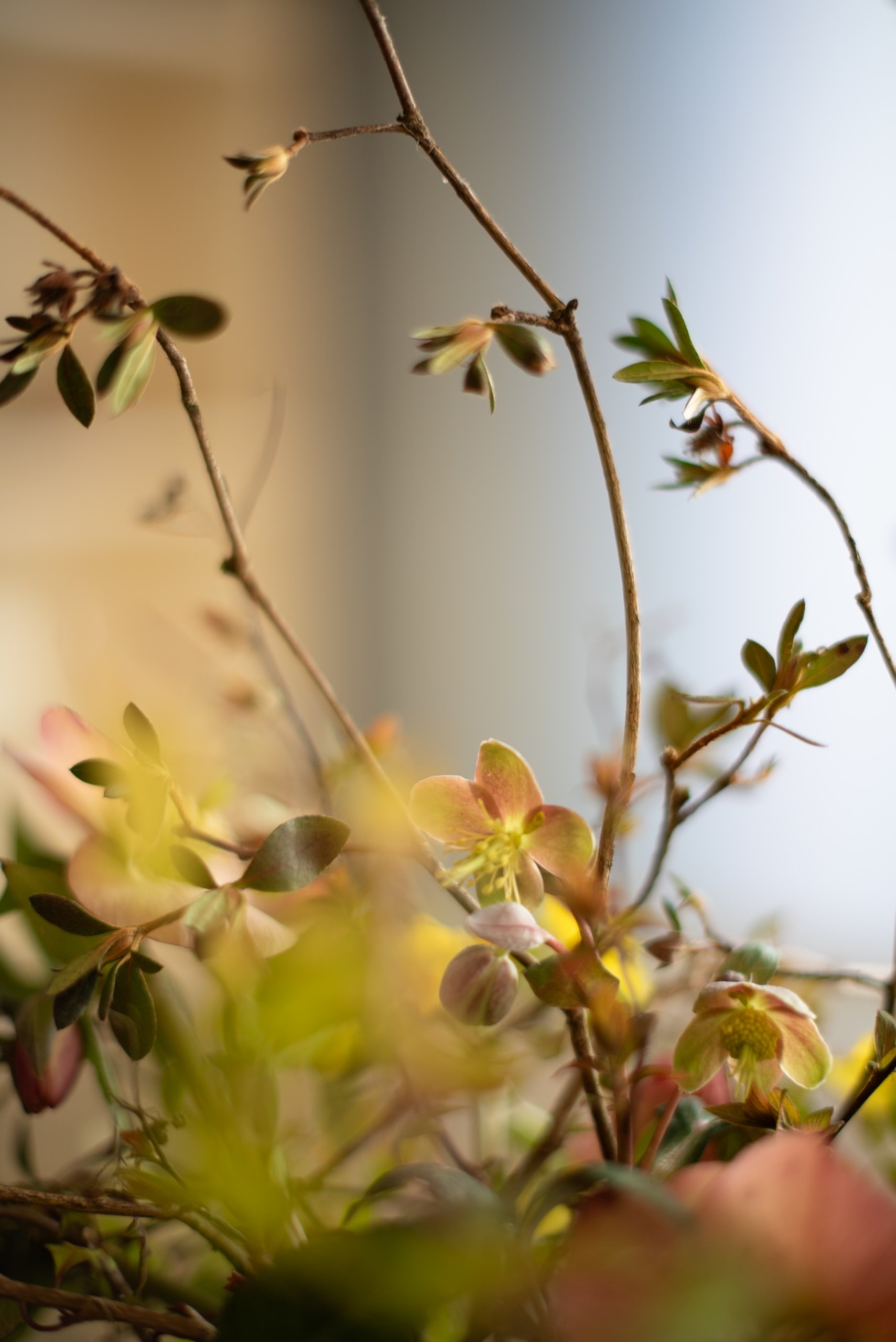
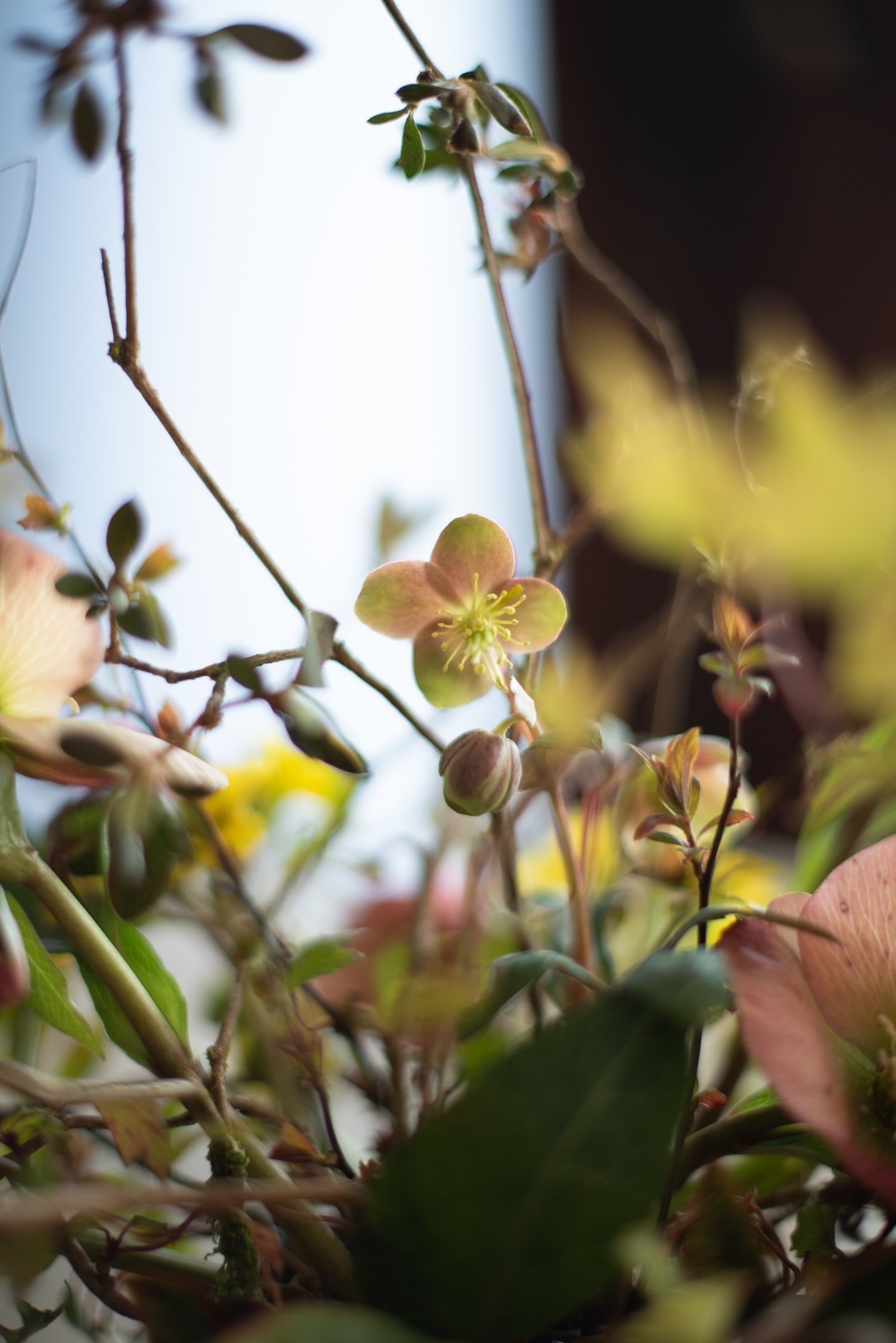
Colour-wise, this arrangement incorporates several varieties that have what we call ‘in-between’ colours. The Majorcan hellebore is blue-grey with a pinkish stem, the azalea is a grey-green, also with a blushing undertone, the Nandina leaves are speckled and the ivy a nuanced watercolour swirl of caramel, peach and lime. This makes for a soft, muted palette that would flatter most settings and crucially it can be brightened up with the addition of an accent colour. I chose to use lemon yellow cowslips but a pale blue muscari or a sprinkle of lilac crocus would be equally effective.
RETURN TO RECIPES
AZALEA, CHERRY, HELLEBORE
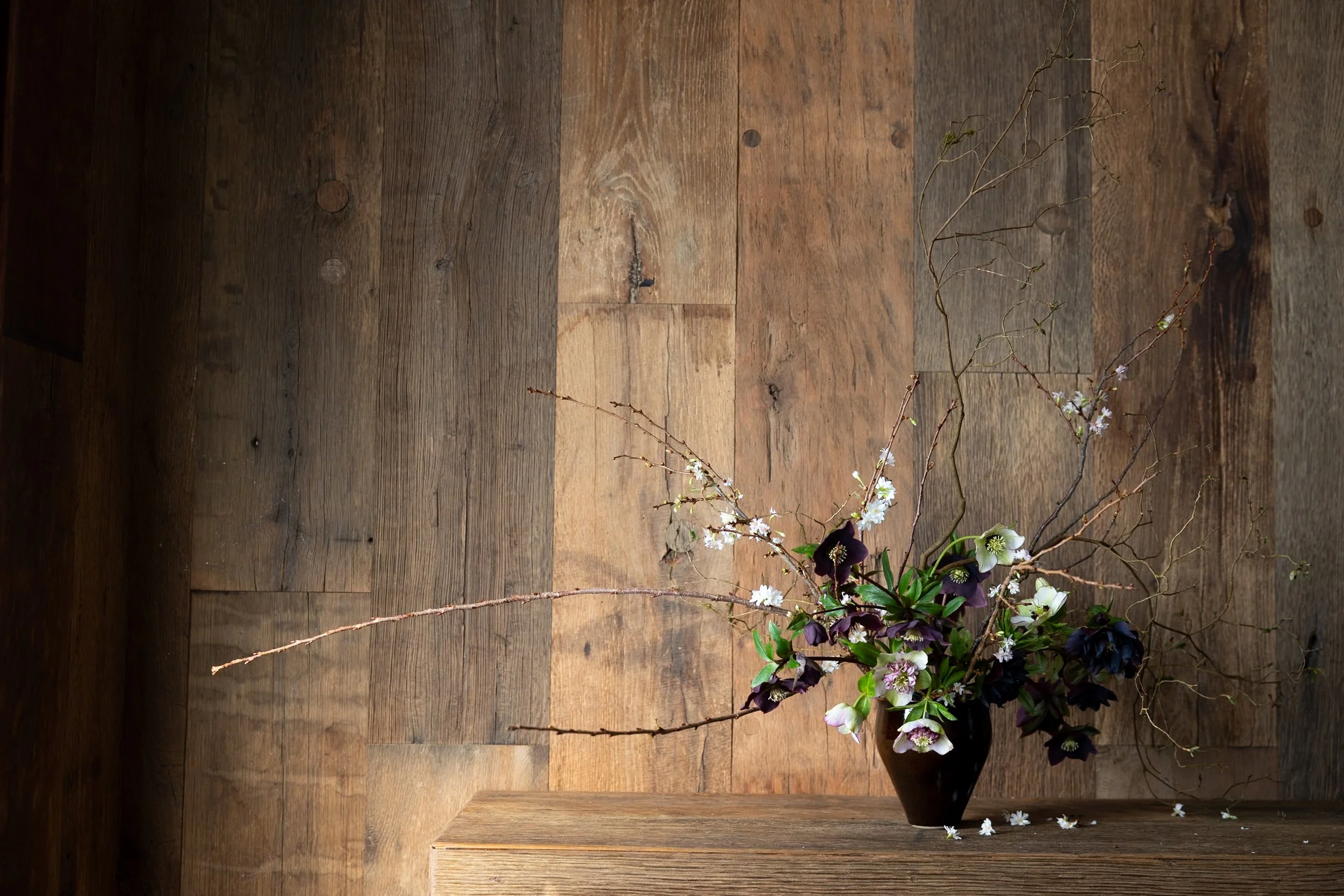
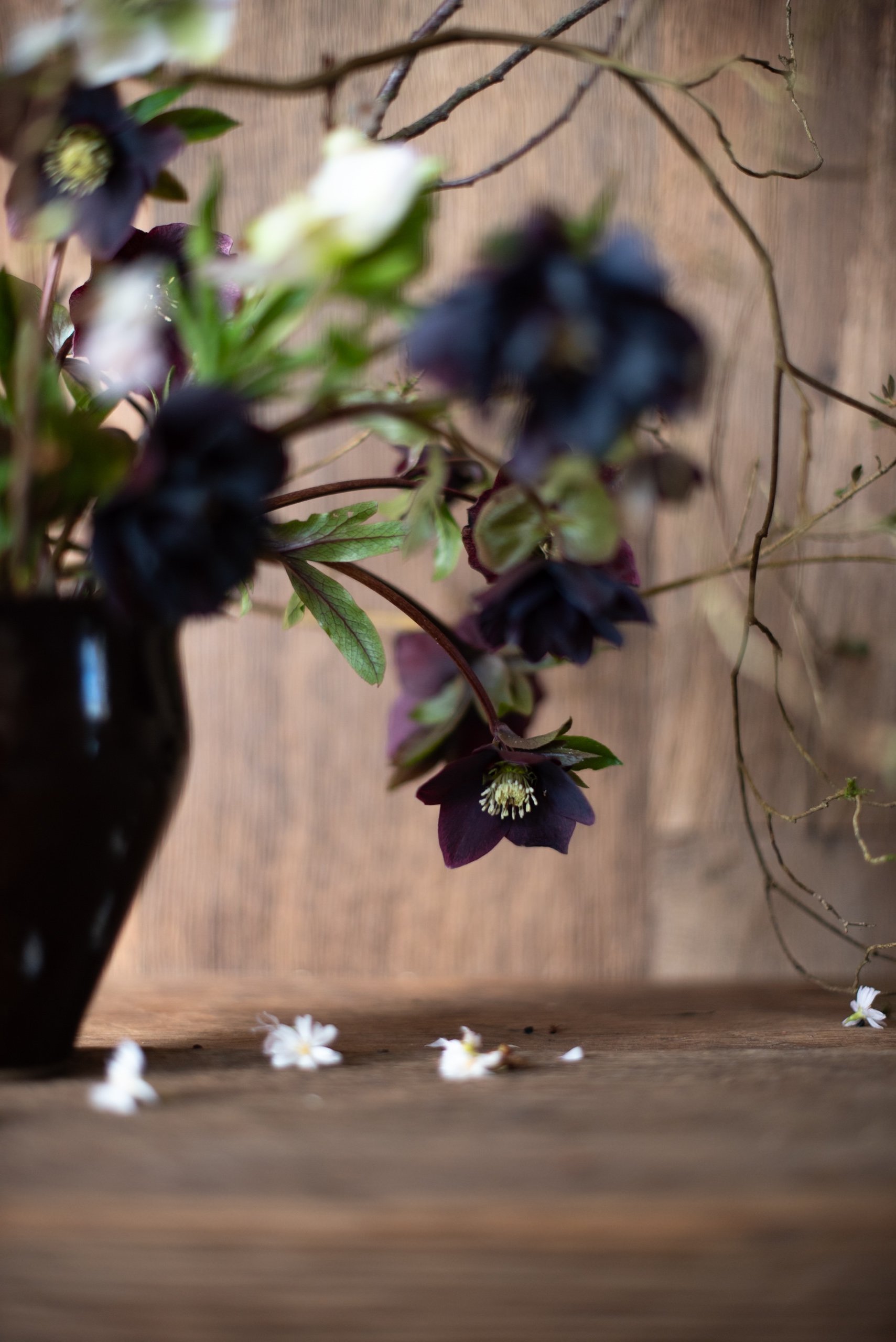
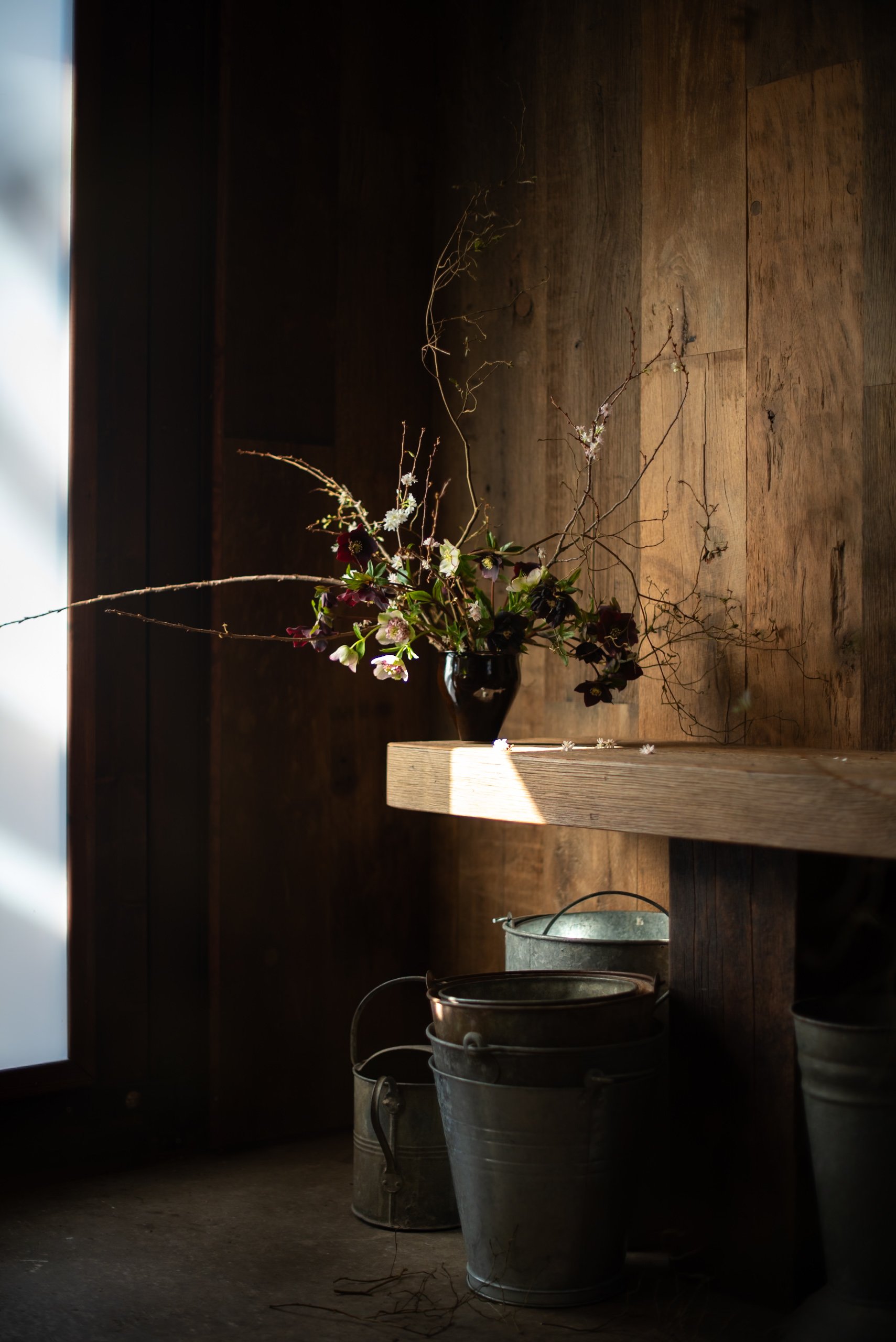
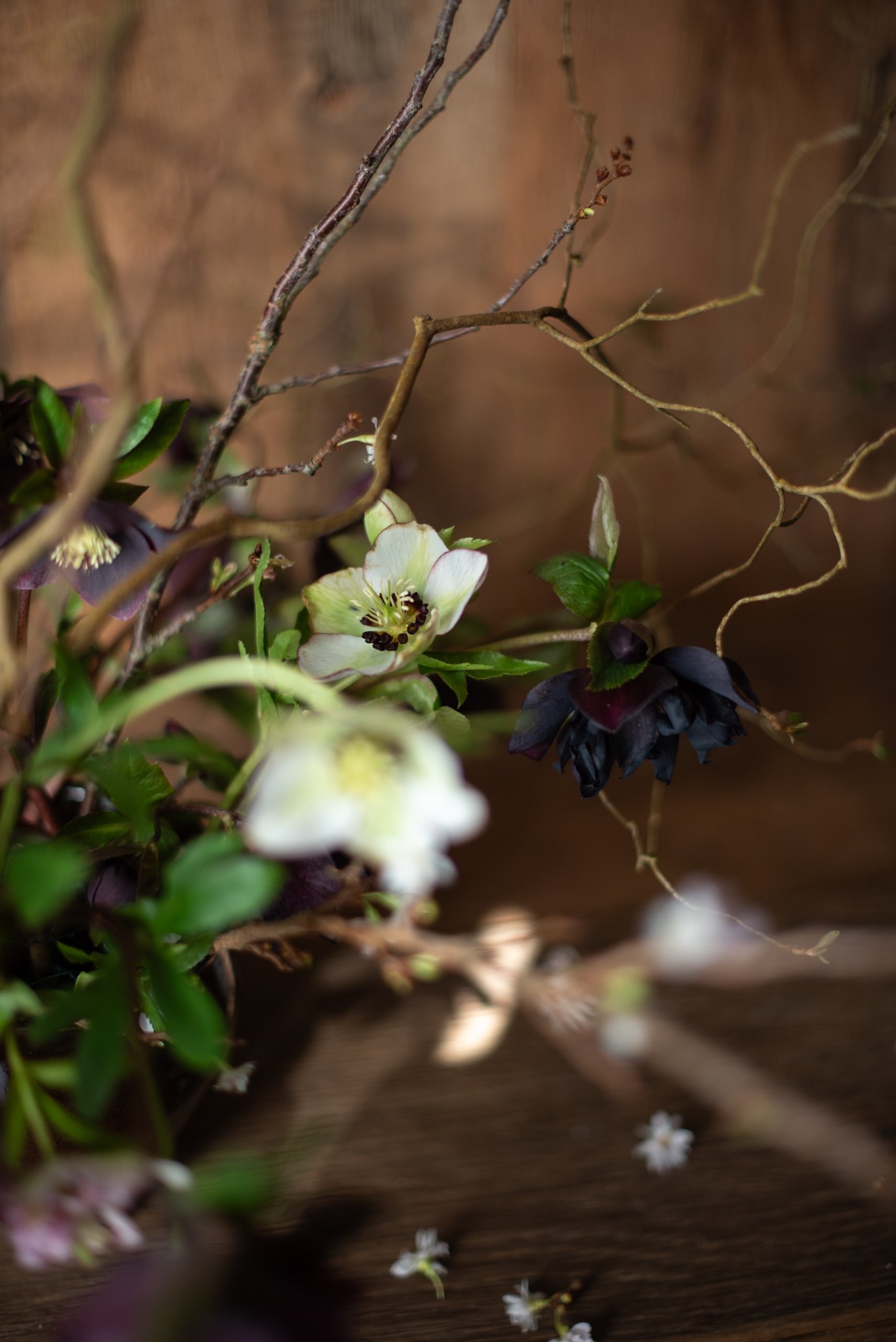
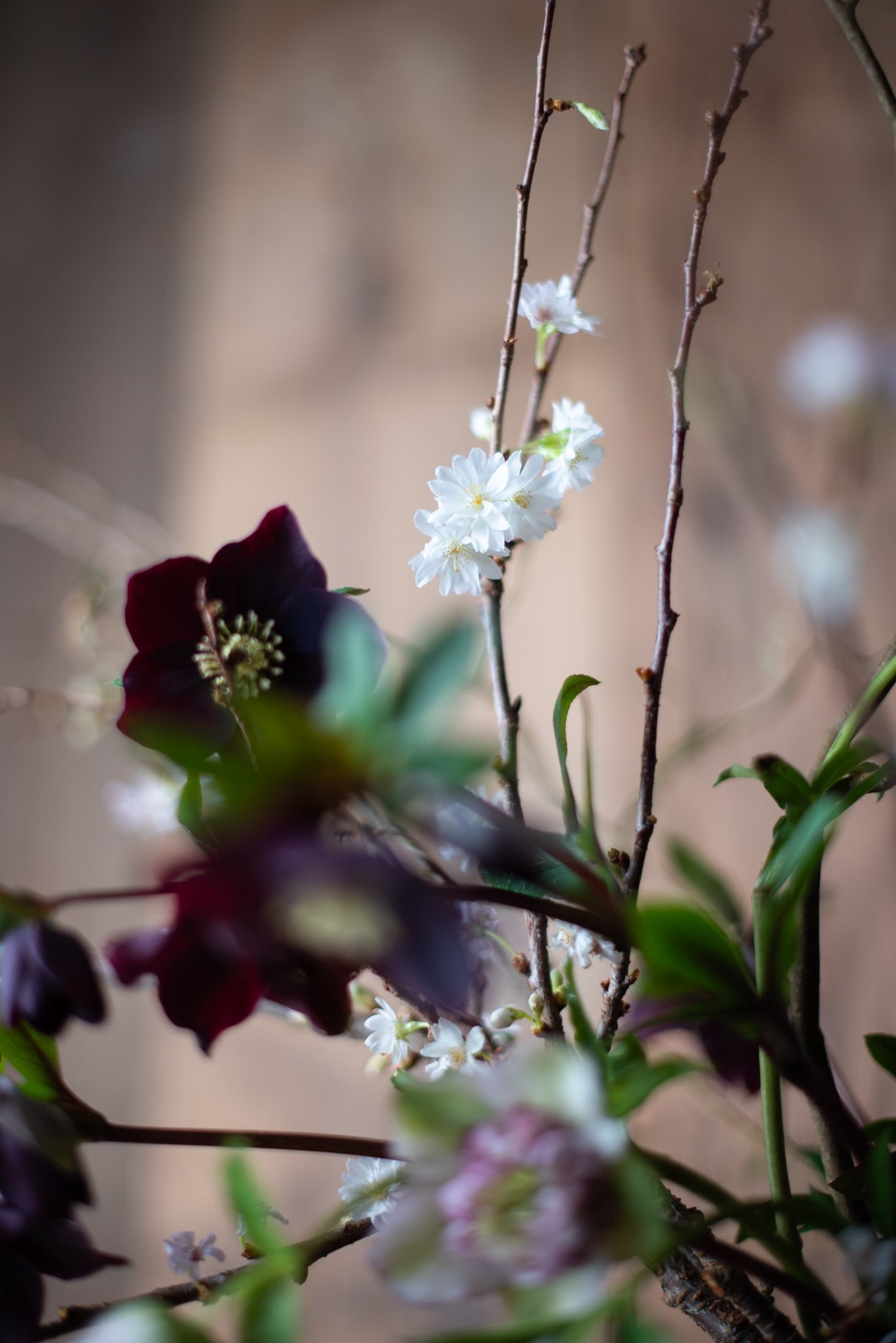
Flowering branches and Lenten rose in a vase with tenmoku glaze.
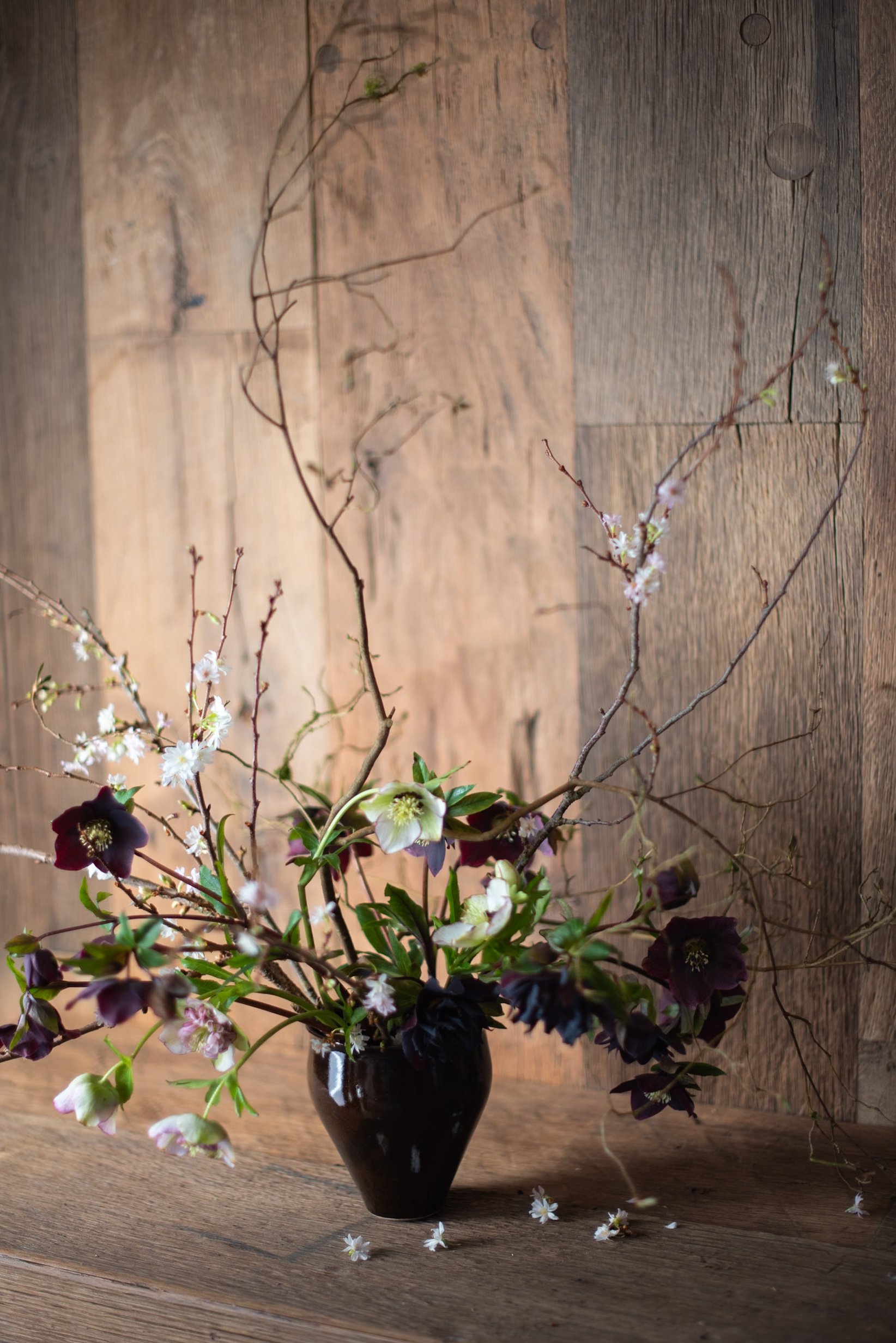

Azalea (Rhododendron - variety unknown)
Winter-flowering cherry (Prunus x subhirtella 'Autumnalis')
Lenten rose (Helleborus orientalis 'Anemone Picotee', Helleborus x hybridus 'Harvington Red', Helleborus x hybridus 'Harvington Double Purple')
Tenmoku urn by Cara Guthrie
Chicken wire
MARCH
An asymmetric shape, slightly wider than it is tall. I edited the branches out quite a bit to provide avenues of negative space between them. The sculptural twigginess suits a restrained selection of accommpanying flowers so I kept it to just three varieties of hellebore, grouping the colours - plum, ivory streaked with blackcurrant and almost-black. The hellebores have a velvety, matte quality to them - I think this dustiness contrasts well with the slick gloss of the vase. The ‘tenmoku’ glaze has a high content of iron oxide and is reduction fired.

CHERRY PLUM, SNOWBERRY
Sugary blossom, and candy pink berries are counterbalanced by the matt, muddy petals of the hellebores and the scratchy dried skeletons of St John’s wort.
CHERRY PLUM, SNOWBERRY
FEBRUARY

Cherry plum (Prunus cerasifera nigra)
Japanese maple (Acer palmatum ‘Katsura’)
Japanese spiraea (Spiraea japonica)
Lenten rose (Helleborus ‘Merlin’ & ‘Maestro’)
Snowberry (Symphoricarpos × doorenbosii 'Magic Berry')
St John’s wort (Hypericum perforatum)
We love our bouquets to be layered with interesting textures, for the ingredients to qualify not just for being pretty but surprising and sculptural too. Case in point - a ravishing armful of ingredients from the garden in early spring. Sugary blossom, and candy pink berries are counterbalanced by the matt, muddy petals of the hellebores and the scratchy dried skeletons of St John’s wort. A ribbon with a sumptuous sheen enhances the romance.
RETURN TO RECIPES

PRIMROSE, DAFFS
A cheering bowl of flowers after a week of non-stop London rain; this citrine concoction of early spring flowers and pretty leaves is a celebration of slowly (but surely!) inching toward those warmer, lighter days.

Beauty bush (Kolkwitzia amabilis ‘Pink Cloud’)
Blackberry (Rubus)
Cowslip (Primula)
Daffodil (Narcissus ‘Elka’, ‘Jack Snipe’, ‘Minnow’, ‘Blushing Lady’, ‘Spoirot’)
Lenten rose (Helleborus ‘Ice n’ Roses’ & ‘Harvington Apricot’)
Netted iris (Iris reticulata ‘North Star’)
Radde's fritillary (Fritillaria raddeana)
Sacred bamboo (Nandina domestica)
Silver berry (Eleagnus commutata)
Wind flower (Anemone ‘The Bride’)
Ceramic bowl from Korea with a pitted tobacco glaze
Kenzan
MARCH
A cheering bowl of flowers after a week of non-stop London rain; this citrine concoction of early spring flowers and pretty leaves is a celebration of slowly (but surely!) inching toward those warmer, lighter days. I want to avoid the arrangement being too ‘contrast-y’ - with a mix of pale flowers and much darker foliage this can look blocky. To soften and bridge the two extremes I introduce some lighter green foliage - khaki and olive, and a few touches of bronze from the Nandina. This immediately feels more nuanced and the bronze picks up the brown tones in the hellebore petals.
RETURN TO RECIPES

GOLDEN BELLS & WHISKERS
Whiskery Forsythia branches with white flowering currant, Fritillaria persica and lots of scented Narcissi in an antique urn.

Daffodil (Narcissus ‘Actea’, ‘Mount Hood’, ‘Blushing Lady’)
Flowering currant (Ribes sanguineum ‘White Icicle’)
Golden bells (Forsythia)
Persian lily (Fritillaria persica)
A small, handled urn made of cast iron
Large kenzan & chicken wire
APRIL
Now that spring is well and truly under way it's time to flex my flower arranging muscles again and make something big and dramatic! I choose a rusted urn - we collect these old garden urns from antique markets and reclamation yards; they often have holes in the bottom as they are used to display plants outdoors so to make them water tight we fill the bases with concrete (or you can just find a suitably sized liner pot to insert inside).