
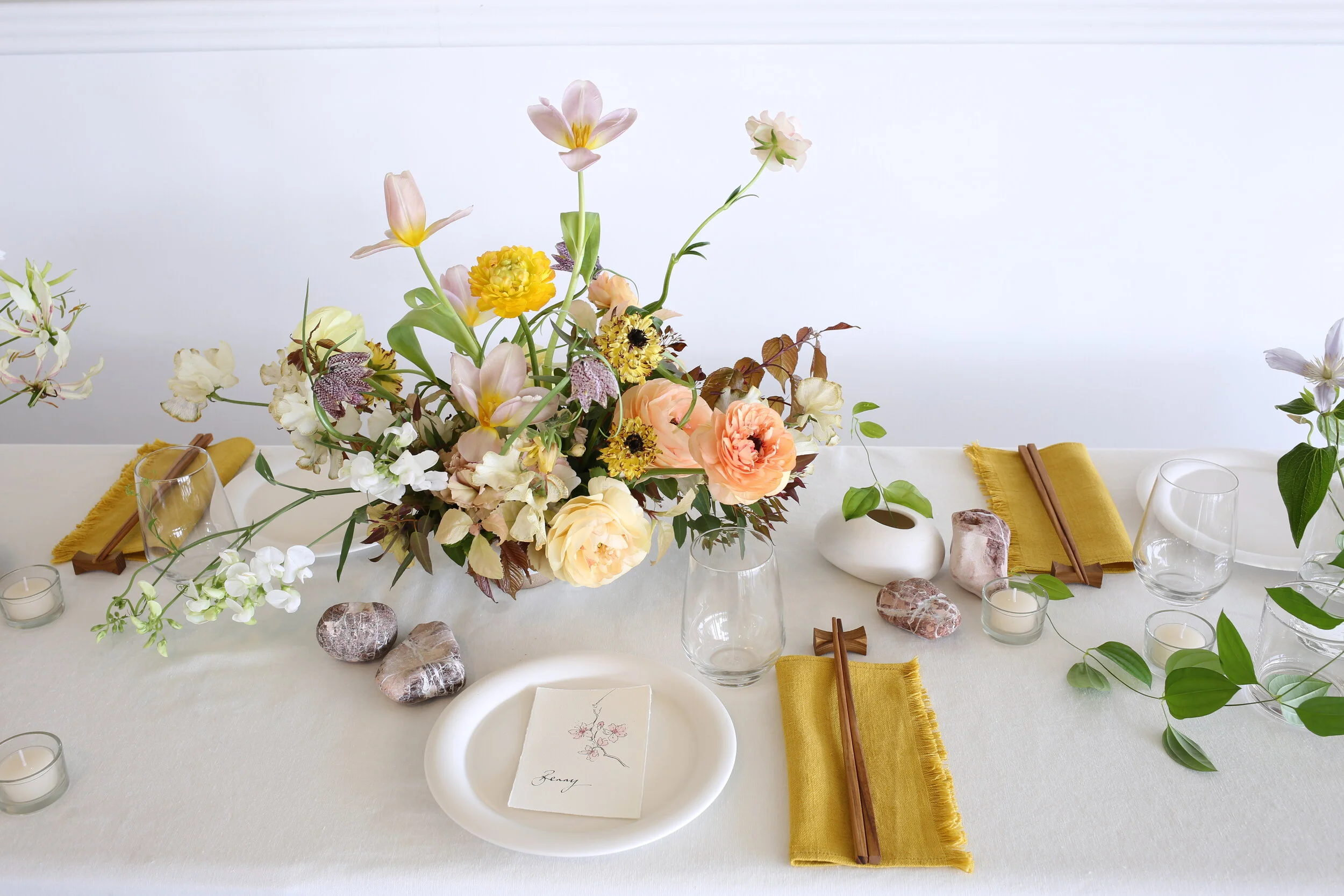
Jeju Island, South Korea
What a way to start the season, hosting a destination workshop on a little volcanic island off the coast of South Korea covered in pine trees and mandarin groves! Starting in Japan (we’ll be sharing a couple of the gardens we visited in Tokyo & Kyoto here soon) we flew to Seoul to spend a few days getting adjusted and preparing for the workshop before heading south to Jeju Island. The workshop was held at a wonderful cafe with views out over the blue waters of the Korea Strait. It was the perfect spot - modern, tastefully designed and with atmospheric music, delicious lunches and some of the best coffee we found on our trip.
All the flowers, foliage and plants were part-shipped, part-flown from Seoul where we had chosen them at the flower market early the preceding mornings. The choice of materials (from Korea, Japan and Holland) was exceptional - I’ve never seen so many flowers and branches in one place, the Seoul market is labyrinthine and just goes on and on… Our palette for the workshop was soft and feminine, with pops of yellow to reference the canola flowers that can be seen everywhere around the island, and mandarins, since Jeju is a tapestry of unending groves of these sweet, fragrant fruits. While travelling I was deep into reading all about citrus via Jess’ recommendation in our last post - it was surreal to be preoccupied with lemons in Italy while speeding through an Eastern landscape dominated by orange fruits.
For three days the sun shone and the sea sparkled and lapped against the dark, craggy rocks. We foraged dried grasses and silverberry from the coast-path and strange pitted black rock formations (they say there are three-hundred and sixty-five volcanoes on the island; one for every day of the year) for a setting-specific installation on the final afternoon. It was such a privilege to be working somewhere entirely new and unfamiliar and yet be made to feel so at home.
JEJU ISLAND | SOUTH KOREA

What a way to start the season, hosting a destination workshop on a little volcanic island off the coast of South Korea covered in pine trees and mandarin groves! Starting in Japan (we’ll be sharing a couple of the gardens we visited in Tokyo & Kyoto here soon) we flew to Seoul to spend a few days getting adjusted and preparing for the workshop before heading south to Jeju Island. The workshop was held at a wonderful cafe with views out over the blue waters of the Korea Strait. It was the perfect spot - modern, tastefully designed and with atmospheric music, delicious lunches and some of the best coffee we found on our trip.
All the flowers, foliage and plants were part-shipped, part-flown from Seoul where we had chosen them at the flower market early the preceding mornings. The choice of materials (from Korea, Japan and Holland) was exceptional - I’ve never seen so many flowers and branches in one place, the Seoul market is labyrinthine and just goes on and on… Our palette for the workshop was soft and feminine, with pops of yellow to reference the canola flowers that can be seen everywhere around the island, and mandarins, since Jeju is a tapestry of unending groves of these sweet, fragrant fruits. While travelling I was deep into reading all about citrus via Jess’ recommendation in our last post - it was surreal to be preoccupied with lemons in Italy while speeding through an Eastern landscape dominated by orange fruits.
For three days the sun shone and the sea sparkled and lapped against the dark, craggy rocks. We foraged dried grasses and silverberry from the coast-path and strange pitted black rock formations (they say there are three-hundred and sixty-five volcanoes on the island; one for every day of the year) for a setting-specific installation on the final afternoon. It was such a privilege to be working somewhere entirely new and unfamiliar and yet be made to feel so at home.


Flower School | A selection of materials lined up for our bouquet class including ranunculus, sweet peas, flannel flower and mandarin branches


Left: a spring centrepiece of ranunculus, tulips & fritillaria
Above: Urn of willow, ranunculus, tulips and mandarin branches

Flower School | our wonderful group of students with their ruffly garden-inspired bouquets

Flower School | table styling & props: beach pebbles, shells, intricate vines and ochre linen

Flower School | spring wreaths of moss and alpine plants


Left: a bouquet of spring flowers and locally foraged silverberry foliage
Above: a student’s sketches of the bouquet demonstration


Above: pale pink urchins and creamy shells to reference the coastal setting
Left:: Jess’ demo bouquet with spiraea and ranunculus


Flower School | Installations: a site-specific design using the local dark rocks with willow, spiraea, tulips, dried orchid leaves and rockery plants


Flower School | Colour: our palette for the workshop was soft pink with accents of orange and yellow, as a nod to the cherry blossom, mandarin groves and canola flowering all over the island in spring

Flower School | a friendly mandarin farmer who gave us permission to roam his greenhouses and gorge on the sweet ripe fruit as we picked


Thank you to Flower Workshop Korea for inviting us, arranging everything so beautifully and being the most generous and welcoming hosts, and to all the suppliers and assistants who helped make this workshop the magical few days it was. And to our students, for travelling the distance and being the most enthusiastic, giggly and talented band of flower-lovers we could ever hope to meet.
In the STUDIO

Back in the studio we unpacked our cases laden with Japanese kenzans, bamboo sticks, scissors and secateurs, as well as a new collection of beautiful Japanese and Korean tea bowls and ceramics in beautiful uneven, earthy glazes.
The rest of the April has been spent gearing up for the start of wedding season and holding the first of our spring classes. The evenings are lighter and longer now, the temperature rising almost imperceptibly but enough for the doors and windows to be open in the afternoons. The workbenches have been strewn with narcissus and tulips up from the garden - primrose yellow and rust and milky-white.


Flower Studio | Table styling 1:1 class: clustered small bowls with garden-grown flowers & beeswax candles

Flower Studio | Left: Narcissus ‘Moonlight Sensation’ & ‘Segovia’

Flower Studio | ‘Belle Epoque’ tulips, at their most beautiful as they fade and crumple



Flower School | Table styling group workshop: antique Indian brass vessels and florals in a palette of red, gold and lime


Flower School | Left: a section of the inspiration board for our Spring Masterclass, referenced during a discussion on colour theory
Last week we held our Spring Masterclass - a three day intensive course in flower arranging with a focus on seasonal, naturalistic and sustainable botanical design for weddings and events (with a difference - i.e. no flower foam, no traditional wiring, rule breaking encouraged etc). In these seasonal courses we focus on using the finest ‘produce’ or ingredients we can grow, source and forage, designing in a nature-led, garden-inspired style and taking inspiration from place, art, fashion and garden design.


Flower School | 1:1 class hanging installation: a suspended trough layered with tulips, geranium, narcissus and fritillaria

The intention on our Flower School courses is to create at atmosphere of open-mindedness, collaboration and creativity; we are always inspired by our students’ enthusiasm and curiosity, and their willingness to think outside the box. Last week the group was made up of students from the UK, Hong Kong and Portugal; everyone was fairly new to flowers, one ran a dried flower business, one wanted to enjoy flower-arranging as a pastime, others were considering career changes. By Friday afternoon we were having such a lovely time we didn’t want it to end - we’d shared a wonderful few days of creation and brainstorming, made lots of beautiful arrangements together, discussed business and social media and colour theory, shared some lovely food and listened to a lot of French jazz. There is an alchemy to what happens in the studio on weeks like this and that evening as we were blowing out the last of the candles, I think we all felt very grateful that we are able to live and work in this way, and to meet other like-minded people who share in the things we love.

Flower School | Table styling 1:1 class: bronze, blue, plum and accents of peach in ceramic vessels


Above: Akebia quinata (chocolate vine) with runner and French climbing beans for planting


Flower School | Spring Masterclass table styling: linear trough vases in a brown, mauve and pale yellow palette


Flower School | Urn design 1:1 class: an ornate French urn with fresh spring greens, leggy tulips and butterfly ranunculus

Flower School | Spring Masterclass demo: Jess’ loosely layered and romantic demo bouquet


Flower Studio | Actinidia kolomikta (variegated-leaf hardy kiwi) with tulip Clusiana ‘peppermint stick’
With a new workbench installed to give us a little more space in the studio, we have decided to open up two additional places on our Summer Masterclass | 5th - 7th June. These spots are first come first served and full details can be found on the website.
In the GARDEN

Cutting Garden | Scabiosa potted on and waiting to be planted in the outside beds
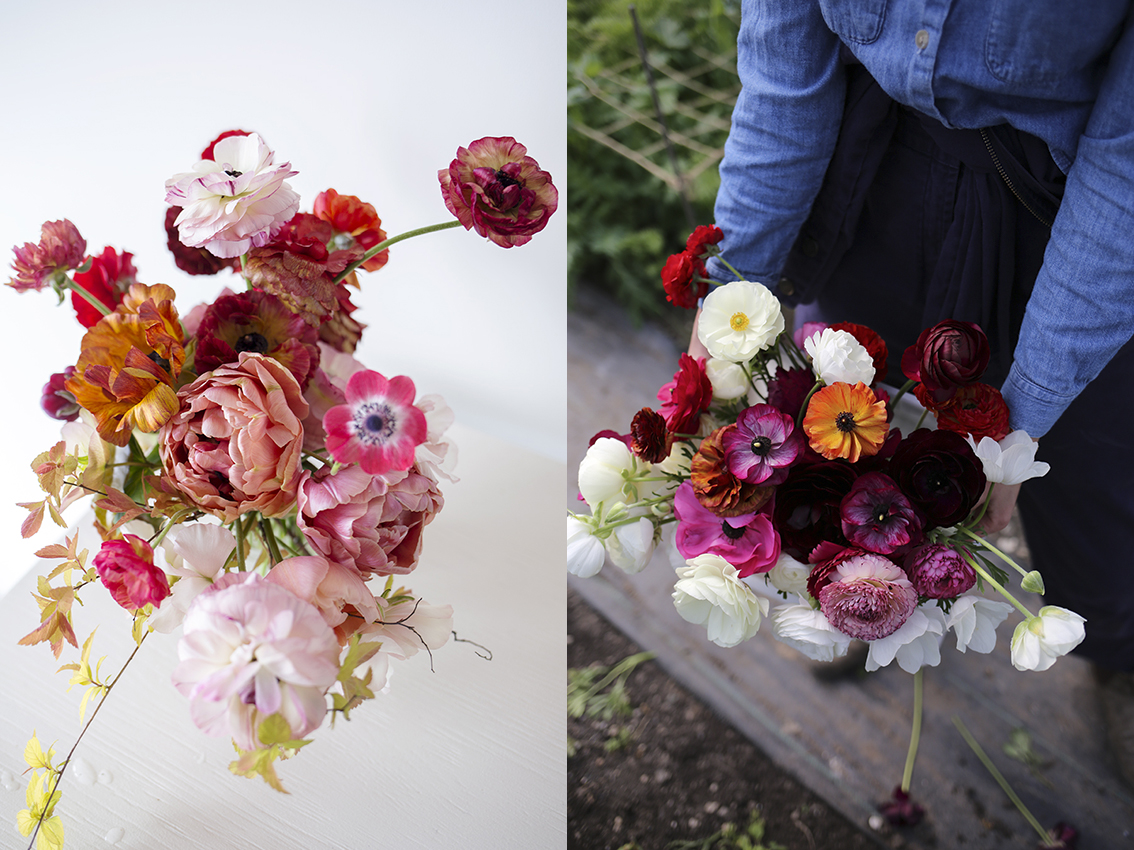
‘Naught you can do about the weather’ one of the landscapers said as we surveyed the rows of ageing tulips in one of the tunnels after our trip overseas. An unseasonably warm spell late March (while we wrapped up and drank hot chocolate in chilly Tokyo) saw many of our tunnel-grown bulbs flowering a few weeks earlier than expected this year. You win some, you lose some. The outdoor planted beds made up for it however, where we were trialling small quantities of a number of different varieties of tulips and narcissus. The ranunculus are flowering prolifically; hundreds of white, pink, plum and bronze, with excellent stem length and ruffly petals opening to those seductive opaque centres. Fritillaria - persica, uva vulpis and imperialis, have been filling the studio with their ‘cannabis’ scent, along with peonies, aquilegia and the last of the anemones, which are very leggy now, with tiny little faces.
So begins the summer - or what I think of as the summer, anyway - the half segment of the year that is measured by bi-weekly deliveries from the garden to the studio and the constantly evolving stock of new, delicious colours and textures that we take from their unprepossessing buckets and that result in branchy urns and beautiful spilly bowls.


Cutting Garden | Tulips in the early evening sun in one of the outdoor beds

Cutting Garden | Ranunculus ‘Aviv white’


In the Ether
A few things we’re loving at the moment…
R E A D I N G - Food for Free (the complete guide to help you safely identify edible species that grow around us, together with detailed artwork, photographs, field identification notes and recipes) by Richard Mabey
L I S T E N I N G T O - Piano & A Microphone, 1983 by Prince. The Table Manners podcast with Jessie Ware
F O L L O W I N G - Samuji, Somewhere Magazine, Arne Maynard Garden Design
C O O K I N G - Steamed kale with capers, thyme, chilli flakes, garlic and creme fraiche and toasted breadcrumbs (inspired by Gill Meller). Melon, buffalo mozzarella and Parma ham salad (via The Kitchen Diaries by Nigel Slater)
V I S I T I N G - Anthracite Coffee Roasters (a beautiful disused warehouse / overgrown ruin / coffee shop in Jeju Island). Chenies Manor in Buckinghamshire (for the displays of tulips and gorgeous walled vegetable and herb gardens)


Rajasthan, India
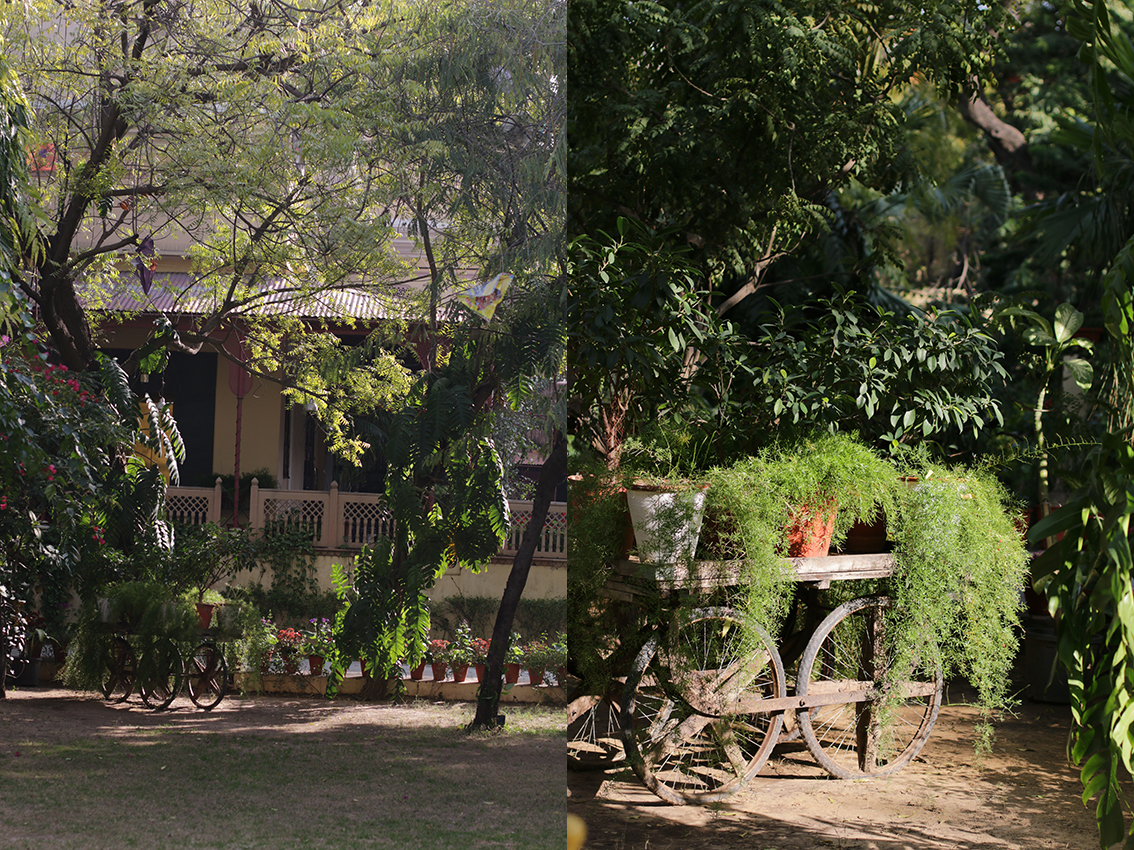
Gardens are the greatest source of inspiration to us in our work as flower arrangers and growers. Seeing how natural materials converge, how plants are grown together, witnessing their shapes, colours and textures - these are fuel for so many creative ideas and revelations in our studio.
Gardens are the greatest source of inspiration to us in our work as flower arrangers and growers. Seeing how natural materials converge, how plants are grown together, witnessing their shapes, colours and textures - these are fuel for so many creative ideas and revelations in our studio.
RAAS HOTEL | JODPHUR


In my notebook:
Kachnar tree, the “orchid” or “camel’s foot” tree has bright purple pink flowers that drop their petals into the water channels and ornate squares of gravel below. The garden is neatly organised into symmetrical sections. An avenue of green, rustling trees leads towards the spa in the old haveli building, behind which looms the Mehrangarh Fort - a cascade of water in front. Pennisetum lines the pool. Gardeners with brushes made from gathered grasses painstakingly sweep the squares of grass beneath the trees clear of fallen leaves, which they gather in wicker baskets. The aromatic beds are full of kumquat trees and frangipani, and dried agastache seed heads. White and cream bougainvillea cascades over our private garden wall. They have placed shallow terracotta bowls for the ring-neck doves and pigeons to drink from.
At night the gardens are lit with small lanterns at ground level and hundreds of flickering tea lights in the crevices of the stone walls. The air is thickly scented with burning incense and charcoal.
chokelao bagh | mehrangarh fort


mOSAICS GUESTHOUSE | AMER


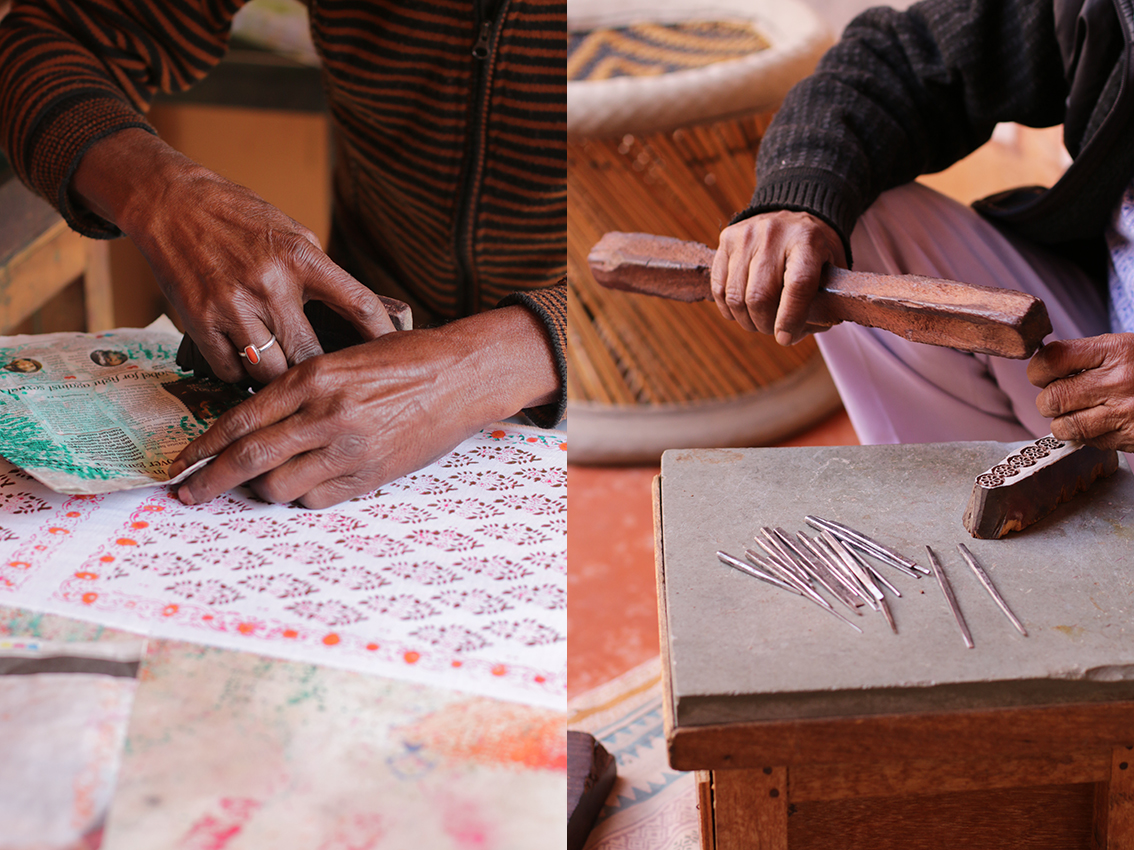
ANOKHI MUSEUM OF BLOCK PRINTING


Amer Fort


out & about | JAIPUR




St John Bread + Wine
And really this is the wedding that sticks in my mind when I ask myself why we do it. We do it for this, these flowers, these people. For me, the photographs here are testament to the endurance of love and friendship. I love that our work is a part of that.

In June there was a wedding at St John Bread & Wine in Spitalfields. St John is a dining room, wine shop and bakery on Commercial Street and pretty much my dream space to decorate - stylish yet unpretentious, sophisticated yet informal, it is all about the food, and the wine (and the bread).
Don't you miss June? Hot and stormy, mosquito-bitten, foxglove-filled June. The first flush of garden roses, the first suntan lines, punnets of English gooseberries; June days are full of natural abundance, when the washing on the line dries in less than an hour, and it is too hot to walk on the gravel barefoot. Every year June comes around and goes so fast, and every year when it has gone I miss it.
July has been gloomy, as it usually is. I love gloominess too, though. Real weather, thunder and scudding clouds, wind in the trees, leaves scuttling across the park. My new puppy has been enjoying those.


Anita and James had the best of everything for their June wedding; sunlight pouring into a white room, crisp linen, taper candles, just-gathered flowers. The cutting garden came up trumps with scented garden roses and Californian poppies and bearded iris; we filled a whole slew of antique vases, goblets and tankards in tarnished pewter and brass. There is a distinct alchemy to the gleam of old metal by candlelight. I like imagining the history of those vessels, I believe some of them are quite old. Who received that prize after an exhausting summer regatta many moons ago, the thirsts those dented flagons might have quenched in London ale-houses long demolished.


For me, this wedding was an excellent example of how effective combined simplicity and seasonality can be. All English-grown, the majority from our own garden, flowers simply gathered in complimentary colours, diversely collected vessels, tall elegant candles, a smattering of ripe, seasonal fruit, sparkling glassware. And that's it. Nothing showy or themed or too contrived. Just an effortless celebratory feast, with delicious food and a lot of very good wine.
My heart was really in it, right from the get-go.


Everything was prepared at our studio in advance. Jess and Camille placed and tweaked the flowers and wove in a few clematis tendrils and I hung some wild dog-rose briars on the back wall from the shaker pegs. Install took three of us an hour. It was the swiftest set-up we have ever done.


Later, as our clients and their family & friends danced the night away down the street, a mile south three terrorists mounted what is now known as the London Bridge attack, killing eight and injuring forty-eight innocent civilians. We drove back the following morning to de-rig through shocked, deserted streets and wailing sirens. That afternoon, with the same familiar exhaustion that every wedding ends with, and from the sadness of that strange day, I crawled into bed and cried myself to sleep.
But when I look back through the photographs, all I see is joy. Flowers are joyful, they make people happy, they are a reminder of happinesses past, they are fleeting, transient, and yet there will always be new growth, whatever you do you cannot stop that. New growth will come. When times are hard I sometimes wonder what we are doing this for, Jess and I, the shlepping backwards and forwards on the motorway with our hard-won flowers (which have survived winter's frost and drought and foraging predators and plenty more besides, each one just to be admired for those few hours), the gargantuan effort we go to to convert people to seasonality and English-grown flowers over imported ones during the seven to eight months of the year when this is possible, to encourage people to think outside the box of conventional wedding floristry (more on this some other time), the early mornings and late nights and constant hustling. And really this is the wedding that sticks in my mind when I ask myself why we do it. We do it for this, these flowers, these people.
For me, the photographs here are testament to the endurance of love and friendship. I love that our work is a part of that.