
FIREWEED, FAT DOMINO
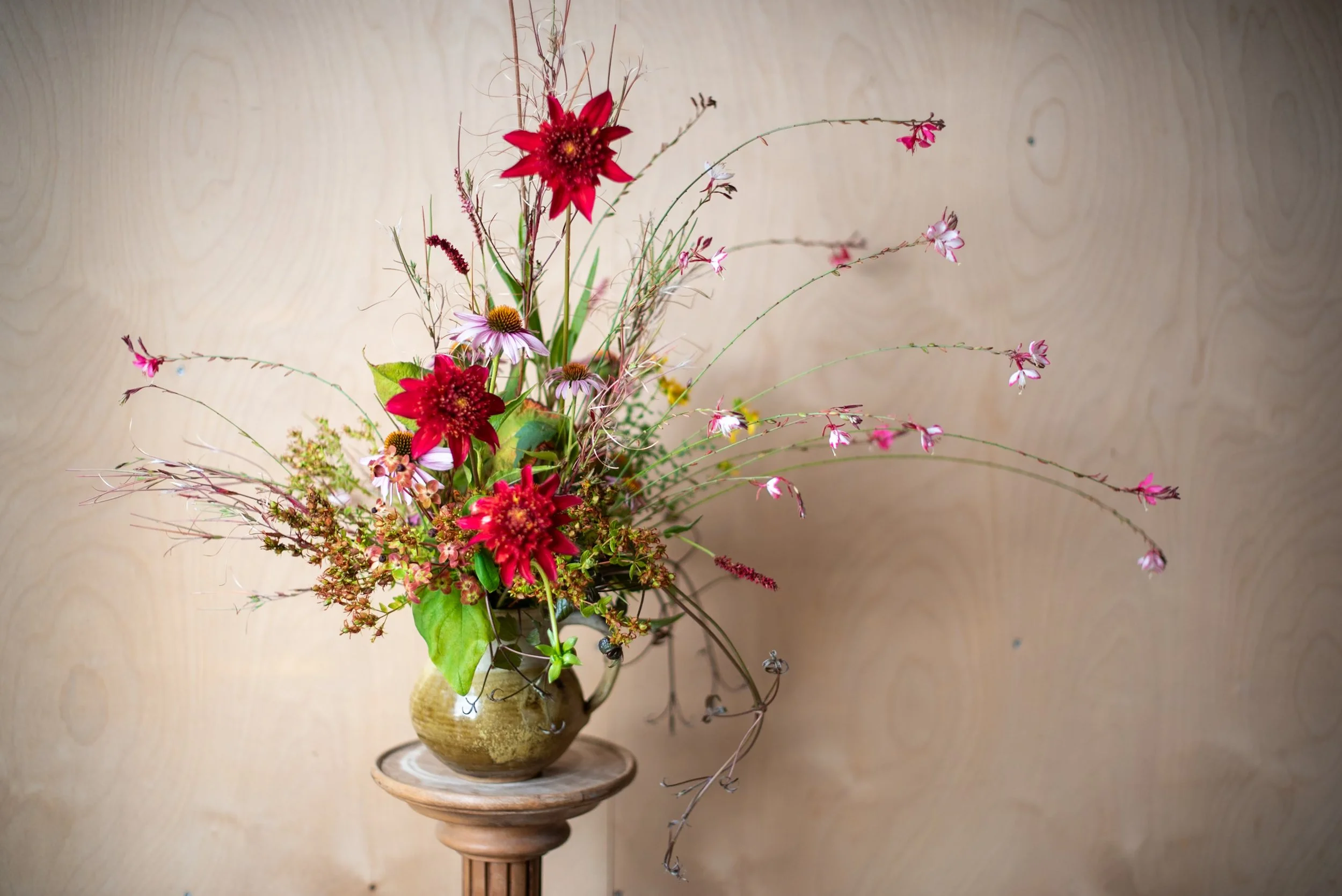
Clematis (Clematis montana ‘Elizabeth’)
Dahlia (Dahlia ‘Jive’)
Fireweed (Chamaenerion angustifolium)
Purple coneflower (Echinacea purpurea)
Red bistort (Persicaria amplexicaulis ‘Fat Domino’ & ‘Rosea’)
St John’s Wort (Hypericum perforatum & ‘Hidcote’)
Wandflower (Oenothera lindheimeri ‘Siskiyou Pink’ & ‘Rosyjane’)
Stoneware ceramic jug
JULY
Many of you longer-term readers will know that my feelings for dahlias are either confused or extremely specific, which is to say that there are only a few varieties I’m into and year by year our collection has been whittled down to just a few. ‘Cafe au Lait’ makes the cut, as ubiquitous as she is, the dinner-plate size and the colour (a pale coffee-shell pink) being so suitable for the larger, later summer arrangements. She’s like good jeans - she stays. The poms poms are extremely streamlined and at the smaller end of the scale, mainly because I don’t tend to like obvious colours and heavy, spherical shapes in one package. This year we’ve reintroducing a few single-petalled varieties into the rotation and so far I’m enjoying them in small doses and then there’s this (my novelty choice)… Dahlia ‘Jive’. How do we feel about it? The colour comes across as more obvious when photographed, it’s smokier in real life and I like the variability between the flowers, the size, the star shaped anemone-form, the streaks, and there’s a sprinkling of gold through it, too, which makes for interesting options when it comes to building out a palette. Make me think maybe next season we’ll bring back the ‘Platinum Blonde’ (white with a creamy, sunny centre) that I used to love but didn’t survive the cull. A good one if you’re looking for an anemone form in a subtle shade / you’re not brave enough for the tomato red!
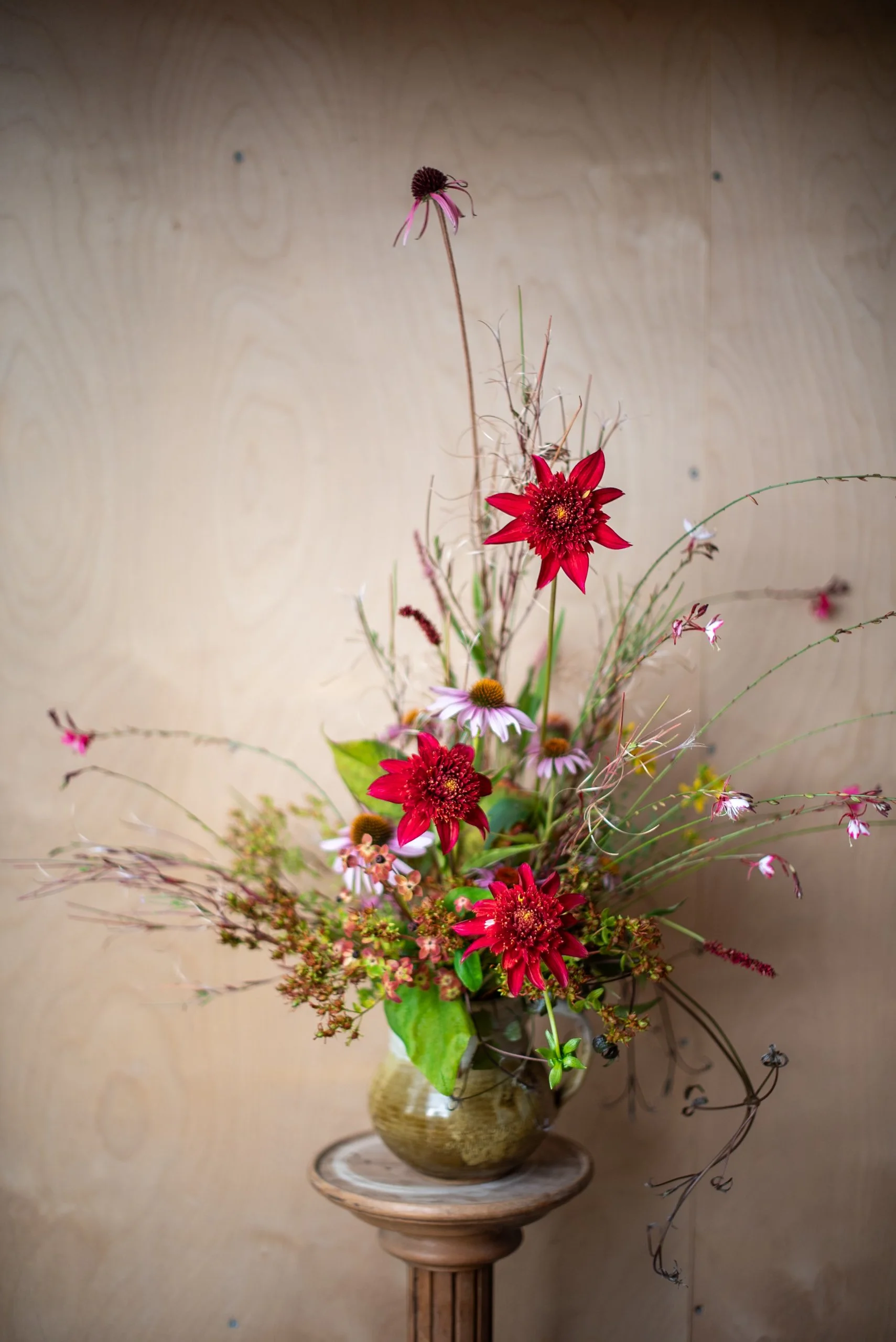
Let me explain where I was going with this as I walked through the garden with my bucket and snips… I already had my dahlias and was leaning towards a raspberry colour story which lead me through to the prairie beds where we have a few self-seeded fireweed here and there (tolerated in small doses). The wisps are great for texture and I like using them almost in place of a branch when I want something lighter but still structural. Following this trajectory I took a few stems of gaura and in my rummaging for this came across the red bistort. Echinacea for a secondary flower form. St John’s wort for filler and texture - both the wild self-seeders which are fading to a burnt toffee colour and the cultivated ‘Hidcote’ with lime leaves (great with the raspberry) and faded flowers, dusky clusters of small stars that play off well with the dahlias. The clematis was a last minute addition - the vine strands dangle enticingly from the roof of our conditioning shelter but persist in threatening to garrotte us on our way in and out and regular pruning is essential - the brown adds a fun cascade but would work equally well with the wild Clematis vitalba for another touch of lime.
Worth noting that I had no chicken wire or pinholder for this arrangement so I made sure to cross the stems over one another (if you imagine the mouth of the vase as a circle and the addition of each stem dividing that circle into multiple wedges, this provides a structure to lean the subsequent stems against until you have a close network and can add in the taller / weightier elements with the structural support to keep them upright).